
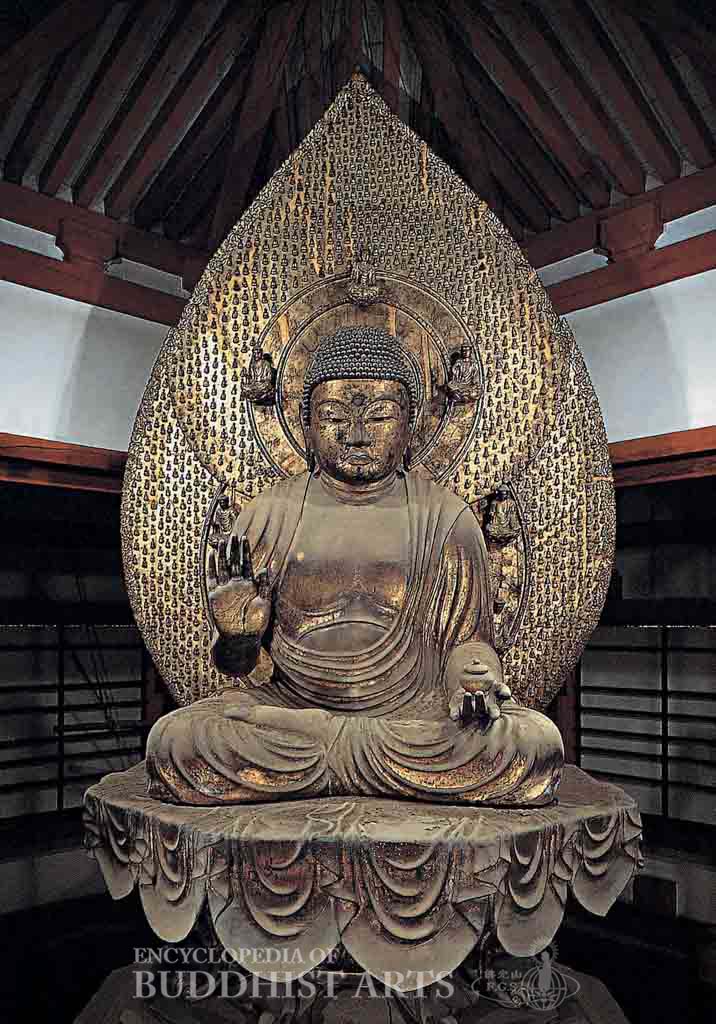
Horyuji Temple West Octagonal Hall: Medicine Buddha
Dry lacquer
Horyuji Temple West Octagonal Hall: Medicine Buddha
JAPAN, Nara, Ikoma; Nara period
The stout physique of the Buddha and the thick folds of the clothing date it to around the late 8th century. According to the inscription on the back of the statue, most of the body was refurbished during 1283 of the Kamakura period. It was listed as a National Treasure in 1953.
The figure has a substantial usnisa and a large urna on the forehead. Other Buddha characteristics include the three lines on the neck. The figure is dressed in monastic robes and makes the abhaya (fearlessness) mudra with the right hand. The left hand holds a medicine pot while resting on the knee. The figure sits in full lotus position on an octagonal lotus throne. A nimbus and an aureole merge with a petal-shaped mandorla that also has seven seated manifestations of the Buddha, a common feature in such sculptures. Hundreds of smaller manifestations radiate outwards onto the mandorla. Eight curved leg stands support the lotus platform. These elements are painted with gold and carved with floral designs in accordance with the aesthetics of the period.
For more details, go to the Encyclopedia of Buddhist Arts: Sculpture G-M, page 460.
Cite this article:
author = Hsingyun and Youheng and Lovelock, Yann and Chou, Yuan and Huntington, Susan and Edson, Gary and Neather, Robert,
booktitle = {Encyclopedia of Buddhist Arts: Sculpture G-M},
pages = 460,
title = {{Horyuji Temple West Octagonal Hall: Medicine Buddha}},
volume = 11,
year = {2016}}