
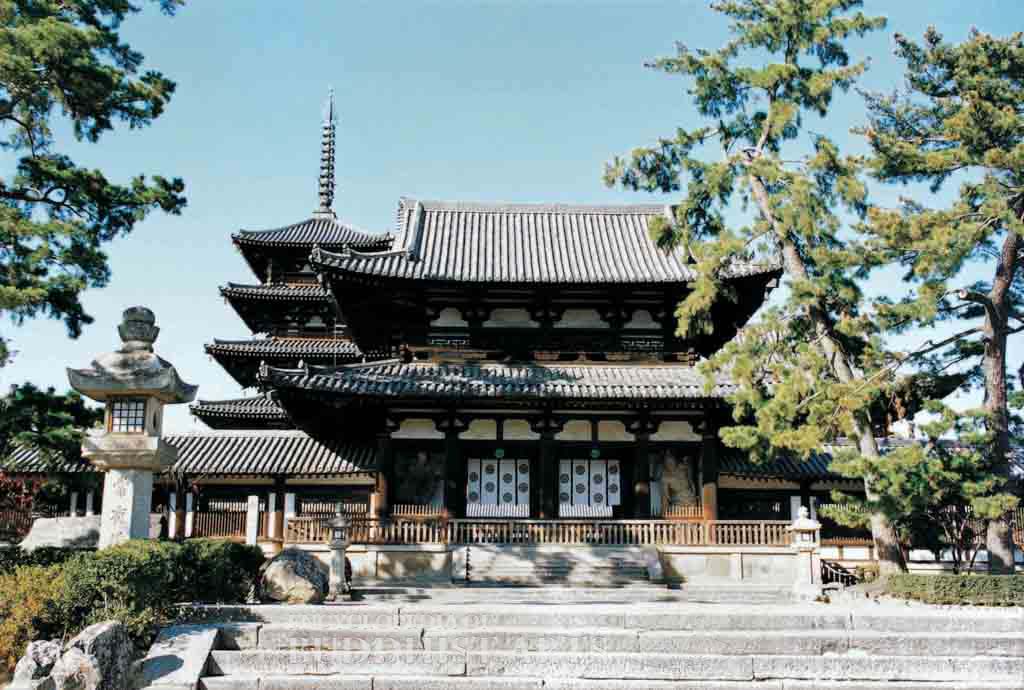
Horyuji Temple: Middle Gate
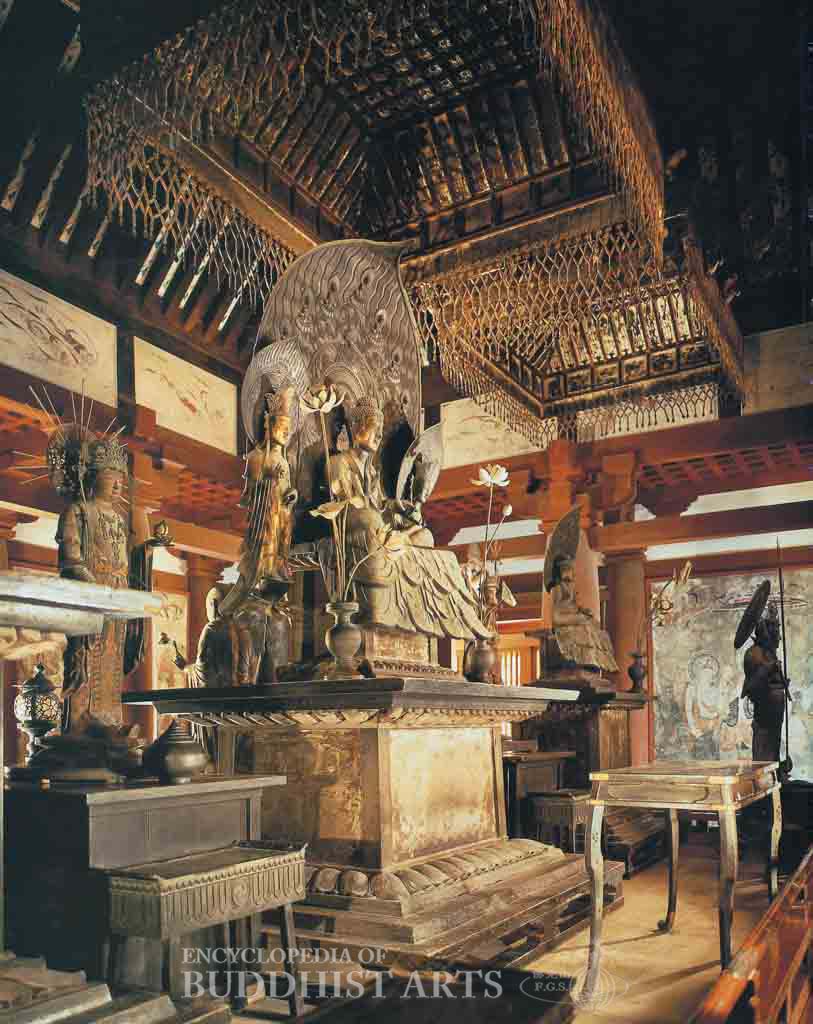
Horyuji Temple: Golden Hall (interior)
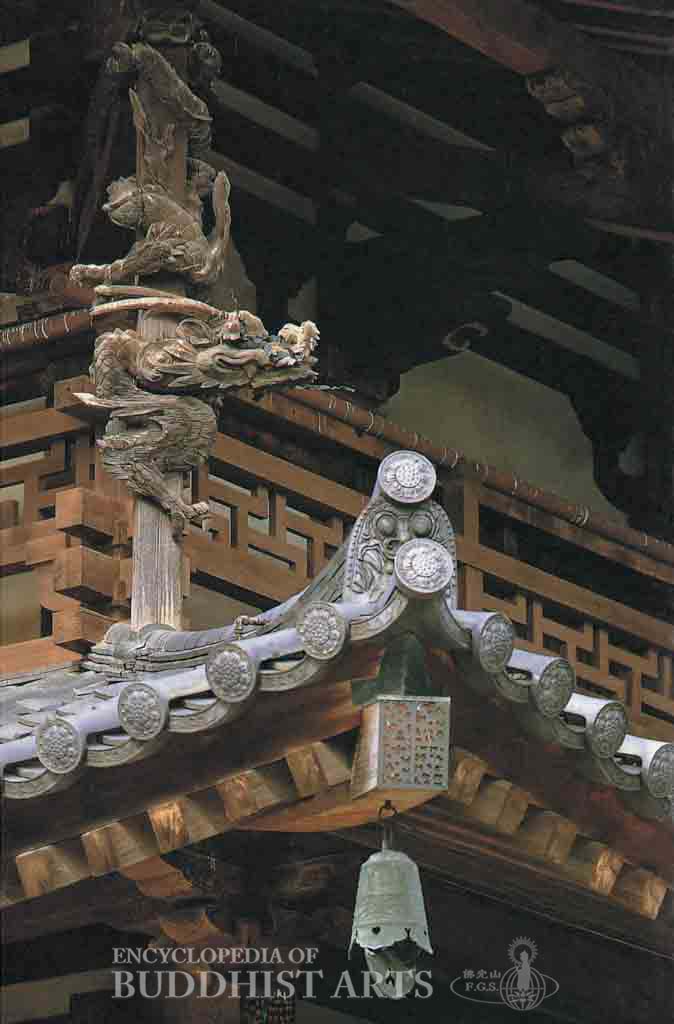
Horyuji Temple: Golden Hall - Corner Eaves
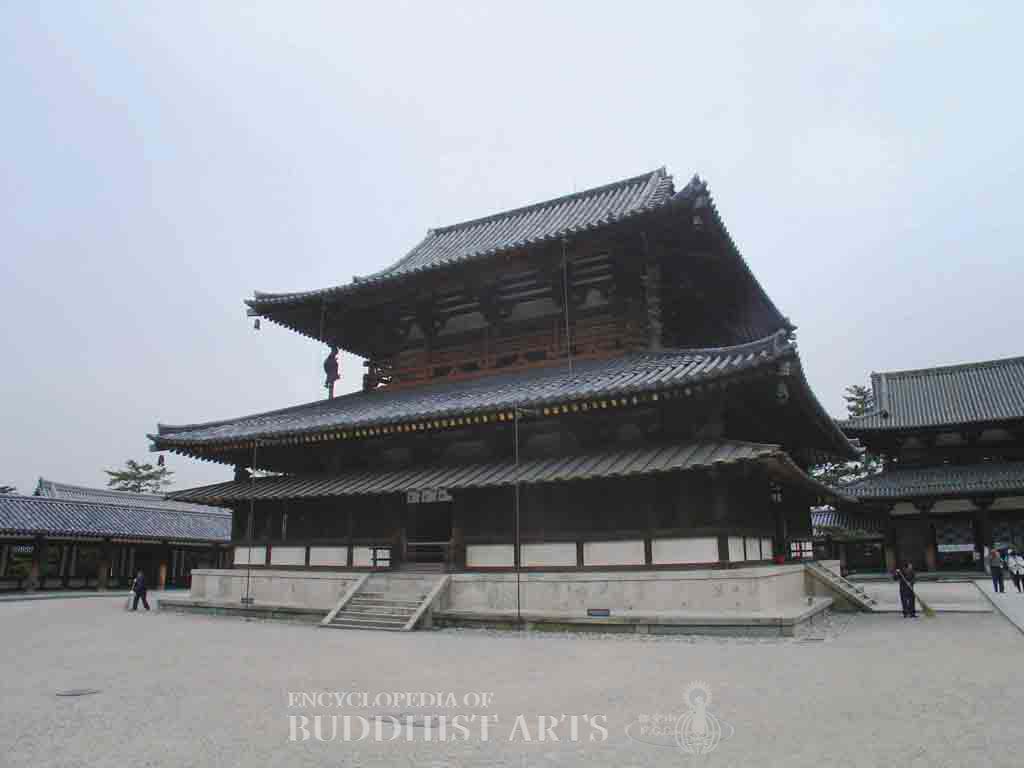
Horyuji Temple: Golden Hall
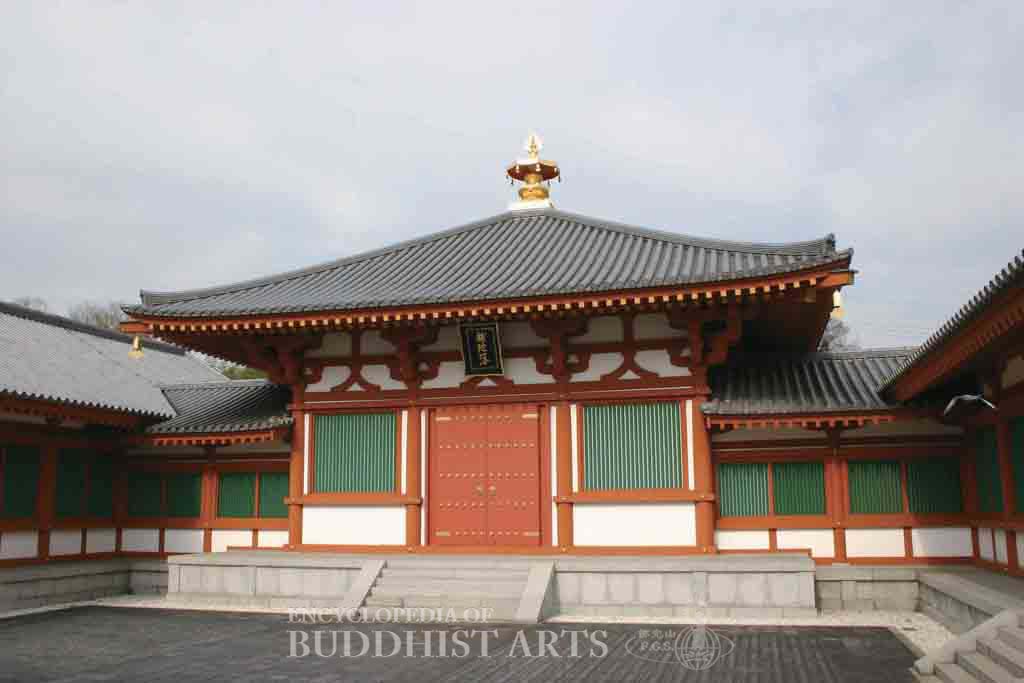
Horyuji Temple: Baekje Avalokitesvara Hall
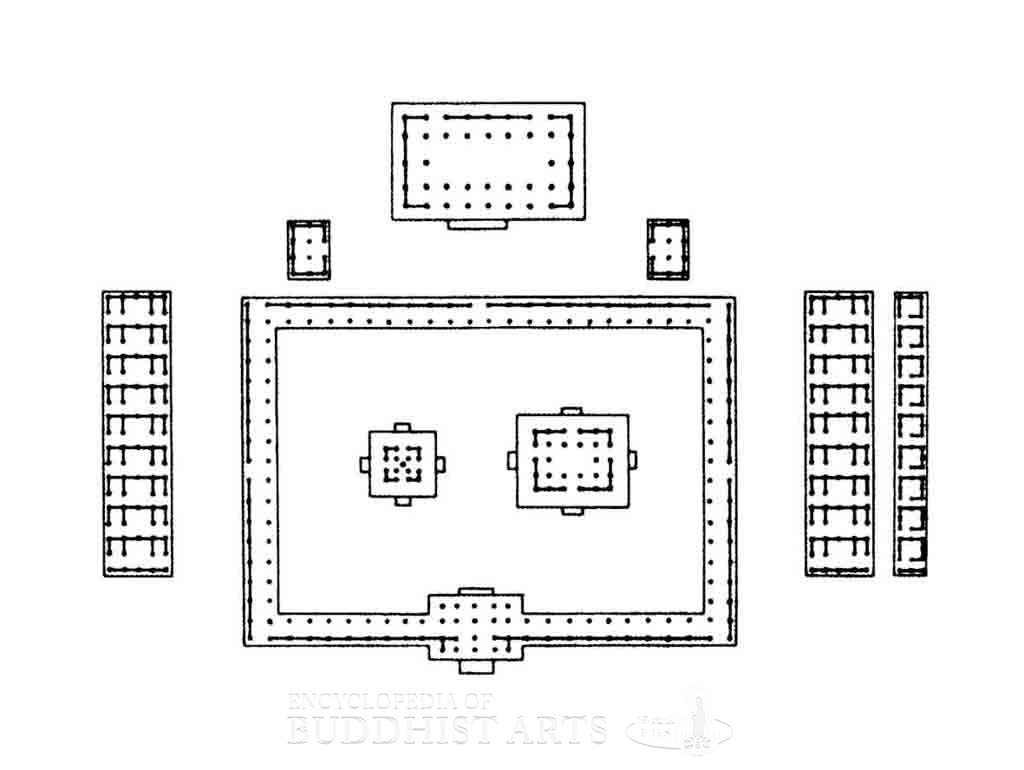
Horyuji Temple (site layout)
Horyuji Temple
JAPAN, Nara, Ikoma
Horyuji means Temple of the Flourishing Dharma. The temple, also known as Horyu Gakumonji or Ikarugadera, is the head temple of the Shotoku school of Buddhism. It is considered to be one of the Seven Major Temples in Nara. The temple was built in 607 during the Asuka period by Empress Suiko (reigned 592–628) and Prince Shotoku to fulfill the dying wish of Emperor Yomei (reigned 585–587). It was destroyed by fire in 670 during the Hakuho period, and was rebuilt during the late 7th and early 8th centuries, followed by subsequent expansions. In 1993 Horyuji was listed as a UNESCO World Heritage Site.
The temple is divided into eastern and western compounds. The buildings in the western compound include the middle gate, Golden Hall, five-story pagoda, Great Lecture Hall, sutra repository, and bell tower. The compound was listed as a National Treasure in 1951. The architectural style was influenced by the Chinese Southern and Northern Dynasties (386–589). The five-story pagoda and main hall are arranged side by side, which does not conform to the traditional layout along a central axis. Thus this is referred to as the Horyuji style.
At the center of the eastern compound is the Hall of Dreams, surrounded by the ceremonial hall, painting hall, Relic Hall, Dharma Transmission Hall, and eastern bell tower. Other buildings scattered around the compound include the dining hall, warehouse, Great Treasure Hall, Baekje Avalokitesvara Hall, Triple Sutra Hall, West Octagonal Hall, and Shoryoin Hall, which is a hall dedicated to Prince Shotoku. A number of these buildings have been listed as National Treasures.
The four-by-three bay middle gate is the main temple gate of the western compound. It has a double-eave hip-and-gable roof covered in cylindrical tiles. The two central bays have doorways guarded by Vajrapanibalins. The five-by-four bay, two-story Golden Hall has a double-eave hip-and-gable roof. The roof has a steep slope and extended eaves. The four corner pillars are decorated with dragon motifs. The thick circular columns in the hall support a coffered ceiling. This is the only remaining main hall from the Asuka period and is the oldest hall in Japan.
The five-story pagoda is considered to be the oldest wooden pagoda in Japan. The nine-by-four bay Great Lecture Hall was rebuilt in 990 during the Heian period, and is the largest building within the temple. A single-eave hip-and-gable roof sits atop it. The interior is constructed with bricks and the Medicine Buddha Triad is enshrined within on a Sumeru throne. The Hall of Dreams is the oldest octagonal building in Japan. Finally, the seven-by-four bay Dharma Hall was established during the Nara period (710–794). It has an overhanging gable roof covered with cylindrical tiles.
The temple houses famous statues which are considered to be National Treasures. There are also numerous paintings and artifacts, which are considered to be Japanese artistic treasures.
For more details, go to the Encyclopedia of Buddhist Arts: Architecture G-L, page 456.
Cite this article:
author = Hsingyun and Youheng and Johnson, Peter and Mankuang and Lancaster, Lewis,
booktitle = {Encyclopedia of Buddhist Arts: Architecture G-L},
pages = 456,
title = {{Horyuji Temple}},
volume = 2,
year = {2016}}