
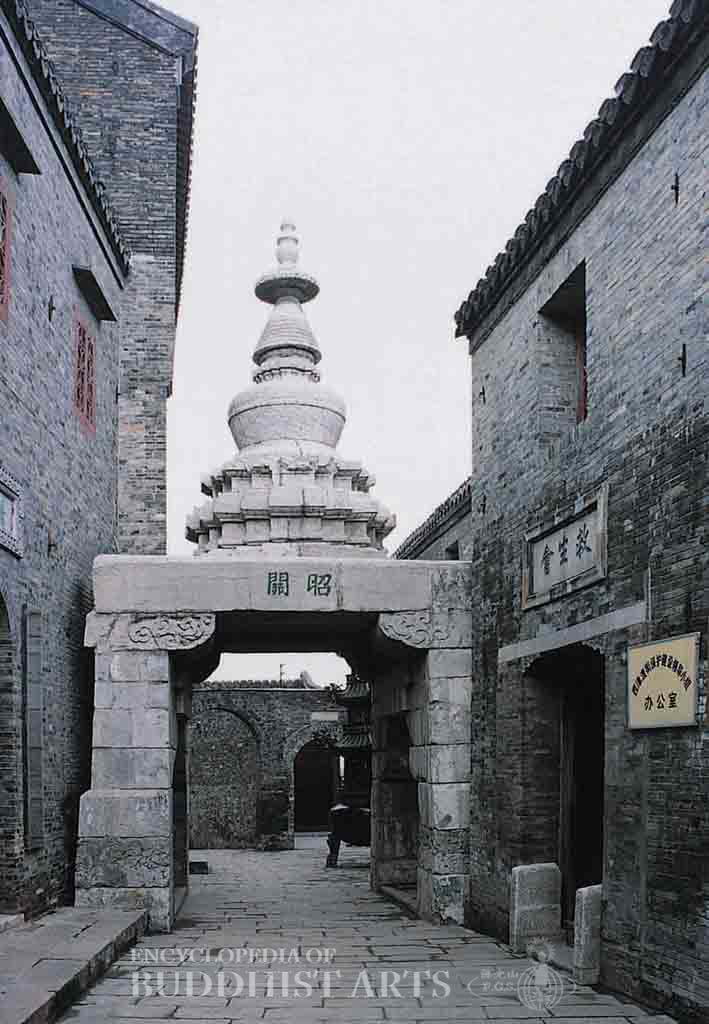
Zhaoguan Stone Pagoda
Zhaoguan Stone Pagoda
CHINA, Jiangsu, Zhenjiang
The Tibetan stupa was built during the rule of Emperor Wuzong (reigned 1308–1311) of the Yuan dynasty. It was repaired in 1582 during the Ming dynasty, and again in 2000. It was listed as a National Cultural Heritage Site in 2006.
The 4.75 m high Tibetan-style stupa stands on a stone archway with Qing dynasty (1644–1911) buildings on both sides. It has a double-layer Sumeru base with multiple corners. The body is in the form of an inverted bowl with a band carved around its circumference. The stone spire consists of 13 stacked rings followed by a canopy and jewels.
During the restoration of the stupa in 2000, two copper discs were discovered under the inverted bowl. The discs were repoussé mandalas measuring approximately 50 cm in diameter and 0.5 cm thick. One had carvings of nine Avalokitesvara Bodhisattvas, while the other featured nine images of the Wealth Deity.
For more details, go to the Encyclopedia of Buddhist Arts: Architecture T-Z, page 1392.
Cite this article:
author = Hsingyun and Youheng and Johnson, Peter and Mankuang and Lancaster, Lewis,
booktitle = {Encyclopedia of Buddhist Arts: Architecture T-Z},
pages = 1392,
title = {{Zhaoguan Stone Pagoda}},
volume = 4,
year = {2016}}