
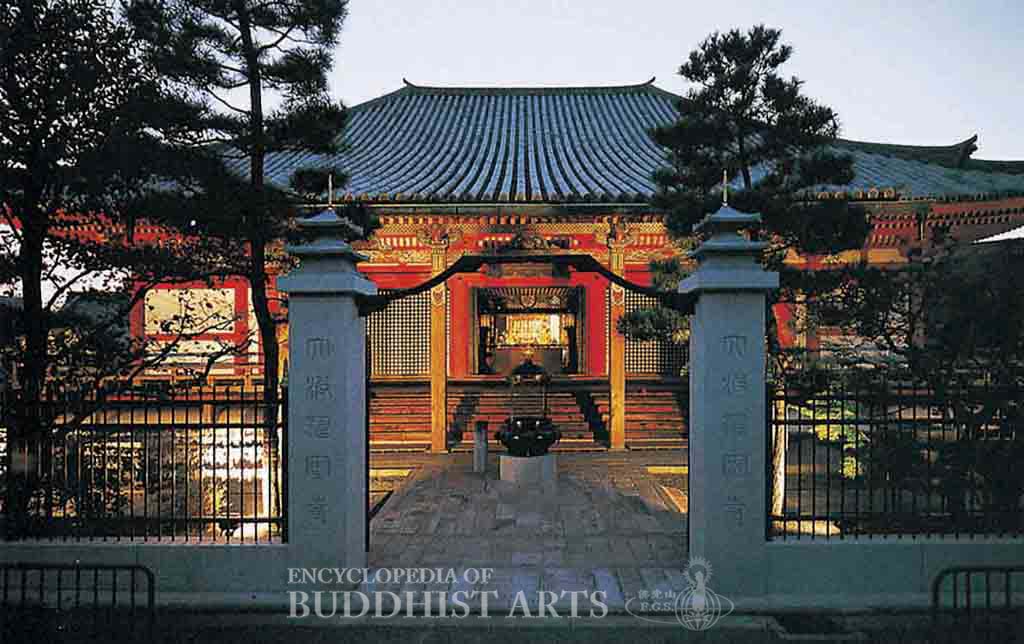
Rokuharamitsuji Temple: Main Hall
Rokuharamitsuji Temple
JAPAN, Kyoto
Rokuharamitsuji means Six Paramitas Temple. It belongs to the Chisan branch of the Shingon school of Japanese Buddhism. It was founded in 951 during the Heian period by Master Kuya and was named Saikoji (Sacred City Temple). After Master Kuya passed away, his disciple revitalized the temple and renamed it to Rokuharamitsuji.
The principal structures in the temple include the main hall, abbot’s quarters, Universal Gate Hall, Ksitigarbha Hall, founder’s hall, Mirror Pond, and Guard Hall, most of which were built in the Kamakura (1185–1333) and Muromachi (1392–1573) periods. The main hall, listed as an Important Cultural Property in 1897, was rebuilt in 1363 during the Nanbokucho period. It is a simple one-story building housing a statue of the Eleven-Headed Avalokitesavara. The sculpture is only displayed once every 12 years and is listed as a National Treasure. During its restoration, tiles shaped like Sanskrit characters, a ritual trident and vajra were excavated. In addition, more than 2,000 five-element stupas were discovered, serving as valuable sources of information on beliefs during the late Heian (794–1185) and Kamakura periods. The temple also houses wooden sculptures of Master Kuya, Ksitigarbha Bodhisattva, Medicine Buddha, and the Four Heavenly Kings, all of which were listed as Important Cultural Properties.
For more details, go to the Encyclopedia of Buddhist Arts: Architecture M-S, page 898.
Cite this article:
author = Hsingyun and Youheng and Johnson, Peter and Mankuang and Lancaster, Lewis,
booktitle = {Encyclopedia of Buddhist Arts: Architecture M-S},
pages = 898,
title = {{Rokuharamitsuji Temple}},
volume = 3,
year = {2016}}