
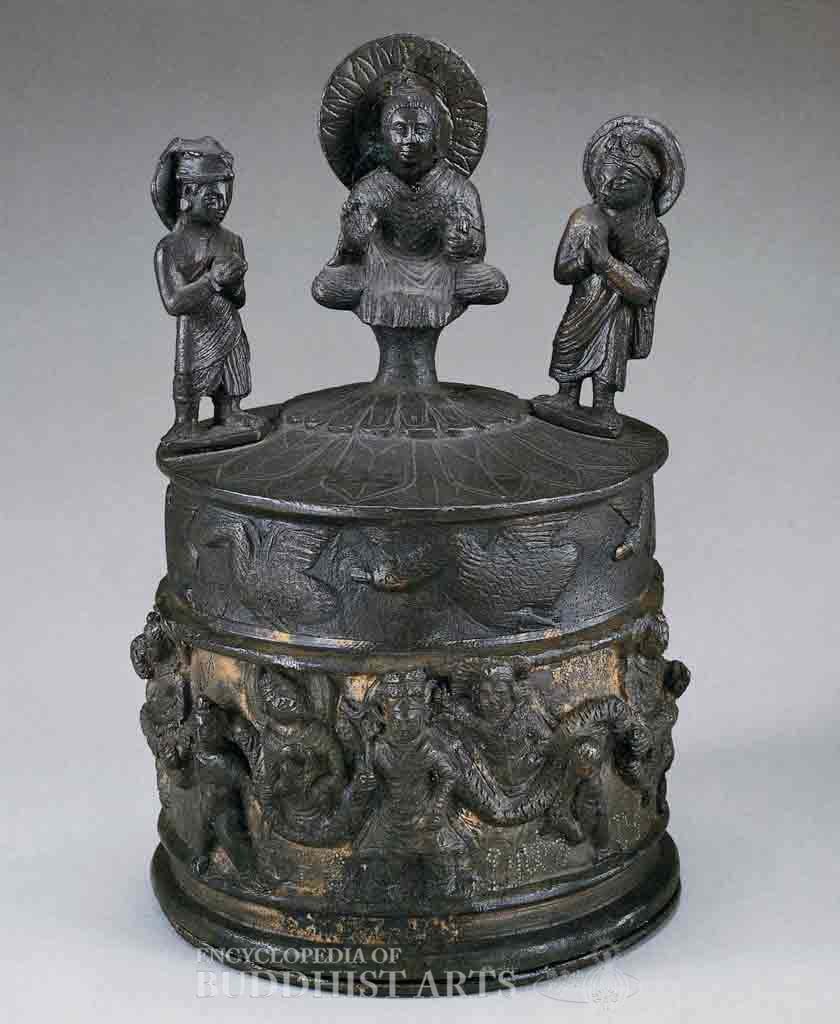
Kaniska Stupa: Reliquary
Bronze
Kaniska Stupa: Reliquary
PAKISTAN, Khyber Pakhtunkhwa, Peshawar; Kushan period
Also known as the Kaniska Reliquary, this piece was excavated between 1908 and 1909 from the Kaniska Stupa at Shah-ji-Deri on the outskirts of Peshawar. It is dated to 127, the first year of the reign of Kaniska, the Kushan emperor. The three bone fragments found in the reliquary were thought to be those of the Buddha, and were sent to Myanmar following the excavation.
The reliquary is made of bronze with traces of gilding. The lid features the Buddha seated on a lotus throne at the center, flanked by Brahma and Sakra with their palms joined. The top of the lid is decorated with lotus petals, while the side has six geese, some of which have a wreath in their beaks.
On the cylindrical body of the reliquary, there is a depiction of Emperor Kaniska wearing a royal robe and holding a lotus. On either side of the king are the sun and moon deities. Other images, such as three seated Buddhas, Sakra, and Brahma, also appear. A garland held by cherubs surrounds the main images.
For more details, go to the Encyclopedia of Buddhist Arts: Artifacts, page 158.
Cite this article:
author = Hsingyun and Youheng and Youji and Pokorski, Stefanie and Mankuang and Fan, Wen,
booktitle = {Encyclopedia of Buddhist Arts: Artifacts },
pages = 158,
title = {{Kaniska Stupa: Reliquary}},
volume = 18,
year = {2016}}