
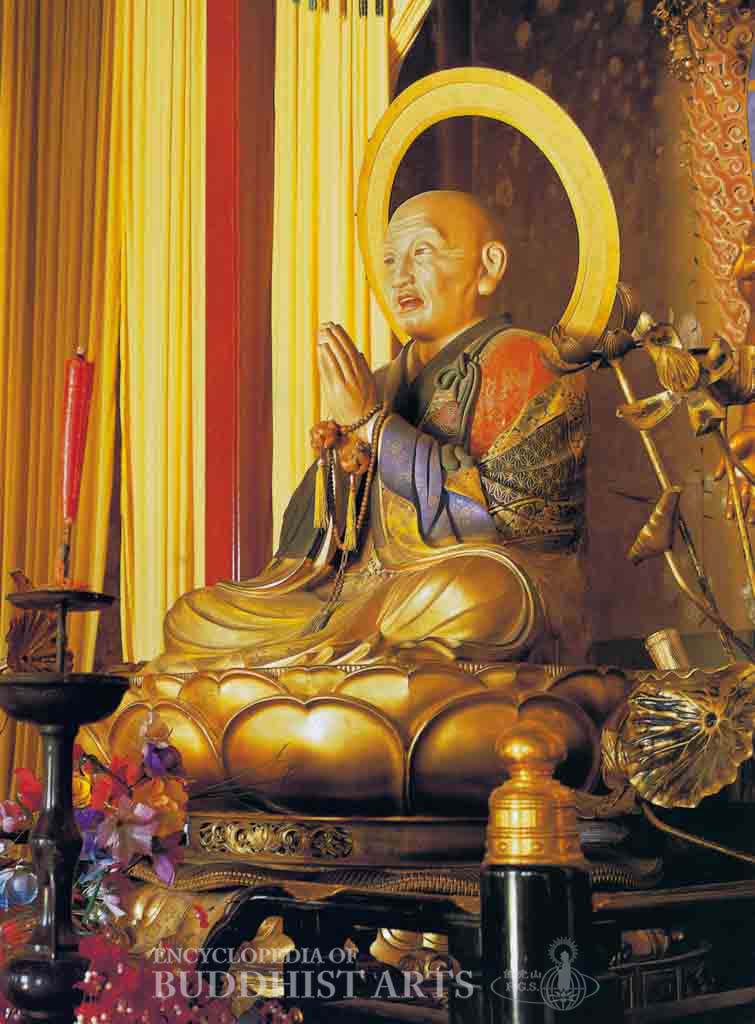
Shandao
Wood
Shandao
CHINA, Anhui, Suzhou; Tang dynasty
Shandao was a Pure Land school monk, as well as a painter and calligrapher. He was born with the family name Zhu and is known to have lived in either Sizhou (present day Sixian, Suzhou) or Linzi (present day Linbo, Shandong). Shandao became a monk early in life, and at the age of 29, he traveled to Xuanzhong Temple in Shanxi to study under Master Daochuo. There, he acquired an in-depth understanding of the Amitayurdhyana Sutra and studied the classic teachings of the Pure Land school. Shandao’s written works include Essence of the Amitayurdhyana Sutra, Way of Visualizing and Chanting, Ceremonial Practices of Pure Land, and In Praise of Pratyutpanna.
Emperor Gaozong (reigned 649–683) of the Tang dynasty bestowed him with a horizontal inscribed board written with “Guangming Temple,” symbolizing the bright light that emanates from Master Shandao’s chanting. He became known as Master Guangming and is regarded as the Second Patriarch of the Pure Land school.
While residing in Shiji Temple in Shaanxi, Shandao was delegated the task of supervising the construction of the Vairocana Buddha statue in Longmen Grotto 1280 in Luoyang, Henan. The resulting statue is a masterful representation of Buddhist artwork from the Tang dynasty. He used all of his donations that he received to purchase paper for the transcription of 100,000 copies of the Amitabha Sutra. Among the numerous handwritten copies of classic Buddhist texts unearthed from a Buddhist site in Turpan, Xinjiang, copies of the Amitabha Sutra were found containing a postscript at the end of the scroll reading, “Written by Monk Shandao.” In addition, Shandao vowed to promote Pure Land Buddhism through art and therefore, he created over 300 Illustrations of the Western Pure Land based on personal spiritual visions of the Pure Land.
In memory of Shandao, Xiangji Temple and Shandao Pagoda were constructed in Shaanxi in 706. Over the years, the temple and pagoda eroded to a state of ruin and in 1980, they were reconstructed. The Japanese Pure Land school commemorated the legacy of Shandao by contributing a wooden statue of him, which is still on display in the main hall within the temple.
For more details, go to the Encyclopedia of Buddhist Arts: People, page 230.
Cite this article:
author = Hsingyun and Youheng and Youlu and Pokorski, Stefanie and Yichao and Mankuang and Miaohsi,
booktitle = {Encyclopedia of Buddhist Arts: People },
pages = 230,
title = {{Shandao}},
volume = 19,
year = {2016}}