

Fahua Temple Grottoes
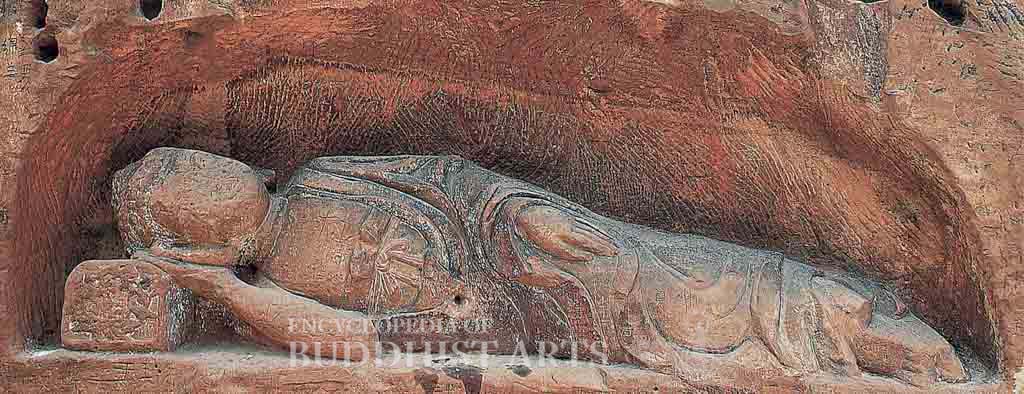
Fahua Temple Grottoes: Niche 10 - Reclining Buddha

Fahua Temple Grottoes: Niche 1 - Ksitigarbha Bodhisattva

Fahua Temple Grottoes: Niche 8 - Ascetic Sakyamuni
Fahua Temple Grottoes
CHINA, Yunnan, Kunming
Located on the cliffside of Luoyangshan (Luoyang Mountain) in Xiaotaohua village, the Fahua Temple Grottoes are the second largest grotto cluster in Yunnan. Fahua Temple was constructed during the Tang dynasty (618–907). In 965, when Kunming became part of the Dali Kingdom (937–1253), the first sculptures at the site, images of the Sixteen Arhats, were created by the Duan royal family. Of the 29 niches at the site, four are empty and many are damaged. The figures in the Fahua Temple Grottoes are carved in a simpler style than those at other sites in the area. The influence of art from the Central Plains region is evident. The grottoes are listed as a Provincial Cultural Heritage Site.
Most of the niches are shallow and have an arched ceiling. There are also niches with flat ceilings, most of which are less than 1 m in height. Most of the niches contain a sculpture of a single Buddha or Bodhisattva. Niche 1 measures 1.7 m wide, 2.4 m high, and 0.75 m deep. Inside is a sculpture of Ksitigarbha Bodhisattva wearing a headdress decorated with lotuses, sitting in relaxation posture with one foot resting on a lotus. The Bodhisattva holds a wish-fulfilling jewel in one hand, and a damaged monk’s staff in the other. Niche 2 contains a sculpture of Avalokitesvara Bodhisattva wearing a robe and a headdress decorated with a Buddha image. The Bodhisattva sits cross-legged upon a raised throne with two lotus stalks decorating the base.
The Eighteen Arhats are sculpted in three tiers in Niche 4 on the east cliff. The figures each have differing appearances, although many have suffered damage. According to the Yunnan Provincial Gazetteer, 16 of the Arhats were commissioned by the Duan royal family, and 2 were added by later generations.
Three niches at this site contain sculptures that illustrate stories from the Life of the Buddha. Niche 8 shows an Ascetic Sakyamuni wearing monastic robes. This figure is uniquely presented sitting on the ground with the right leg crossed and the left leg upright, while both hands are placed on the raised knee. Niche 10 contains a sculpture of a 4.1 m long reclining Buddha, which is the largest sculpture at Fahua Temple Grottoes. This simplified illustration of parinirvana shows the Buddha resting on the right side and wearing a monastic robe draped across the left shoulder.
For more details, go to the Encyclopedia of Buddhist Arts: Caves R-L, page 359.
Cite this article:
author = Hsingyun and Youheng and Johnson, Peter and Mankuang and Huntington, Susan and Edson, Gary and Neather, Robert,
booktitle = {Encyclopedia of Buddhist Arts: Caves R-L},
pages = 359,
title = {{Fahua Temple Grottoes}},
volume = 6,
year = {2016}}