
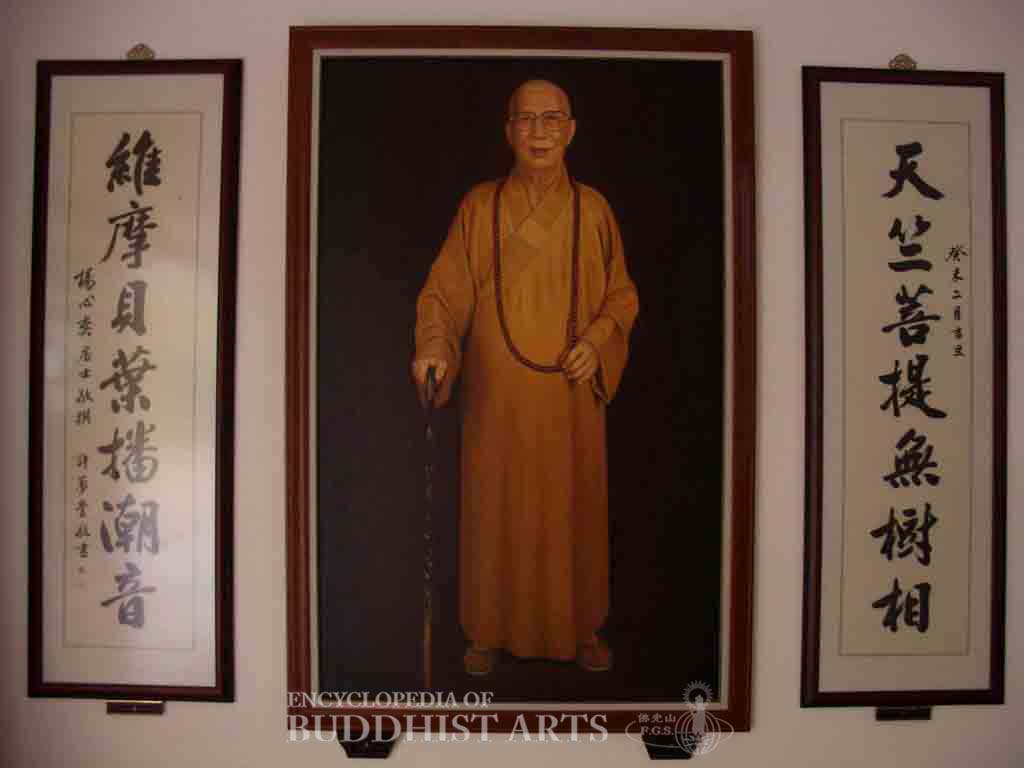
Zhumo
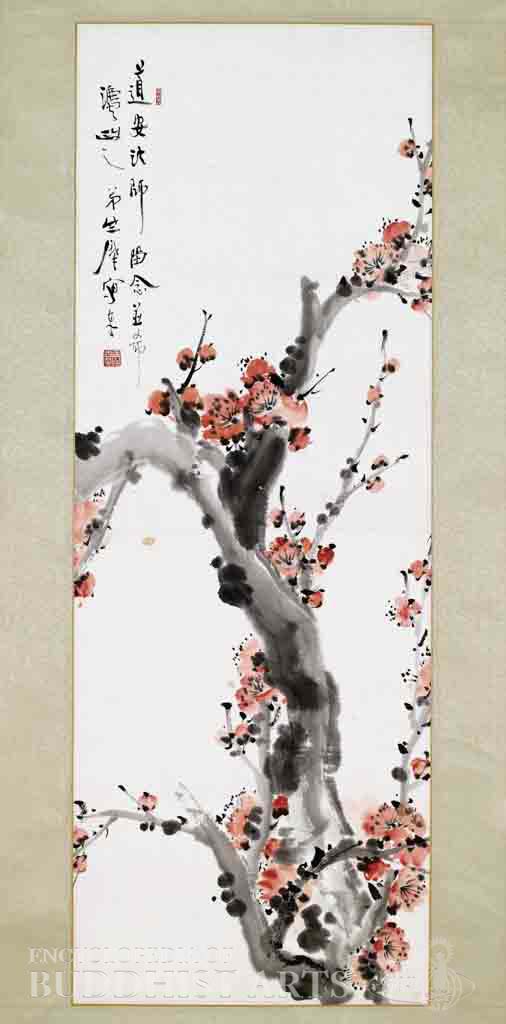
Red Plum Tree by Zhumo; 20th century
Ink and color on paper
Zhumo
CHINA, Zhejiang, Wenzhou
Originally named Chen De’an with a Dharma name of Mocheng, Zhumo was a monk and calligrapher from Yueqing, Wenzhou. Born into a devout Buddhist family, he renounced at the age of 12 under monk Baiyun, abbot of Shouchang Temple in Zhejiang. At the age of 16, he participated in the full ordination headed by Master Dixian at Guanzong Temple in Zhejiang and then entered Guanzong Dharma Propagation Research Society where he studied the Tiantai school teachings and contemplation under Master Jingquan. Zhumo entered the Minnan Buddhist College at Nanputuo Temple in Fujian in 1931, and became a close disciple of the revolutionary monk Taixu. He later became a research fellow at the Wuchang Buddhist College in Hubei.
In 1938, Zhumo established a Buddhism research class in Macau and later worked as the editor-in-chief of the magazine, Voice of Awakening. He became good friends with Gao Jianfu, a painter of the Southern school, under whom he studied painting. He gave many Dharma lectures and founded another magazine, Inexhaustible Lamp, to propagate Buddhism. The magazine was later moved to Malaysia, and was published by the Malaysian Buddhist Association, which he established in 1959. Zhumo was subsequently invited in 1954 to be mentor at Phor Tay High School in Penang, Malaysia, and propagated the Dharma in Malaysia for half a century. Throughout his life, Zhumo devoted himself to promoting Buddhist education and cultivating Buddhist talent. He was greatly respected by monastics and devotees alike, and was renowned in the Malaysian Buddhist community as the Father of Chinese Buddhism in Malaysia.
Good at composing poems, prose, and calligraphy, Zhumo’s carefree calligraphic style is well acclaimed. His calligraphy is kept at many temples in Malaysia and overseas. Among his works is Seven-Character Couplet in running script, now kept at Fo Guang Shan Monastery in Kaohsiung, Taiwan. In addition, his painting, Red Plum Tree, is kept at Ho’s Calligraphy Foundation in Taipei, Taiwan.
For more details, go to the Encyclopedia of Buddhist Arts: People, page 367.
Cite this article:
author = Hsingyun and Youheng and Youlu and Pokorski, Stefanie and Yichao and Mankuang and Miaohsi,
booktitle = {Encyclopedia of Buddhist Arts: People },
pages = 367,
title = {{Zhumo}},
volume = 19,
year = {2016}}