
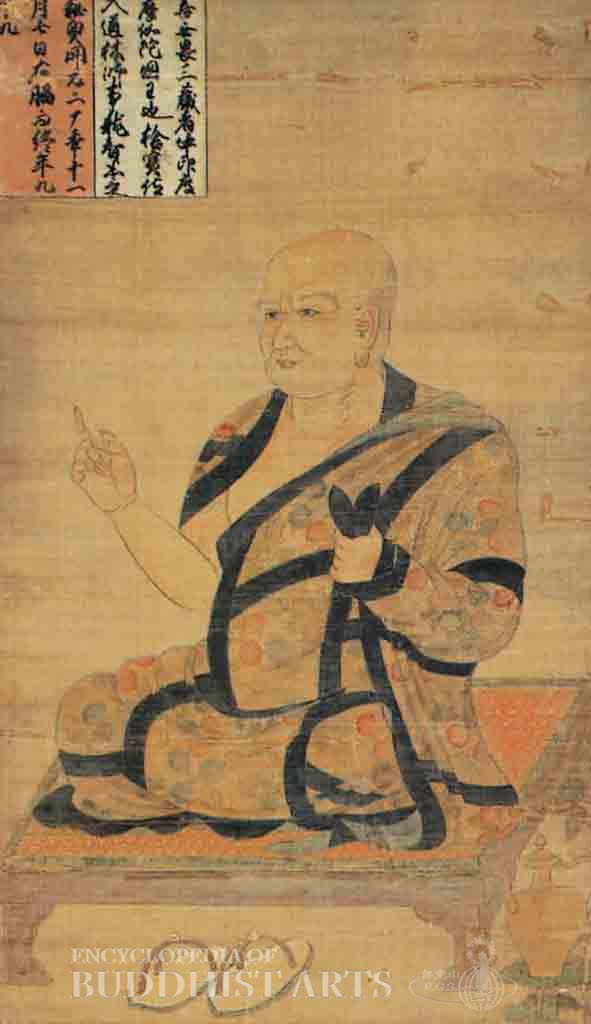
Subhakarasimha; Kamakura period
Ink and color on silk
Subhakarasimha
INDIA, Odisha
Subhakarasimha was a descendant of Suddhodana, who was the youngest uncle of Buddha. He was a Vajrayana Buddhist monk from Orissa (present day Odisha) in India. He ascended the throne as king at the age of 13. However, due to domestic chaos, he rescinded his title and became a monk. Subhakarashimha learned Vajrayana practices and acquired the complete essence of the Dharma from Master Dharmagupta in Nalanda, India.
At the age of 80, under the instruction of his teacher, Subhakarasimha went to China to spread Dharma and arrived in Chang’an (present day Xian, Shaanxi) in 716. He was honored as a National Master by Emperor Xuanzong (reigned 712–756) of the Tang dynasty. He was the first monk to impart Vajrayana teachings in China and is considered one of the First Patriarchs of the Vajrayana school in China. Together with Vajrabodhi and Amoghavajra, they were regarded as the Three Great Bodhisattvas of the Kaiyuan Period.
Translations by Subhakarasimha include the Vairocana Sutra, Susiddhikara Sutra, and Tantra of the Questions of Subahu. Also skilled in arts and crafts, it was said that he created molds and fabricated golden copper pagodas. The mandalas he painted were refined and sophisticated, and imparted Indian influence on the Buddhist art in China.
For more details, go to the Encyclopedia of Buddhist Arts: People, page 247.
Cite this article:
author = Hsingyun and Youheng and Youlu and Pokorski, Stefanie and Yichao and Mankuang and Miaohsi,
booktitle = {Encyclopedia of Buddhist Arts: People },
pages = 247,
title = {{Subhakarasimha}},
volume = 19,
year = {2016}}