
Originally There Was Nothing
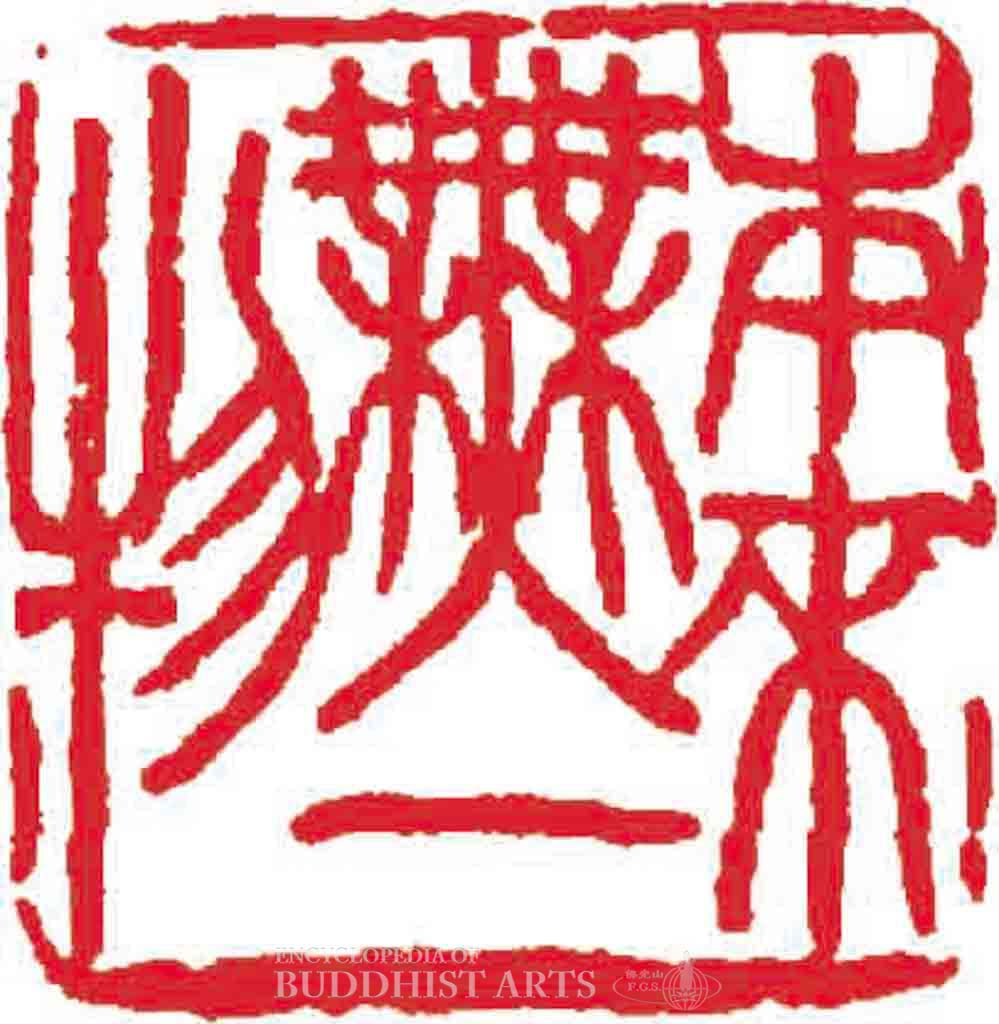
Red-character square seal
Originally There Was Nothing
CHINA
Found in the Platform Sutra, the verse, “originally there was nothing,” was taught by Master Huineng, the Sixth Patriarch of Chinese Chan school. The logic behind the passage is that in the beginning, all phenomena in the world are empty, false, or not real.
The seal script of this work is simple, clear, and strong, carved with a vigorous cutting method. The layout is at the same time both open and tight, and the disparity of strokes is distinct, particularly between the two characters in the middle of the seal. Though the top character for “wu” (no) is complex in strokes, it occupies a larger amount of space, below which is a single-stroke character. The result of the intertwining complexity and the simplicity in contrast is a work that is lively and varied.
Wu Han was the second son of Wu Changshuo. Particularly adept in seal engraving, his works appear somewhat chaotic, yet with systematic clarity, and employ a vigorous carving style. His seal engravings, much like his father’s, are shrewd and boundless in spirit.
For more details, go to the Encyclopedia of Buddhist Arts: Calligraphy, page 314.
Cite this article:
author = Hsingyun and Youheng and Youlu and Pokorski, Stefanie and Mankuang and Edson, Gary,
booktitle = {Encyclopedia of Buddhist Arts: Calligraphy },
pages = 314,
title = {{Originally There Was Nothing}},
volume = 17,
year = {2016}}