
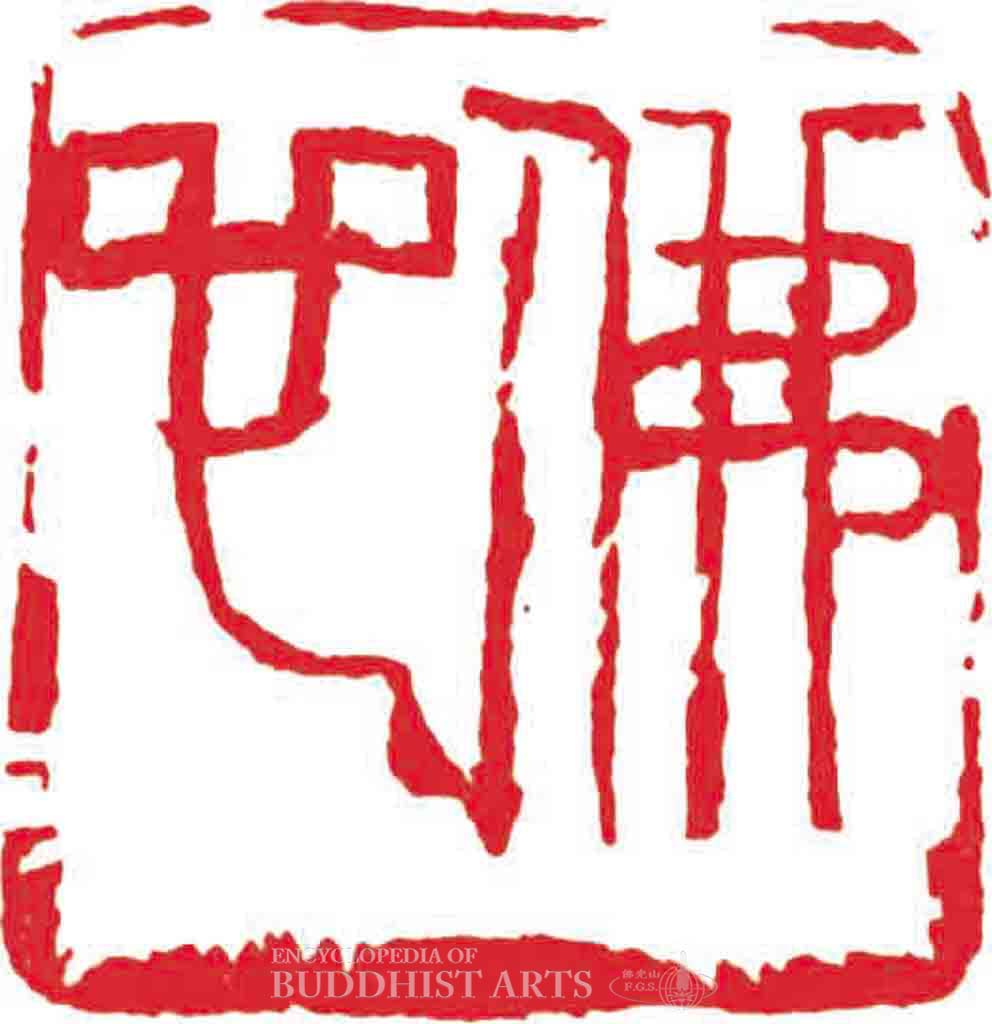
Buddha Mind
Red-character square seal
Buddha Mind
CHINA
The idea of the “Buddha Mind” is extracted from various sutras and encompasses three basic interpretations, the first and most basic is the concept that all Buddhas possess great compassionate minds. The second and third are looser in interpretation, elucidating the “Buddha Mind” as both the mind of non-attachment, and the pure and unobstructed mind that every sentient being inherently possesses.
This seal, which served as a personal sealing stamp, was carved in a sturdy and simplistic style. The two characters were executed in a combination of sinuous seal script and ancient Han scripts. Stylistically, the design and composition of the seal and the alternation of hollow and solid strokes exhibit a balance of vulnerability and stability.
Zhao Shi, also known as Guni or Ni Daoren, was a native of Changshu in Suzhou, Jiangsu. Skilled in poetry, painting, and seal engraving, he studied under the famed artist, Wu Changshuo. His style combines greater seal script, small seal script, Han seal script, and sinuous seal script, and is popularly known as the Yushan seal style.
For more details, go to the Encyclopedia of Buddhist Arts: Calligraphy, page 292.
Cite this article:
author = Hsingyun and Youheng and Youlu and Pokorski, Stefanie and Mankuang and Edson, Gary,
booktitle = {Encyclopedia of Buddhist Arts: Calligraphy },
pages = 292,
title = {{Buddha Mind}},
volume = 17,
year = {2016}}