
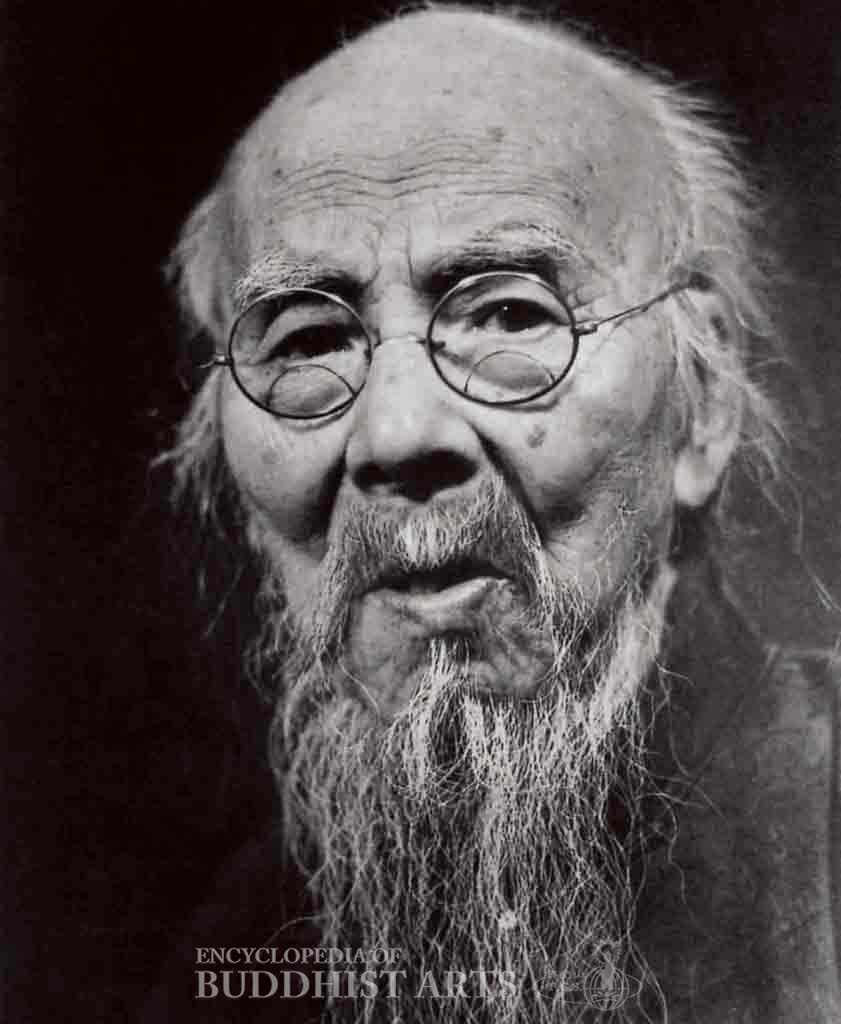
Qi Baishi
Qi Baishi
CHINA, Hunan, Xiangtan
Qi Baishi had an original name of Qi Chunzhi, and was also known as Weiqing, among several other aliases. He was a well regarded painter, calligrapher, and seal engraver of his time. At a young age, he practiced carpentry, and as he grew older, learned to appreciate poetry, writing, painting, and seal engraving. He formally began to study poetry and painting under Hu Qingyuan and Chen Shaozhai at the age of 27. After years of cultivating his skills, Qi once commented on himself, “Seal engraving first, poetry and writing second, calligraphy third, and painting fourth.”
Before the age of 30, Qi produced a large series of paintings depicting noble women and other figures which was called “Qi Beauty.” He began to take interest in landscape painting later, and after he turned 40, he took to painting flowers, birds, grass, and insects. Qi visited many well-known mountains and scenic areas and made friends with celebrities beginning in 1902. During this time, his painting style changed dramatically and he was no longer bound by strict artistic rules. A representative work from this period is Twenty-Four Scenes of Shimen.
He went to Beijing in 1917 and became good friends with Chen Shizeng, Chen Banding, and Lin Fengmin. At the suggestion of Chen Shizeng, he developed a new and unrestricted painting style. Qi became outstanding in depicting fruits, vegetables, flowers, birds, insects, and fishes. Later in age, his style became even more powerful and carefree with bold and thin strokes. These new works evoked a sense of simplicity, humor, and an independent spirit.
First studying calligraphy under Hu Zizhou, he later turned to the style of He Shaoji, and then finally to that of Northern Wei stele inscriptions. In seal engraving, he learned the styles of Ding Longhong and Huang Xiaosong. Later, Qi adopted the style of Zhao Zhiqian and was influenced by the early works of the Qin (221–207 CE) and Han (206 BCE-220 CE) dynasties. He combined seal and clerical scripts with the Northern Wei stele form to create his own engraving style. His seals include Monk Striking a Bell in His Previous Life and Mountain Monk in an Ancient Temple.
Qi once stayed at Fayuan Temple in Beijing and created many Buddhist paintings. The Buddhas drawn by him were not limited to certain formats or rules, and he demonstrated his art in amazing strokes with a unique character. Surviving Buddhist paintings include Amitayus Buddha, Arhat, Avalokitesvara in a White Robe, and Holding Up a Flower, Responding With a Smile. Amitayus Buddha is kept at the Chang Foundation Museum in Taipei, Taiwan. Many of Qi’s sketches are kept at the Qi Baishi Memorial Hall in Xiangtan, Hunan and several of his paintings, such as Shitao Producing a Painting and Longevity Buddha, calligraphic works, and seals are now kept at the Beijing Fine Art Academy. His Buddhist seals include the red-character square seal Buddha Cabinet.
Books about Qi’s works include Collection of Qi Baishi’s Works and Collection of Qi Baishi’s Landscape Paintings. In 1953, he was granted the title of People’s Artist from the Ministry of Culture. Qi was later granted the 1955 International Peace Prize from the World Peace Prize Awarding Council, and in 1963, the council nominated him a World Cultural Celebrity.
For more details, go to the Encyclopedia of Buddhist Arts: People, page 214.
Cite this article:
author = Hsingyun and Youheng and Youlu and Pokorski, Stefanie and Yichao and Mankuang and Miaohsi,
booktitle = {Encyclopedia of Buddhist Arts: People },
pages = 214,
title = {{Qi Baishi}},
volume = 19,
year = {2016}}