
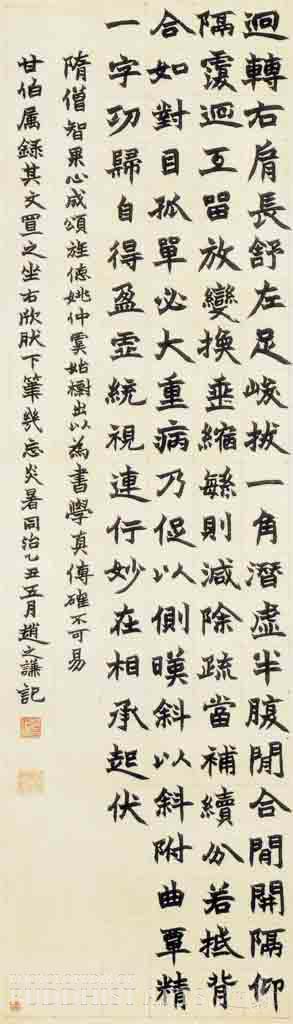
Verse of Monk Zhiguo Xincheng by Zhao Zhiqian; Qing dynasty
Ink on paper
Zhao Zhiqian
CHINA, Zhejiang, Shaoxing; Qing dynasty
Zhao Zhiqian was a calligrapher, painter, and seal engraver from Kuaiji (present day Shaoxing, Zhejiang) who was also known as Yifu, Huishu, or Bei’an. He was studious and talented since a young age, and in 1859, he became a Provincial Scholar. He authored Wrongly Written Stele Characters in Six Dynasties, Essay on the Four Books, Poems of Bei’an Jushi, Essays of Bei’an Jushi, Supplement to the Record of Countrywide Steles, and Seals Collection of Erjindie Hall. He also edited the Jiangxi Gazetteer.
Zhao was adept in poetry, essay, calligraphy, painting, and seal engraving. His calligraphy was modeled after the steles and sculptures of the Northern Wei dynasty (386–534), and later he learned from Deng Shiru in his pursuit of the spirit and charm of seal and clerical scripts. Zhao’s extant calligraphic works include Military Songs of the Han Dynasty and Introduction to the Explaining Graphs and Analyzing Characters. Zhao once wrote in seal script the four characters for Amitabha Buddha with an accompanying caption indicating that he often chanted Amitabha’s name.
His paintings centered around the depiction of flowers, plants, fruits, and vegetables. He was adept in intermixing calligraphy into his paintings with smooth strokes, flowing ink, and lush colors. Zhao was also fond of using Buddhist terminology in his metaphors for his painting method and theory. His extant works are many and include a Screen with Four Scripts, Flowers, Winter Plum and Camellia Flowers, and Jishu Rock Cliff, all of which are kept at the Shanghai Museum.
In seal engraving, Zhao initially absorbed the styles of the Zhejiang and Anhui schools, but later he learned from the artist Guquan, as well as from the bronze script and various steles and tablets from ancient times. Zhao was equally reputed alongside his contemporaries Wu Rangzhi and Xu Sangeng. Among his Buddhist works are a seal with text borrowed from the Avatamsaka Sutra, Reading Sutras as Nourishment, Buddha’s Brother, and Great Compassionate Father.
For more details, go to the Encyclopedia of Buddhist Arts: People, page 352.
Cite this article:
author = Hsingyun and Youheng and Youlu and Pokorski, Stefanie and Yichao and Mankuang and Miaohsi,
booktitle = {Encyclopedia of Buddhist Arts: People },
pages = 352,
title = {{Zhao Zhiqian}},
volume = 19,
year = {2016}}