
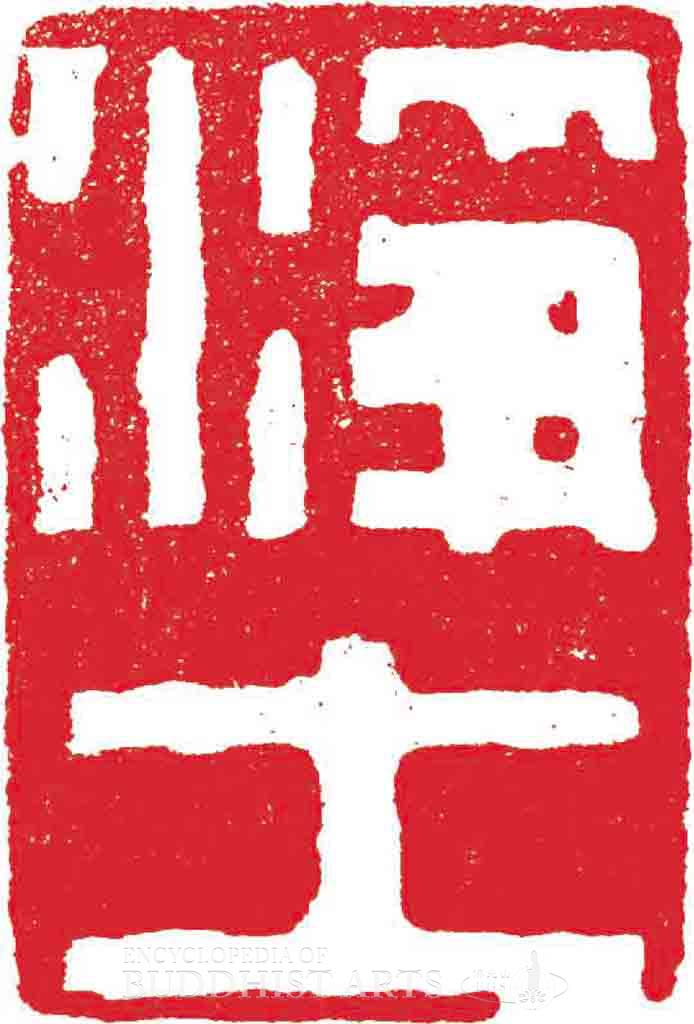
Pure Land
White-character rectangular seal
Pure Land
CHINA; Qing dynasty
In Buddhism, the Pure Land implies an ultimate land of bliss, or simply the “Buddha Land.” The term is expressed in the Vimalakirti Sutra, “If the mind of a Bodhisattva is pure, the Buddha Land is pure.”
Although the artist of this seal, Jiang Ren, predominantly adhered to the acclaimed style of Ding Jing, his own style is apparent. Differing from the blatant knife marks that often appear in Ding’s Zhejiang school seals, the squared incisions of this carving are employed only at the strokes and dots. As a result, the lines flow smoothly and are both simple and full in form. The seal features a layout which is dense on top and sparse on the bottom. Variety is observed in the arrangement of the two characters, yet they still echo one another in a unique and charming manner that generates an overall sense of balance and composure.
Jiang Ren was a renowned seal engraver of the Qing dynasty (1644–1911). A native of Hangzhou, Zhejiang, he was regarded as one of the Eight Masters of Xiling. His seals often feature a simple and solid layout that is both profound and natural with an emphasis on sincerity.
For more details, go to the Encyclopedia of Buddhist Arts: Calligraphy, page 318.
Cite this article:
author = Hsingyun and Youheng and Youlu and Pokorski, Stefanie and Mankuang and Edson, Gary,
booktitle = {Encyclopedia of Buddhist Arts: Calligraphy },
pages = 318,
title = {{Pure Land}},
volume = 17,
year = {2016}}