
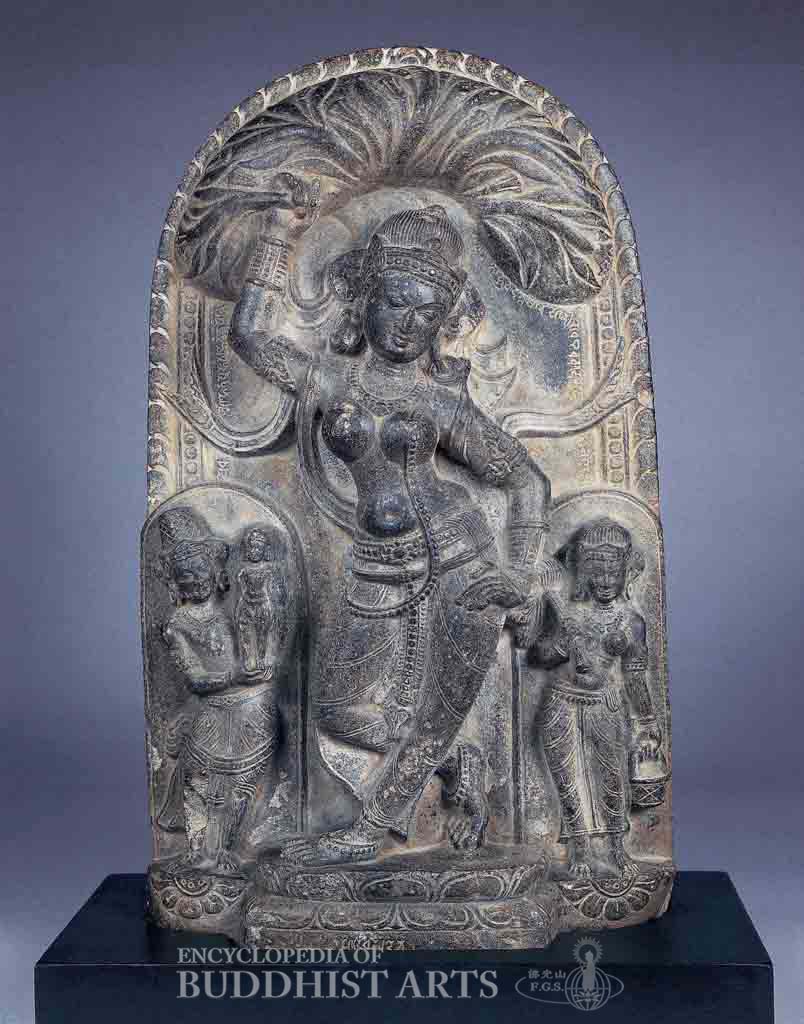
Bihar: Life of the Buddha - Birth of Prince Siddhartha
Biotite schist
Bihar: Life of the Buddha - Birth of Prince Siddhartha
INDIA, Bihar
This sculpture was unearthed in Bihar. It is believed that the figures were influenced by the Gupta (circa 320–550) style, whereas the jewelry is more commonly seen on works from the Pala period (circa 8th–12th century).
The central figure is Queen Maya, who has hair in a topknot and secured by a headdress. She wears an array of jewelry, such as earrings and a sacred thread made from a string of beads. A stole is wrapped around the arms and flutters in the air, while the jeweled belt secures the dhoti. The queen’s head tilts to one side while she raises her right hand to grasp a branch of the asoka tree that spreads out like a canopy. The left hand is placed upon the thigh, while she stands gracefully on a lotus pedestal with one leg straight and the other bent.
Standing to the queen’s right is Sakra, wearing a high crown and holding the newborn Prince Siddhartha with both hands. The other figure is the queen’s sister, Mahaprajapati, who also wears her hair in a topknot with a headdress. Both Sakra and Mahaprajapati stand on lotus pedestals. At the bottom of the sculpture, there is an inscription.
For more details, go to the Encyclopedia of Buddhist Arts: Sculpture A-F, page 149.
Cite this article:
author = Hsingyun and Youheng and Lovelock, Yann and Chou, Yuan and Huntington, Susan and Edson, Gary and Neather, Robert,
booktitle = {Encyclopedia of Buddhist Arts: Sculpture A-F},
pages = 149,
title = {{Bihar: Life of the Buddha - Birth of Prince Siddhartha}},
volume = 10,
year = {2016}}