
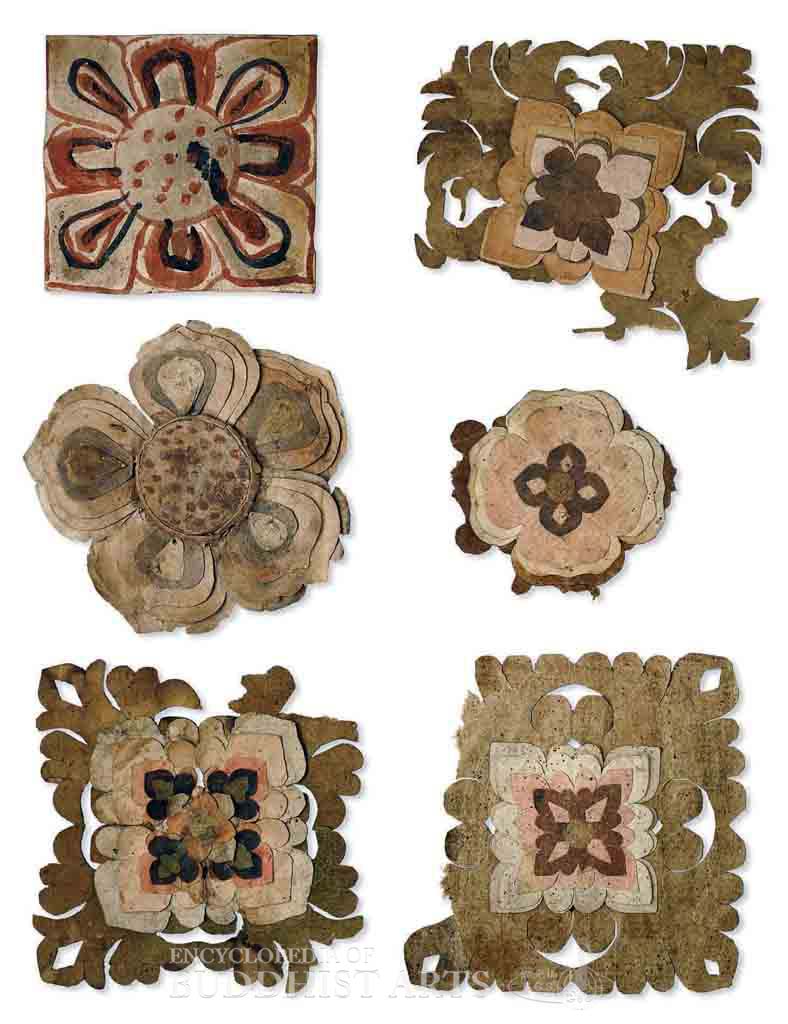
Mogao Cave 17: Paper Decorations
Paper
Mogao Cave 17: Paper Decorations
CHINA, Gansu, Dunhuang; Tang dynasty
Recovered from Mogao Cave 17 in Dunhuang, these papercuttings were created during the 9th to 10th century and are among the earliest examples of papercutting.
The majority of the flower papercuttings are square with sides measuring 13 cm, each varying with four, six, or eight petals. The floral decoration shown in the upper left corner is made of thick, square paper; a red coloring material is used to draw the edges of eight petals and lotus seeds, before filling in with red and blue. The remaining five decorations were cut from thin, folded paper and pasted together in six layers to form composite flowers with symmetrical lines. There is an adhesive on the backs so that they could be pasted on to walls.
For more details, go to the Encyclopedia of Buddhist Arts: Artifacts, page 201.
Cite this article:
author = Hsingyun and Youheng and Youji and Pokorski, Stefanie and Mankuang and Fan, Wen,
booktitle = {Encyclopedia of Buddhist Arts: Artifacts },
pages = 201,
title = {{Mogao Cave 17: Paper Decorations}},
volume = 18,
year = {2016}}