
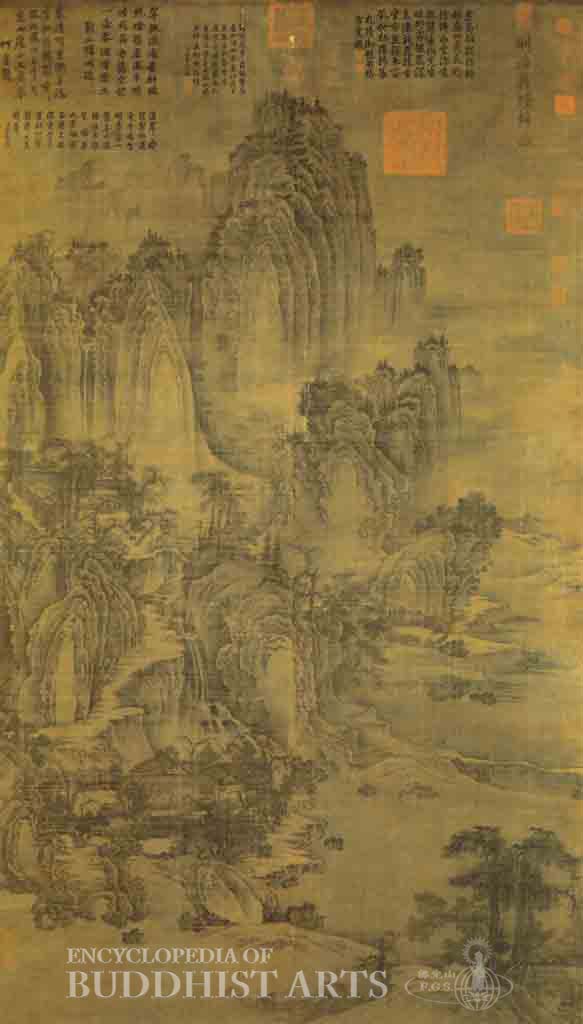
Lushan by Jing Hao; Later Liang dynasty
Ink on silk
Jing Hao
CHINA, Shanxi, Qinshui; Later Liang dynasty
Jing Hao, also known as Hao Ran or Hongguzi, was a painter and calligrapher from either Qinshui of Shanxi, or Qinyang of Henan. He studied Liu Gongquan’s calligraphic style, as well as the painting styles of Wu Daozhi and Xiang Rong. Skilled in landscape painting, he specialized in depicting mountains among the clouds. He lived in seclusion at Honggu, a valley in Taihangshan, often illustrating the natural scenery surrounding him; thus, he was known as Hongguzi.
Having studied the various ink-wash painting techniques of the Tang dynasty (618–907), Jing developed two different ink-wash methods of his own and laid the foundation for later styles of landscape painting, earning him the title of the patriarch of Northern landscape painting. Aside from landscapes, Jing painted various images of the Buddha. According to Addendum to Famous Paintings of the Five Dynasties, he painted a mural of Avalokitesvara. His most famous work, Lushan, features an inscription by Emperor Gaozong (reigned 1127–1162) of the Southern Song dynasty regarding the painting as a masterpiece.
For more details, go to the Encyclopedia of Buddhist Arts: People, page 121.
Cite this article:
author = Hsingyun and Youheng and Youlu and Pokorski, Stefanie and Yichao and Mankuang and Miaohsi,
booktitle = {Encyclopedia of Buddhist Arts: People },
pages = 121,
title = {{Jing Hao}},
volume = 19,
year = {2016}}