
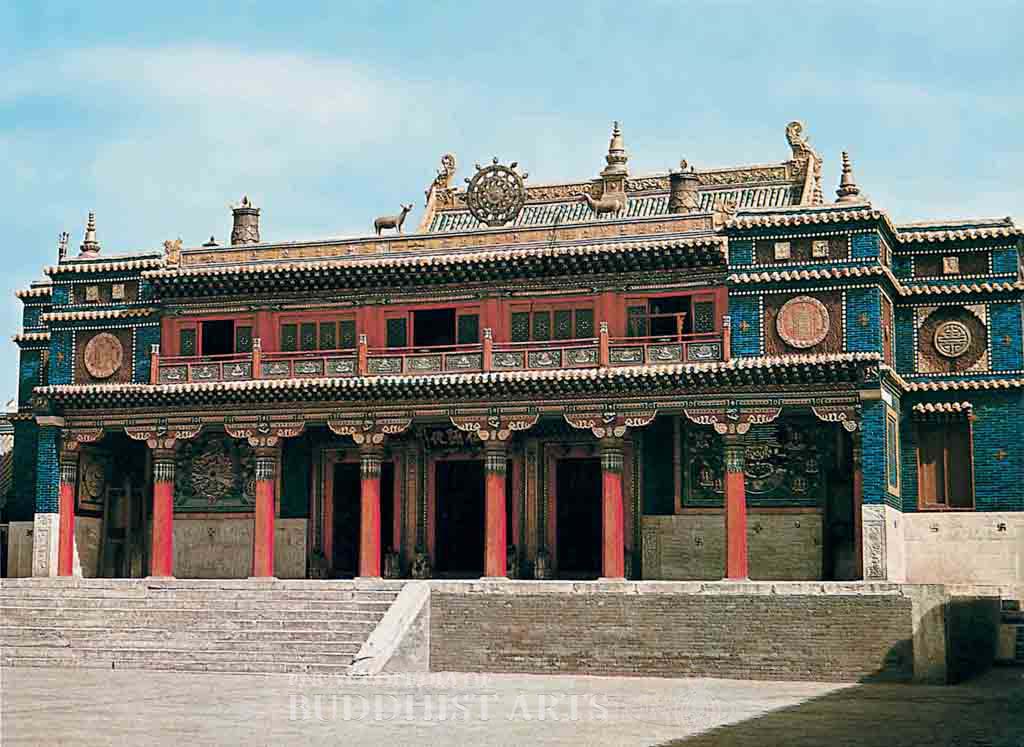
Shiretu Juu Temple: Central Hall
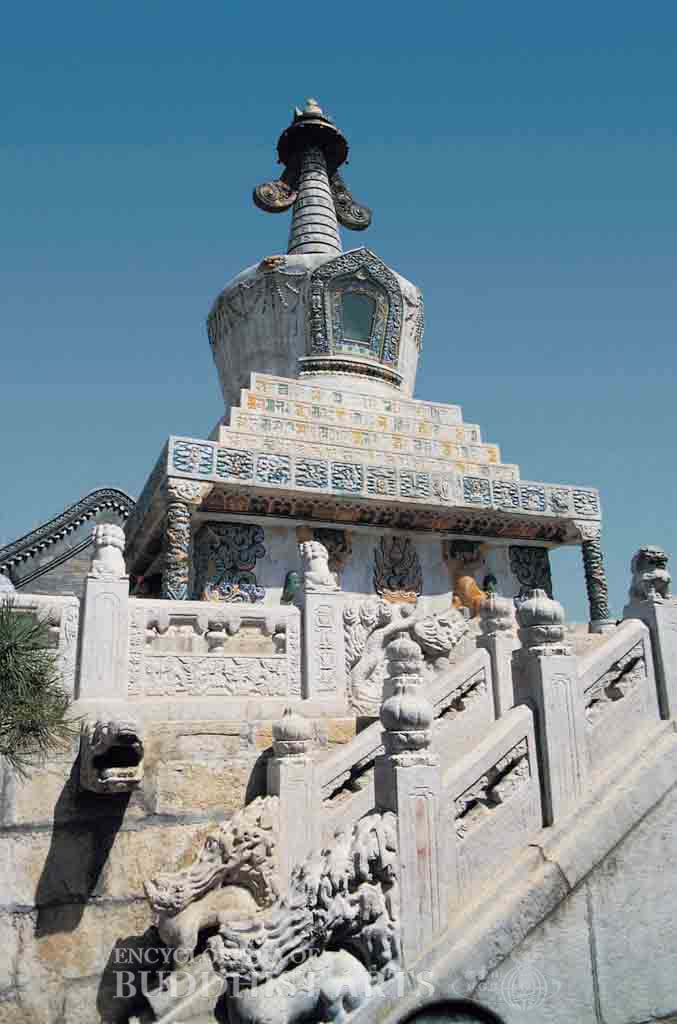
Shiretu Juu Temple: White Pagoda
Shiretu Juu Temple
CHINA, Inner Mongolia, Hohhot
This temple was built in 1585 during the Ming dynasty, and was initially constructed on a smaller scale. The temple used to be the Dharma Seat, known as Shiretu in Mongolian, of the third and fourth Dalai Lama. In 1696 during the Qing dynasty, it underwent expansion and was granted the name Yanshou (Longevity) Temple. It was listed as a Provincial Cultural Heritage Site in 1986.
Facing south, the buildings are arranged symmetrically along and on either side of the central axis. It consists of a series of courtyards on three paths, with the central path being the main path. The buildings along the central axis of the central path are the gateway, temple gate, Bodhi intermediate hall, and central hall, with the bell and drum towers, walkway, and stele pavilion on the sides. Along the east path there are the white stupa, Naiqiong Shrine, and monastic quarters, while along the west path there are an old shrine and the living quarters of Khutuktu.
The central hall consists of the assembly hall and shrines. It has three parallel hip-and-gable roofs connected from the front to the rear. The nine-by-nine bay, two-story assembly hall has columns in the three central bays rising up into the second story. There is a wide extended portico at the front. The hall is constructed with yellow glazed tiles and decorated with green glazed bricks, with many gilt bronze ornaments. The columns, doorways and five central bays of the second story are painted in vermilion.
Built between 1662 and 1722 during the Qing dynasty, the white stupa is made of stone and is almost 15 m high. It has a Sumeru throne base whose narrow section is carved with images such as flames, vajras, and lions. At each of the four corners of the Sumeru throne, there is a dragon pillar carved out of stone, which is rare among Tibetan stupas. There are four layers on top of the Sumeru throne, above which there is the stupa body. In the center of the stupa body on the south face there is a Buddha niche in the shape of double ogee arches. The upper part of the stupa body is decorated with strings of beads. The spire consists of 13 stacked rings, a canopy, a horizontal crescent moon and a jewel. As there are gilt bronze ornaments in the shape of ears on either side of the stacked rings, the stupa is also known as the Double-Ear Tibetan Stupa.
For more details, go to the Encyclopedia of Buddhist Arts: Architecture M-S, page 997.
Cite this article:
author = Hsingyun and Youheng and Johnson, Peter and Mankuang and Lancaster, Lewis,
booktitle = {Encyclopedia of Buddhist Arts: Architecture M-S},
pages = 997,
title = {{Shiretu Juu Temple}},
volume = 3,
year = {2016}}