
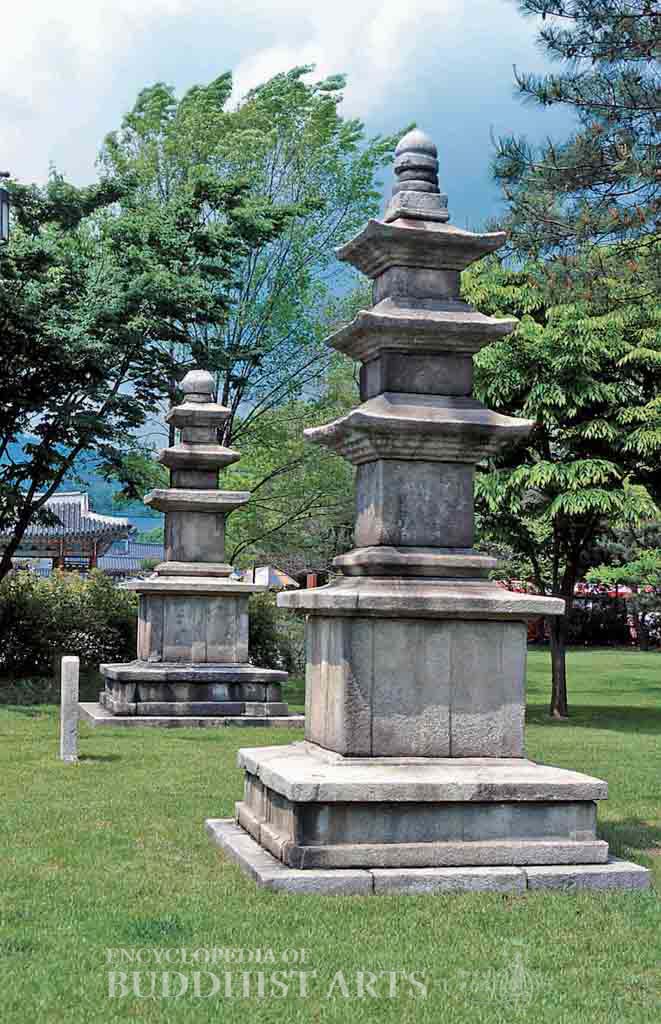
Yeongjeonsa Temple Boje Twin Pagodas
Yeongjeonsa Temple Boje Twin Pagodas
SOUTH KOREA, Seoul
These twin pagodas were originally located at Yeongjeonsa Temple in Wonju, Gangwon. The pagodas were built in 1388 during the Goryeo dynasty. They were moved from their original location in 1915. During the relocation, a reliquary was found in one pagoda and a stone tablet was found in the other. According to the inscription on the tablet, they were built as funerary pagodas containing relics of Master Boje, also known as Master Naong. The pagodas were relocated to the National Museum of Korea in Seoul in 2005. They were listed as Treasures No. 358 in 1963.
Both pagodas have a two-layer base and a three-tier body. Intermediate and corner pilasters are carved on their bases. A stone slab is placed on the upper base of each pagoda to support the pagoda body above, which is a characteristic of stone pagodas built during the Goryeo dynasty (918–1392). Each tier and each roof of the pagoda body is made from a single piece of stone. Under the roofs there are four layers of corbeling representing the eaves.
The two pagodas differ in their heights, their eaves, and their spires. The east pagoda, which is 3.9 m high, has thicker and heavier eaves than the west pagoda. Its spire consists of an inverted bowl and a jewel. On the other hand, the 4.1 m high west pagoda has roofs with slightly upturned corners, and a spire consisting of a square harmika, an inverted bowl, stacked rings, and a jewel. Both pagodas provide valuable information on the design of stone pagodas during the Goryeo period.
For more details, go to the Encyclopedia of Buddhist Arts: Architecture T-Z, page 1349.
Cite this article:
author = Hsingyun and Youheng and Johnson, Peter and Mankuang and Lancaster, Lewis,
booktitle = {Encyclopedia of Buddhist Arts: Architecture T-Z},
pages = 1349,
title = {{Yeongjeonsa Temple Boje Twin Pagodas}},
volume = 4,
year = {2016}}