
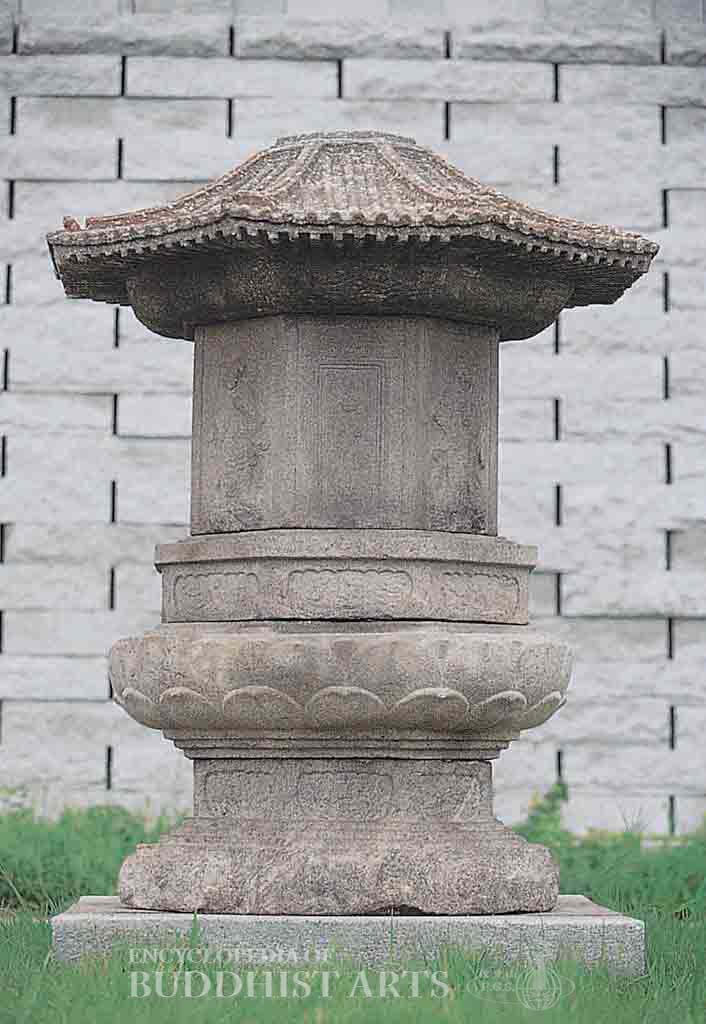
Heungbeopsa Temple Yeomgeo Stupa
Heungbeopsa Temple Yeomgeo Stupa
SOUTH KOREA, Seoul
This memorial stupa dedicated to Master Yeomgeo is said to have been located at Heungbeopsa Temple. Based on an inscription, the stupa was built in 844, making it the oldest dated Korean stupa dedicated to a monk. It has been relocated to several places, including the Pagoda Park and Gyeongbokgung Palace in Seoul, and finally the National Museum of Korea. It was listed as National Treasure No. 104 in 1962.
The octagonal stupa is 1.7 m high and consists of a base platform, base, body, and roof. The base is carved with lions, incense burners, lotuses, and apsaras. The octagonal body has reliefs of doors alternating with reliefs of the Four Heavenly Kings. The octagonal pyramidal roof has imitation wooden rafters and is covered in corrugated tiles. The apsaras carved underneath the eaves enhance the elegance of the stupa. When the stupa was being relocated, a gilt-bronze record was discovered dating the stupa to 844, the year when Master Yeomgeo passed away.
Master Yeomgeo was the second Seon Master of the Gajisan school. He had been a disciple of Master Doui and dedicated his time at Eokseongsa Temple to propagating Seon Buddhism, which at that time was unfamiliar to Korean Buddhists.
For more details, go to the Encyclopedia of Buddhist Arts: Architecture G-L, page 435.
Cite this article:
author = Hsingyun and Youheng and Johnson, Peter and Mankuang and Lancaster, Lewis,
booktitle = {Encyclopedia of Buddhist Arts: Architecture G-L},
pages = 435,
title = {{Heungbeopsa Temple Yeomgeo Stupa}},
volume = 2,
year = {2016}}