
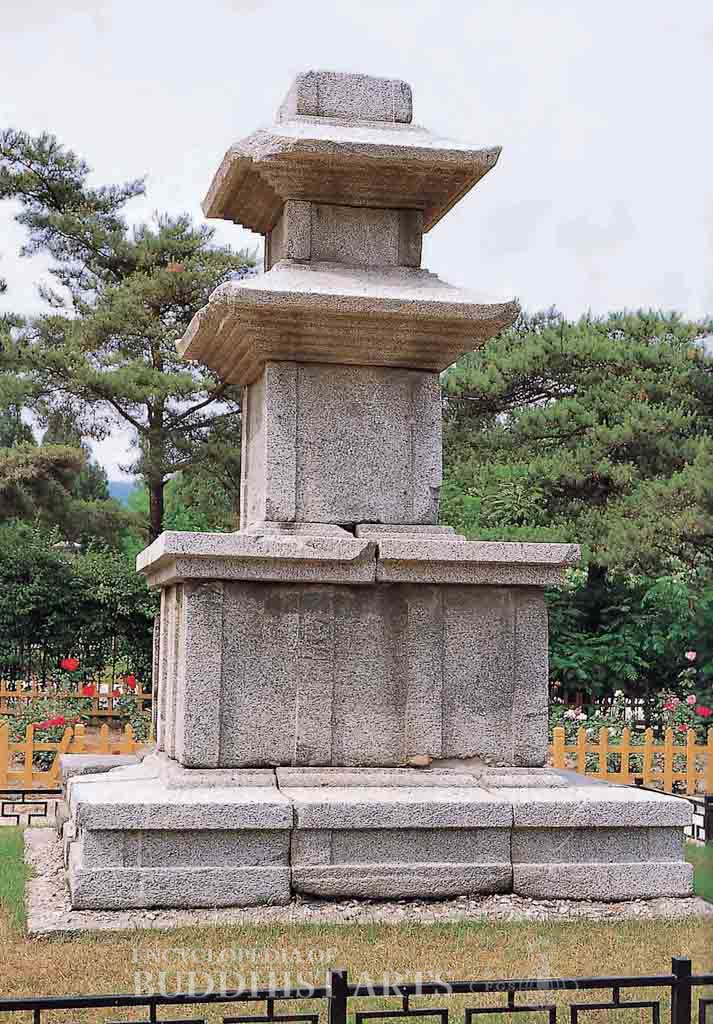
Galhangsa Temple Twin Pagodas: West Pagoda
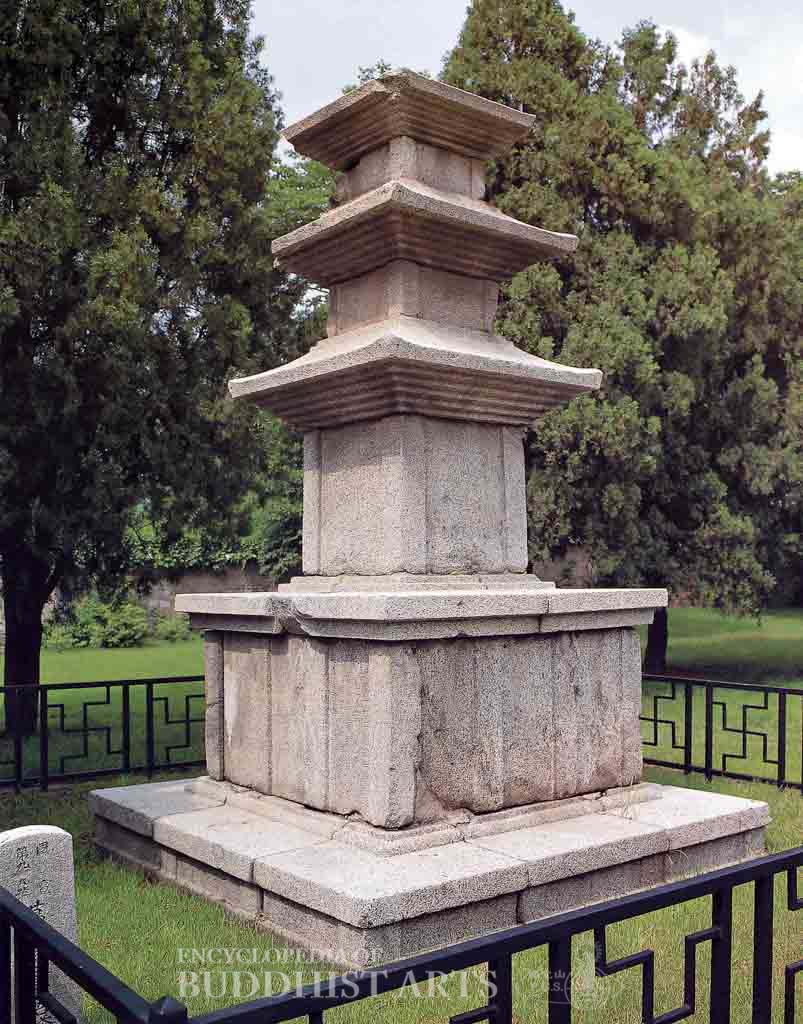
Galhangsa Temple Twin Pagodas: East Pagoda
Galhangsa Temple Twin Pagodas
SOUTH KOREA, North Gyeongsang, Gimcheon
This pair of pagodas once stood on the grounds of Galhangsa Temple. They are currently located at the National Museum of Korea in Seoul. The stone pagodas were originally constructed in 758 during the Unified Silla dynasty by Master Eonjeok. They were relocated to Gyeongbokgung Palace in Seoul in 1916, and they were moved again to their present location in 2005. They were listed as National Treasure No. 99 in 1962.
Both the east and west pagodas have three levels and are 4.3 m and 4 m high respectively. Built in granite, both pagodas have a base platform and a base, which is a very common feature of the Unified Silla dynasty (668–935). Each face of the base is carved with two pilasters in between the corner pilasters. Each level and each eave of the pagoda is carved from a single piece of granite. Except for the missing eave on the third tier of the west pagoda, there are five layers of corbeling supporting each eave, which is a characteristic of stone pagodas during that time.
When these two pagodas were moved from Galhangsa Temple, a bronze reliquary box and gilt copper alloy reliquary bottle were discovered under the base of the east pagoda, while items such as a gilt bronze reliquary bottle, a copper box, and pieces of paper were found under the west pagoda. The inscription on the base of the east pagoda stating its year of construction provides valuable information for research on the pagodas. Both pagodas, with their simple style and harmonious proportions, were regarded as models of stone pagodas in the middle of the 8th century, along with Sakyamuni Pagoda of Bulguksa Temple.
For more details, go to the Encyclopedia of Buddhist Arts: Architecture G-L, page 351.
Cite this article:
author = Hsingyun and Youheng and Johnson, Peter and Mankuang and Lancaster, Lewis,
booktitle = {Encyclopedia of Buddhist Arts: Architecture G-L},
pages = 351,
title = {{Galhangsa Temple Twin Pagodas}},
volume = 2,
year = {2016}}