
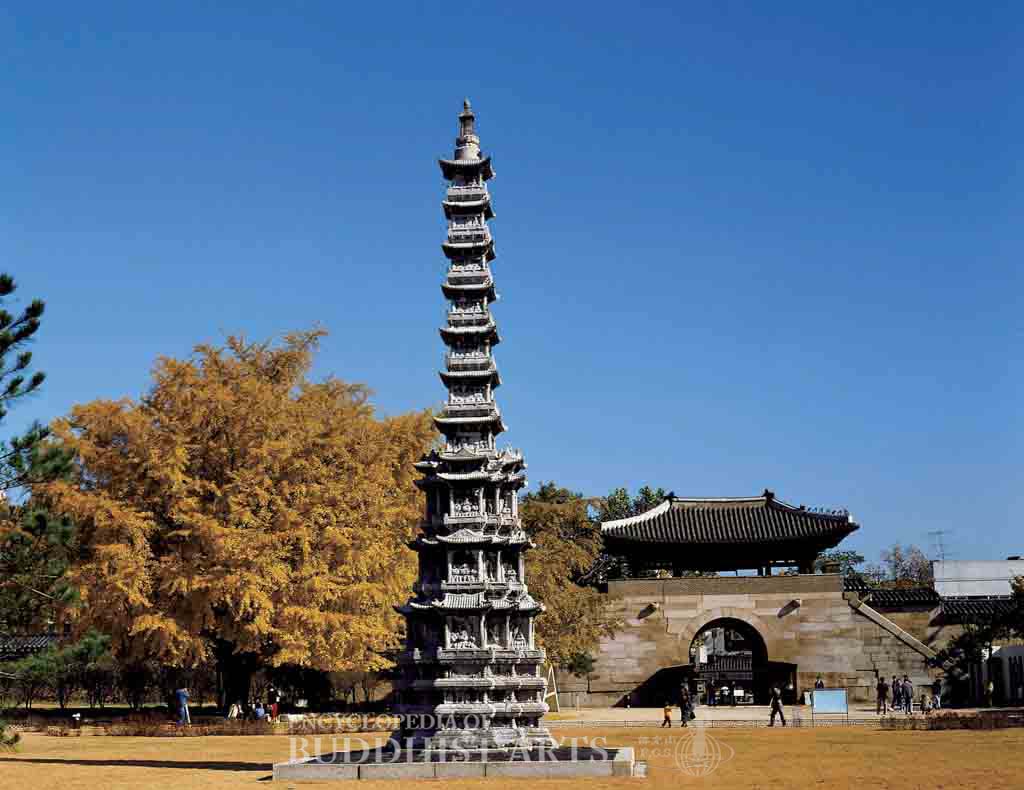
Gyeongcheonsa Temple Ten-Tier Pagoda
Gyeongcheonsa Temple Ten-Tier Pagoda
SOUTH KOREA, Seoul
The pagoda once stood on the grounds of Gyeongcheonsa (Honoring Heaven Temple) in Gyeonggi. On the basis of an inscription, it is known that the pagoda was constructed by Chinese craftsmen in 1348 during the Goryeo dynasty. It was taken to Japan in 1906 and returned to Korea in 1918. Although the pagoda was rebuilt at Gyeongbokgung Palace in 1960, it was affected by acid rain and weathering. After further restoration, it was relocated to the National Museum of Korea in Seoul in 2005. It was listed as National Treasure No. 86 in 1962.
This magnificent ten-tier marble pagoda is 13.5 m high. The three-layer square base with multiple corners has a regular cruciform shape and is different from the typical square or octagonal pagodas. At each level of the base there are projecting cornices. The first three tiers of the pagoda body have the same shape as the base. The remaining tiers consist of cuboid shapes. Except for the third tier, which has overlapping double eaves, the remaining tiers have single eaves. They are carved with corrugated tiles and are supported by bracket sets. The corners of the base are carved with short circular columns, while much higher columns supporting the eaves feature in the first three tiers of the pagoda body. The base and the ten tiers are decorated with delicately carved reliefs of Buddhas, Bodhisattvas, heavenly beings, flora and fauna, and dragons.
The pagoda was built under the architectural influence of the Yuan dynasty (1271–1368) and also was affected by the concept of the Thirteen Buddhas, counting the three layers of the base and the ten tiers of the body. The ten-tier stone pagoda at Wongaksa Temple was constructed based on this model. This pagoda is thus very significant and is a valuable resource for research into the history of architecture. The overall impression emanating from the pagoda is one of elegance, beauty, and harmony.
For more details, go to the Encyclopedia of Buddhist Arts: Architecture G-L, page 416.
Cite this article:
author = Hsingyun and Youheng and Johnson, Peter and Mankuang and Lancaster, Lewis,
booktitle = {Encyclopedia of Buddhist Arts: Architecture G-L},
pages = 416,
title = {{Gyeongcheonsa Temple Ten-Tier Pagoda}},
volume = 2,
year = {2016}}