
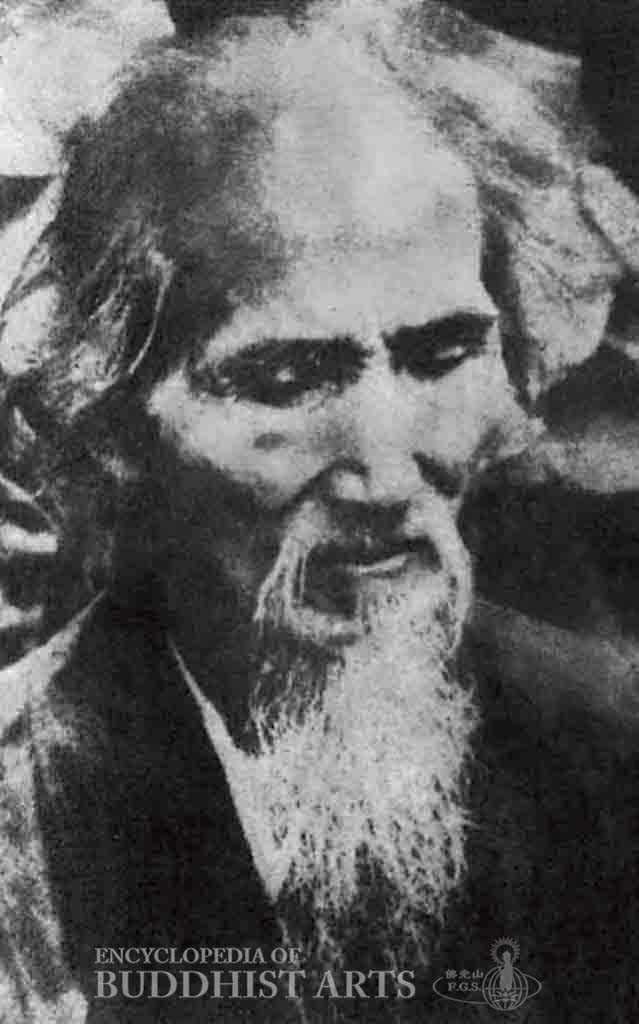
Xuyun
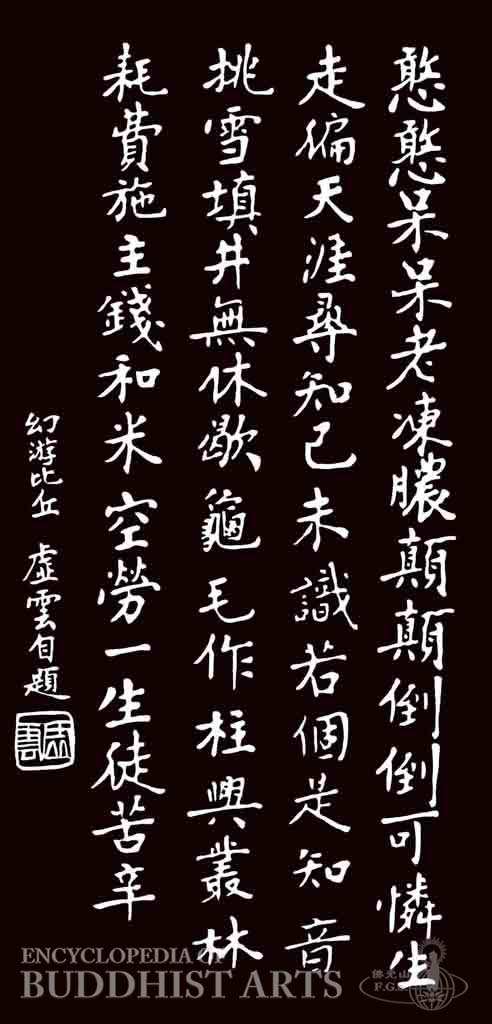
Master Xuyun Reviews His Life by Xuyun; 20th century
Rubbing
Xuyun
CHINA, Hunan, Xiangxiang
Master Xuyun’s original family name was Xiao and he was also known as Deqing. He became a vegetarian at a young age and had a particular affinity with Buddhism. At the age of 19, he renounced at Yongquan Temple in Fujian and was fully ordained one year later. He traveled to various mountains in China. At the age of 43, wishing to repay the kindness of his parents, he undertook a long pilgrimage from Putuoshan to Wutaishan by making a prostration every three steps.
After leaving Wutaishan, Master Xuyun continued his journey to other sacred mountains throughout Asia. At the age of 56, he stayed at Gaomin Temple in Jiangsu and practiced Chan Buddhism. During a 49-day retreat, he attained sudden enlightenment at the sound of a breaking teacup. Disillusioned with the dismal state of Buddhism during his time, Master Xuyun vowed to restore Buddhist education and revive old monasteries. As a consequence, over 80 temples, nunneries, and monasteries were re-built and made operational. The restorations included Zhusheng Temple in Yunnan, Yongquan Temple in Fujian, Yunju Temple in Jiangxi, and Nanhua Temple and Yunmen Temple in Guangdong.
Master Xuyun spread the various teachings of the five schools of Chan Buddhism, and encouraged the practice of being mindful of Amitabha Buddha. He became a representative figure of Chan Buddhism in China and lived to the age of 120. The writings of Xuyun include Essential Points of the Surangama Sutra and the Commentary on the Lotus Sutra. His Dharma talks, poems, as well as records of question and answer sessions during seminars, were compiled into a book entitled Collection of Dharma Words by Xuyun.
Master Xuyun’s calligraphic style was simple and neutral, penned with strokes not perceptibly stylish, creating bold and squared characters. Among his works is the engraving of Master Xuyun Reviews His Life on the Stele Wall at Fo Guang Shan Monastery in Kaohsiung, Taiwan; Eight-Character Couplet and Letter; and two horizontal inscribed boards reading Prajna Vihara and Great Hero Hall which can be found in their original location at Prajna Vihara in Hong Kong.
For more details, go to the Encyclopedia of Buddhist Arts: People, page 312.
Cite this article:
author = Hsingyun and Youheng and Youlu and Pokorski, Stefanie and Yichao and Mankuang and Miaohsi,
booktitle = {Encyclopedia of Buddhist Arts: People },
pages = 312,
title = {{Xuyun}},
volume = 19,
year = {2016}}