
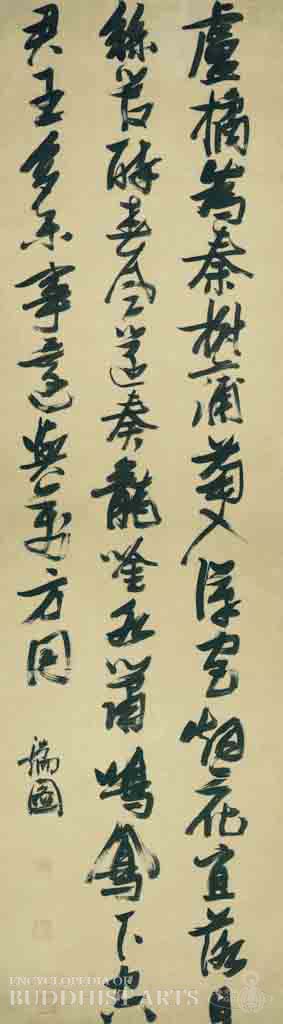
Li Bai’s Poem by Zhang Ruitu; Ming dynasty
Ink on paper
Zhang Ruitu
CHINA, Fujian, Quanzhou; Ming dynasty
Zhang Ruitu was a calligrapher and painter who was also known as Wuhua or Changgong. He studied Confucianism at an early age and was erudite in Chinese literature and history, later lecturing on the subjects and earning a widespread reputation in academia. He became an Imperial Scholar after passing the imperial examination in 1607 and was offered a position as an editor at the Hanlin Academy. Zhang later entered the cabinet in 1626 and served as the Minister of Rites, Education, and Foreign Affairs, enjoying a successful official career. In 1630, he resigned and opted to live a reclusive life.
Zhang was reputed for his unique calligraphic style. Alongside Xing Dong, Dong Qichang, and Mi Wanzhong, he is regarded as one of the Four Great Calligraphers of the late Ming dynasty. His works eventually spread to Japan, imparting great influence on Japanese calligraphy. His calligraphic pieces include Seven-Character Verse Poems, kept at the Nanjing Museum in Jiangsu; Li Bai’s Poem and Heart Sutra, at the Shanghai Museum; and Seven-Character Poem, at the Anhui Provincial Museum in Hefei. Five-Character Poem, engraved in running script, is displayed on the Stele Wall at Fo Guang Shan Monastery in Kaohsiung, Taiwan. Additionally, he once scripted the words, “Whole Body Are Hands and Eyes” on a horizontal inscribed board for the Great Hero Hall of Longshan Temple in Fujian.
He learned landscape painting from Huang Gongwang, and exhibited a bold, fresh, and elegant style. His Buddhist paintings include Avalokitesvara Bodhisattva and Eighteen Arhats.
For more details, go to the Encyclopedia of Buddhist Arts: People, page 338.
Cite this article:
author = Hsingyun and Youheng and Youlu and Pokorski, Stefanie and Yichao and Mankuang and Miaohsi,
booktitle = {Encyclopedia of Buddhist Arts: People },
pages = 338,
title = {{Zhang Ruitu}},
volume = 19,
year = {2016}}