
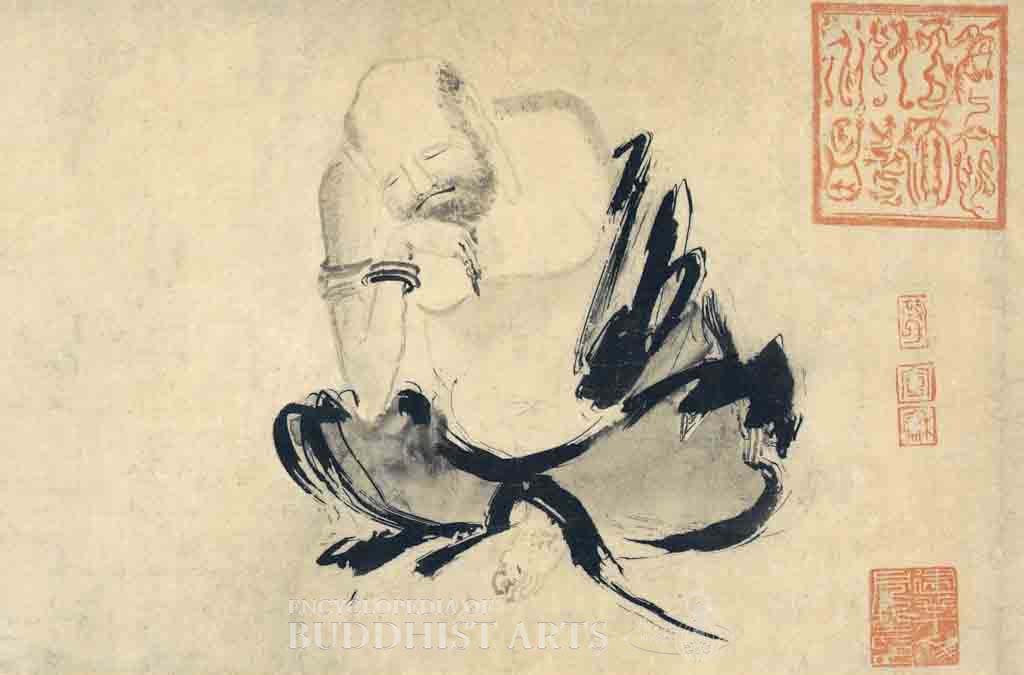
Patriarchs Taming Their Minds - Huike attributed to Shi Ke; Five dynasties
Ink on paper
Shi Ke
CHINA, Sichuan, Chengdu; Five Dynasties
Known to be humorous and a quick-witted speaker, Shi Ke was a painter from Pixian, Chengdu. Shi first studied under Zhang Nanben and created works that were prolific with narrative illustrations. He later developed a new style which featured strokes that are stylized, unrestrained, and indulgent. Although he was not a Buddhist, he grasped the essence of Chan, and created works of Buddhist and Daoist subjects. His figurative images are exaggerated, distorted, and caricature-like. According to Evaluation of Painters of the Past and Present, Shi pioneered a simplistic style that utilized bold strokes, and was reminiscent of the “jianbi” or “abbreviated brush” technique developed by Liang Kai during the Southern Song dynasty (1127–1279).
During the rule of Emperor Taizu (reigned 960–976) of the Song dynasty, Shi was appointed to complete a mural at Xiangguo Temple in Henan. He was rewarded with a position in the Imperial Painting Academy, but he declined. Shi despised the vulgarity of the nobles and the powerful. Such sentiments were expressed in his satirical illustration, Jade Emperor Holding Audience, where officials were portrayed with fish and crabs hanging from their belts; it aimed to ridicule the officials who showed off their status by hanging their official purple robes and golden fish bags from their belts at all time.
Shi’s paintings were recorded in Xuanhe Catalog of Paintings, Records of Famous Paintings in Yizhou, Evaluation of Famous Painters of the Song Dynasty, and Evaluation of Painters. The set of two paintings, Patriarchs Taming Their Minds, were attributed to Shi and are listed as Important Cultural Properties of Japan.
For more details, go to the Encyclopedia of Buddhist Arts: People, page 234.
Cite this article:
author = Hsingyun and Youheng and Youlu and Pokorski, Stefanie and Yichao and Mankuang and Miaohsi,
booktitle = {Encyclopedia of Buddhist Arts: People },
pages = 234,
title = {{Shi Ke}},
volume = 19,
year = {2016}}