
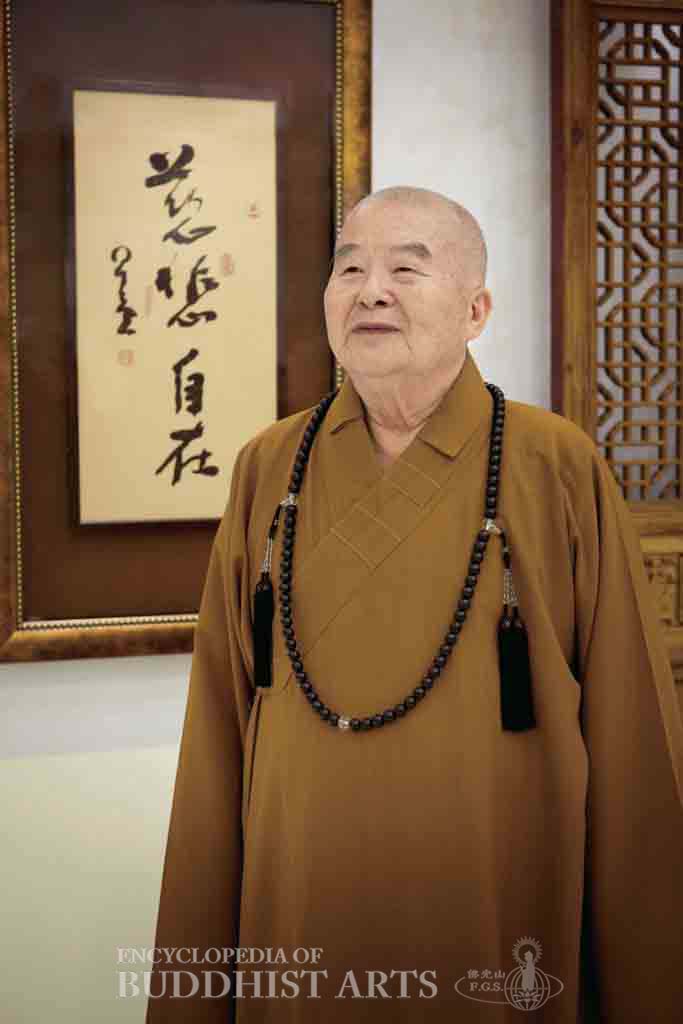
Hsing Yun
Hsing Yun
CHINA, Jiangsu, Yangzhou
Master Hsing Yun, also known by the Dharma names of Wuche and Jinjue, is the 48th patriarch of the Linji school of Chan Buddhism. He was born in 1927 and renounced the age of 12 under Master Zhikai at Qixia Temple in Jiangsu, where he was fully ordained two years later. His studies took place at Qixia Vinaya school and Jiaoshan Buddhist College. Hsing Yun arrived in Taiwan in 1949, and in 1952, he began to lay the foundation for his future in Dharma propagation at Lei Yin Temple in Yilan. He established Shou Shan Buddhist College in Kaohsiung in 1962, and his most significant contribution came in 1967, when he founded Fo Guang Shan Monastery in Kaohsiung. He stepped down from abbotship in 1985 and subsequently founded the Buddha’s Light International Association (BLIA) in 1992, in addition to branch temples around the globe. Currently, there are over 200 Fo Guang Shan branch temples and more than 140 BLIA chapters worldwide.
One of the pioneers in promoting Humanistic Buddhism, Master Hsing Yun utilizes a variety of means to propagate the Dharma throughout all aspects of human life. In doing so, he has established 5 universities, 16 Buddhist colleges, and 23 art galleries, as well as mobile clinics and library, senior homes, and a foster home. In 1979, Hsing Yun became the first Buddhist monk in Taiwan to propagate the Dharma on television, later founding Beautiful Life Television. In addition, he established a daily newspaper called Merit Times, and has authored over 150 written works, many of which have been translated into languages such as English, German, French, Dutch, and Spanish. His notable long-standing propagation efforts include 30 years of lecture at the National Dr. Sun Yat-Sen Memorial Hall in Taipei and 20 years at the Hong Kong Coliseum. Recognized for his contributions, Hsing Yun has received 15 honorary Ph.D. degrees from various universities around the world, such as Peking University in Beijing.
A talented architect, all design aspects of Fo Guang Shan Monastery were conceived by Master Hsing Yun himself. The monastery complex exhibits a typical Chinese palace-style Buddhist architectural layout. A particularly notable feature is the construction of the Great Hero Hall and the Cloud-Dwelling Building, which houses a dining hall that accommodates 3,000 people, both of which were built without an internal column for added support. Fo Guang Shan overseas branch temples appear similar in their design, as can be seen at Hsi Lai Temple in USA, Nan Tien Temple in Australia, Nan Hua Temple in South Africa, and Templo Zu Lai in Brazil. Another noteworthy architectural venture by Hsing Yun was the construction of the Fo Guang Shan Buddha Memorial Center in 2011. Adjacent to Fo Guang Shan Monastery in Kaohsiung, the center encompasses a design that took inspiration from famous Buddhist sites around the world. With the addition of Buddhist art work throughout the center, his intention was to infuse the teachings of Humanistic Buddhism with the architecture and art to create a visual learning experience.
Master Hsing Yun strives to promote international Buddhist exchange, as well as world peace and religious harmony. He has convened with prominent religious leaders such as the Fourteenth Dalai Lama, Pope John Paul II, and Pope Benedict XVI. In 1998, Hsing Yun successfully completed a significant attempt to reinstate the ordination of nuns in the Theravada Buddhist tradition in Bodhgaya, India. Over 150 monastic preceptees from more than 20 countries participated in the ordination ceremony that transcended race, region, and Buddhist lineages. In addition, his request of the Taiwanese government to recognize the Buddha’s Birthday as a national holiday was appeased in 2000.
Master Hsing Yun knew that in order to revitalize and expand Buddhism, future talents must be fostered. Therefore, he set out to establish Buddhist colleges, such as Shou Shan Buddhist College, Tsung Ling University, and the Chinese Buddhist Research Institute. He also founded Fo Guang Shan Open University at various branch temples for devotees. In addition to the five universities: University of the West in the USA, Nan Tien Institute in Australia, Fo Guang University and Nan Hua University in Taiwan, and Guang Ming College in the Philippines, he has founded three high schools, two grade schools, and several kindergartens.
Having a consistent history of promoting Buddhism through writing, Master Hsing Yun’s first book was Biography of Sakyamuni Buddha. His other publications include Buddhist Affinities Across 100 Years and Humble Monk. Additionally, he was the editor of the Buddhist publications, Life Monthly, Awakening the World and Buddhism Today, founded Buddha’s Light Publishing, and organized the Fo Guang Buddhist Canons and Universal Gate Buddhist Journal.
Due to his diabetes, Master Hsing Yun’s vision has begun to deteriorate. Despite this, he continues to create works of calligraphy. Funds raised from his “One-Stroke Calligraphy” help to influence social integrity through supporting the Master Hsing Yun Public Trust Fund for Education. Among the thousands of his calligraphy pieces, the notable ones are Characters - Buddhism in Practice, Characeters - May Everything Go Perfectly for You, and Characters - One Flower a World, One Leaf a Buddha. His calligraphy has been exhibited at various museums around the world, such as the National Museum of China in Beijing, the United Nations Office in Geneva, Switzerland, and the Albertina Museum in Vienna, Austria.
For more details, go to the Encyclopedia of Buddhist Arts: People, page 96.
Cite this article:
author = Hsingyun and Youheng and Youlu and Pokorski, Stefanie and Yichao and Mankuang and Miaohsi,
booktitle = {Encyclopedia of Buddhist Arts: People },
pages = 96,
title = {{Hsing Yun}},
volume = 19,
year = {2016}}