
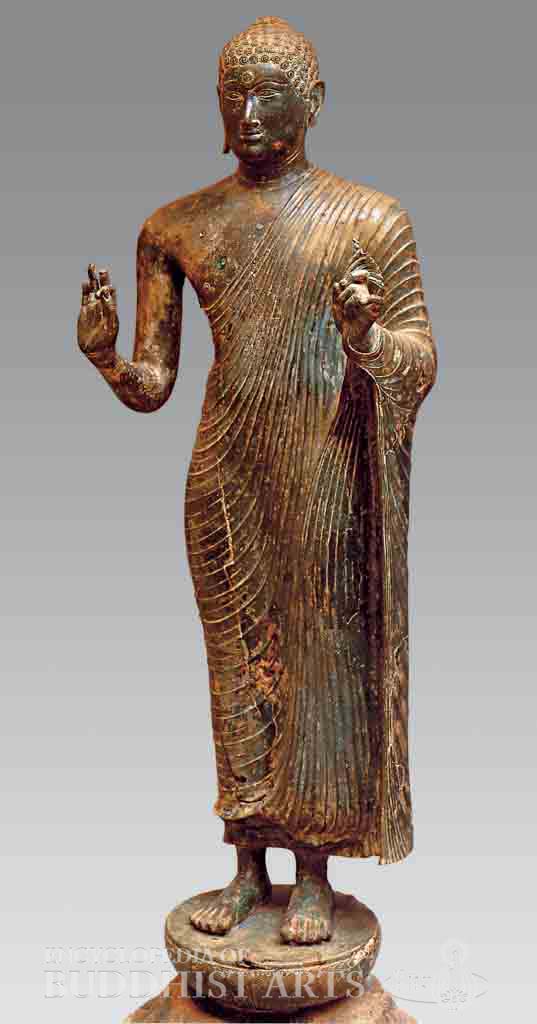
Dong Duong: Standing Buddha
Bronze
Dong Duong: Standing Buddha
VIETNAM, Quang Nam, Thang Binh
This Buddha shows obvious Indian influences as a product of the Champa Kingdom (circa 7th century–1382). Characteristics of his status include the snail shell curls on the head leading to a low usnisa, an urna on the forehead, and three lines on the neck. The monastic robe leaves the right shoulder bare and the folds are depicted as falling diagonally on the left and vertically on the right. The right hand is lifted in vitarka (teaching) mudra and the robe falling from the left forearm drops free of the body, while elsewhere the material allows the body’s shape to show through.
For more details, go to the Encyclopedia of Buddhist Arts: Sculpture A-F, page 299.
Cite this article:
Hsingyun, et al. "Dong Duong: Standing Buddha." Encyclopedia of Buddhist Arts: Sculpture A-F, vol. 10, 2016, pp. 299.
Hsingyun, Youheng, Yann Lovelock, Yuan Chou, Susan Huntington, Gary Edson, and Robert Neather. 2016. "Dong Duong: Standing Buddha" In Encyclopedia of Buddhist Arts: Sculpture A-F, 10:299.
Hsingyun, Youheng, Lovelock, Y., Chou, Y., Huntington, S., Edson, G., & Neather, R.. (2016). Dong Duong: Standing Buddha. In Encyclopedia of Buddhist Arts: Sculpture A-F (Vol. 10, pp. 299).
@misc{Hsingyun2016,
author = Hsingyun and Youheng and Lovelock, Yann and Chou, Yuan and Huntington, Susan and Edson, Gary and Neather, Robert,
booktitle = {Encyclopedia of Buddhist Arts: Sculpture A-F},
pages = 299,
title = {{Dong Duong: Standing Buddha}},
volume = 10,
year = {2016}}
author = Hsingyun and Youheng and Lovelock, Yann and Chou, Yuan and Huntington, Susan and Edson, Gary and Neather, Robert,
booktitle = {Encyclopedia of Buddhist Arts: Sculpture A-F},
pages = 299,
title = {{Dong Duong: Standing Buddha}},
volume = 10,
year = {2016}}