
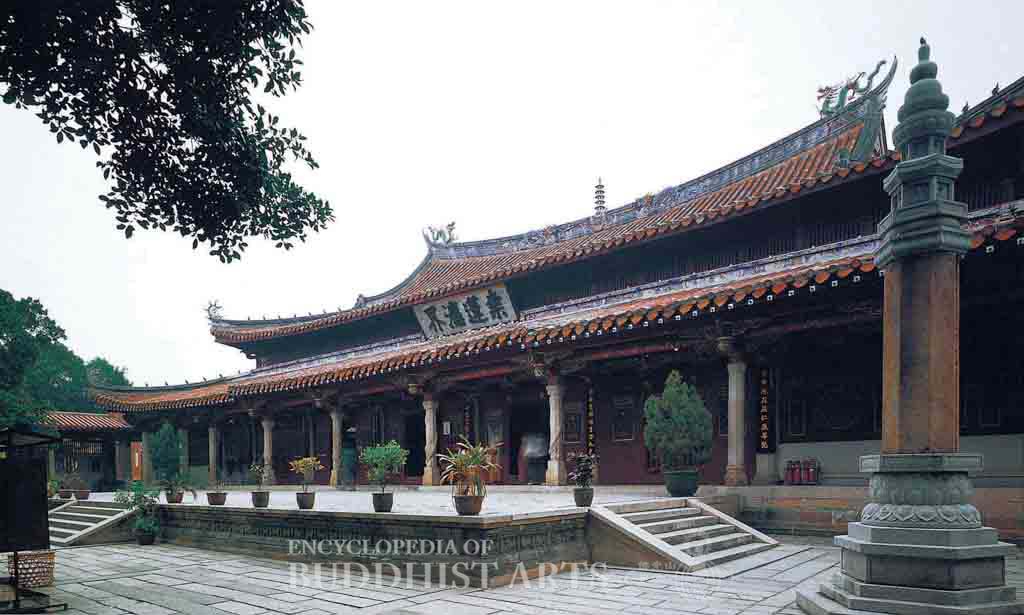
Kaiyuan Temple Great Hero Hall
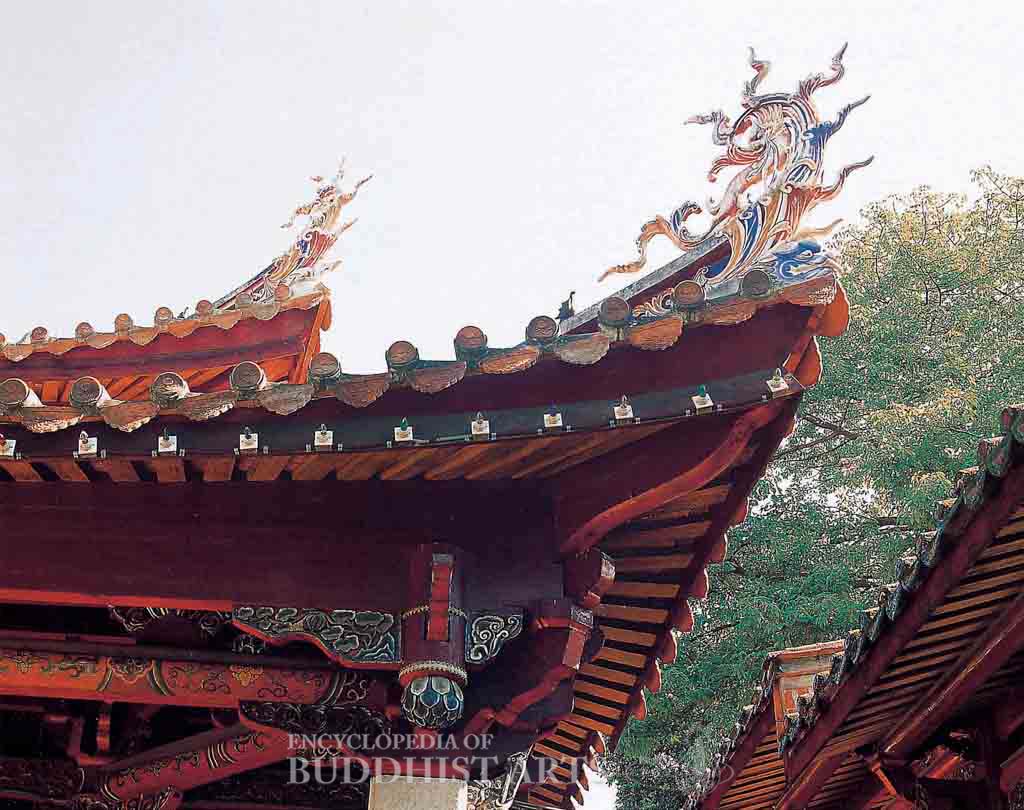
Kaiyuan Temple Great Hero Hall: Corner of Roof
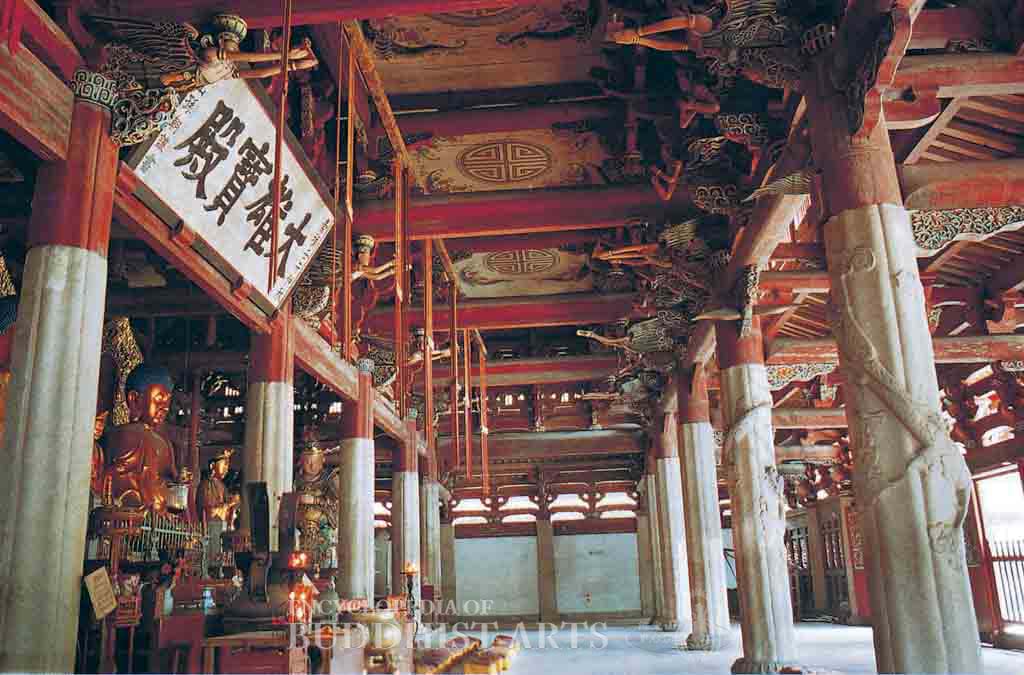
Kaiyuan Temple Great Hero Hall: Bracket Sets
Kaiyuan Temple Great Hero Hall
CHINA, Fujian, Quanzhou
The Great Hero Hall was built in 686 during the Tang dynasty, and was repaired a number of times throughout its history. The existing building was restored by Zheng Zhilong, a Chief General, in 1637 during the Ming dynasty. It has retained its magnificent architecture from the Tang dynasty (618–907).
The nine-by-six bay hall has a double-eave hip-and-gable roof. It occupies about 1,338 sq m and is around 20 m high. Inside the hall there are the statues of the Five Dhyani Buddhas and directly behind them is Avalokitesvara Bodhisattva. The interior is supported by 86 granite columns, although there were originally 92. The columns come in different styles, such as round, square, petal-shape, or carved with coiling dragons. Due to the large number of columns, the hall is also known as Hundred Column Hall. There are 24 bracket sets consisting of vivid carvings of kalavinkas, each of which is depicted performing a different action, such as holding writing brushes, playing a wind instrument, or plucking a lute. These exquisite carvings combine religious, artistic, and architectural forms. At the back of the hall, two granite columns can be found supporting the veranda. They are decorated with 24 carvings from the legend of Mahakala as well as some floral motifs.
The Sumeru platform in front of the Great Hero Hall has a waist section decorated with 72 carvings of sphinxes and lions in granite stone.
For more details, go to the Encyclopedia of Buddhist Arts: Architecture G-L, page 579.
Cite this article:
author = Hsingyun and Youheng and Johnson, Peter and Mankuang and Lancaster, Lewis,
booktitle = {Encyclopedia of Buddhist Arts: Architecture G-L},
pages = 579,
title = {{Kaiyuan Temple Great Hero Hall}},
volume = 2,
year = {2016}}