
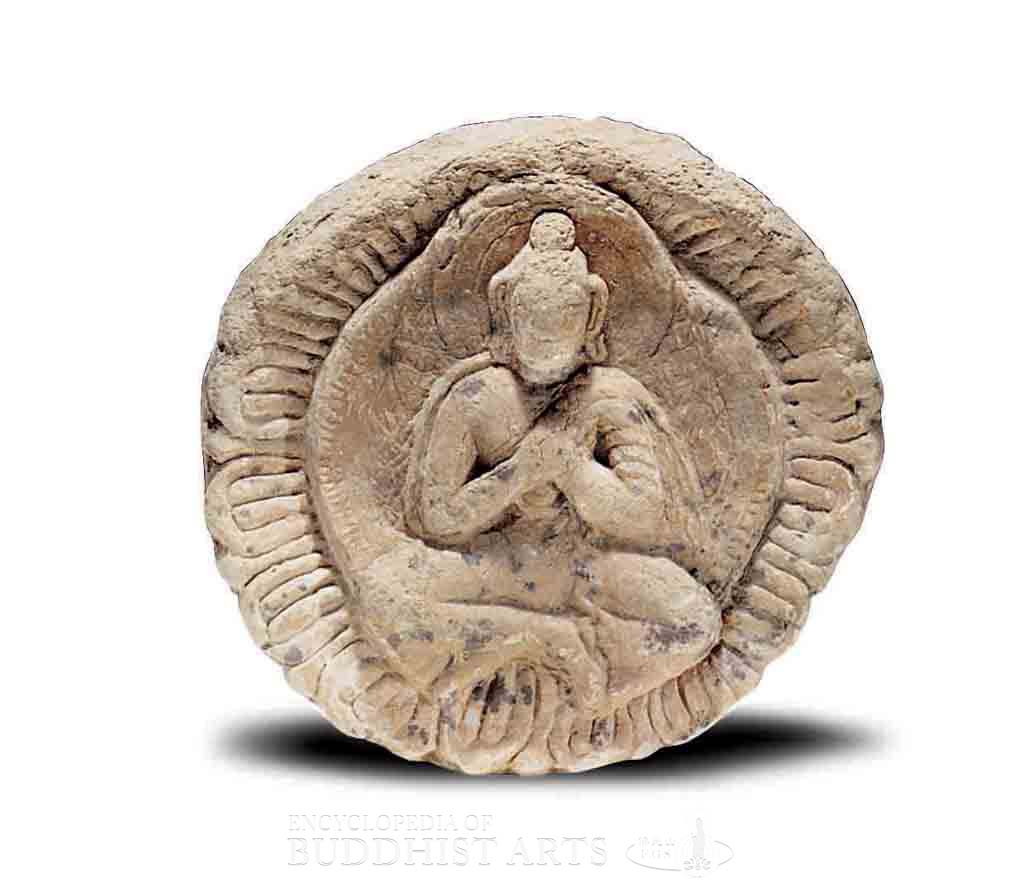
Rawak Stupa: Buddha and Bodhisattva - Buddha
Clay
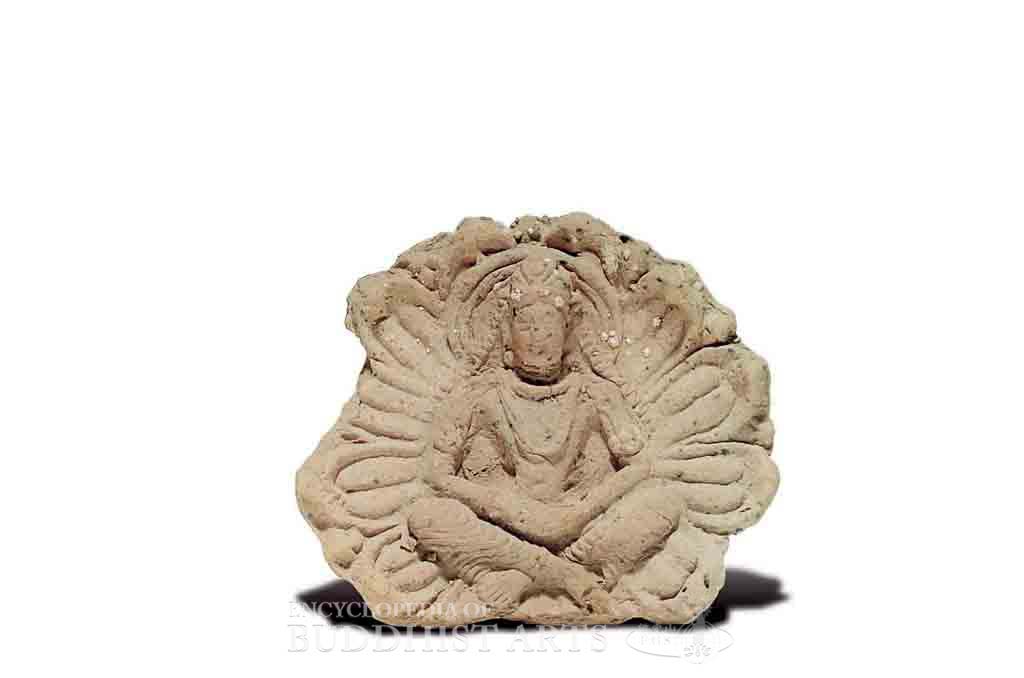
Rawak Stupa: Buddha and Bodhisattva - Bodhisattva
Rawak Stupa: Buddha and Bodhisattva
CHINA, Xinjiang, Hotan
These figures were excavated from the ruins of Rawak Stupa. They were found on the walls of the courtyard and were most likely part of a nimbus or mandorla of a Buddha statue. Both figures sit cross-legged surrounded by lotus petals, and are remarkably similar to figures found at the site of Sravasti in India.
The Buddha wears a monastic robe that leaves the right shoulder bare and he appears to be making the Dharmacakra (Dharma wheel) mudra. The figure has a nimbus and a mandorla embellished with flame patterns. The Bodhisattva wears a headdress, some jewelry, a stole that hangs from the shoulders, and a lower garment. The hands are placed in front of the abdomen.
For more details, go to the Encyclopedia of Buddhist Arts: Artifacts, page 274.
Cite this article:
author = Hsingyun and Youheng and Youji and Pokorski, Stefanie and Mankuang and Fan, Wen,
booktitle = {Encyclopedia of Buddhist Arts: Artifacts },
pages = 274,
title = {{Rawak Stupa: Buddha and Bodhisattva}},
volume = 18,
year = {2016}}