
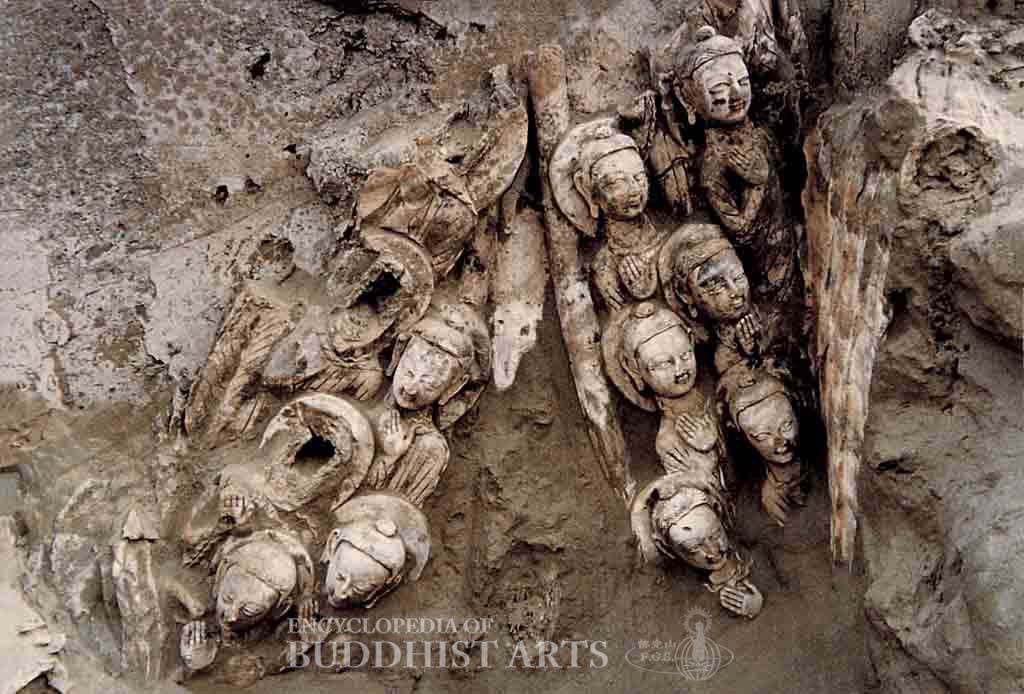
Rawak Stupa: Buddha Reliefs
Clay
Rawak Stupa: Buddha Reliefs
CHINA, Xinjiang, Hotan
These reliefs were excavated from Rawak Stupa and are believed to have originally decorated the mandorlas of two larger Buddhas that were seated next to each other. The figures are similar in appearance, each with their own nimbus and hands in the abhaya (fearlessness) mudra. They wear monastic robes that cover both shoulders, with the corner of the garment draped over the left shoulder. The thick folds are reminiscent of the Gandhara style. The early dating is based on observing typical features of the time, such as the wavy hair, the wide opened eyes, the lack of an urna between the eyebrows, and the stiffness in the mudra and clothing.
For more details, go to the Encyclopedia of Buddhist Arts: Sculpture N-Sr, page 878.
Cite this article:
Hsingyun, et al. "Rawak Stupa: Buddha Reliefs." Encyclopedia of Buddhist Arts: Sculpture N-Sr, vol. 12, 2016, pp. 878.
Hsingyun, Youheng, Yann Lovelock, Yuan Chou, Susan Huntington, Gary Edson, and Robert Neather. 2016. "Rawak Stupa: Buddha Reliefs" In Encyclopedia of Buddhist Arts: Sculpture N-Sr, 12:878.
Hsingyun, Youheng, Lovelock, Y., Chou, Y., Huntington, S., Edson, G., & Neather, R.. (2016). Rawak Stupa: Buddha Reliefs. In Encyclopedia of Buddhist Arts: Sculpture N-Sr (Vol. 12, pp. 878).
@misc{Hsingyun2016,
author = Hsingyun and Youheng and Lovelock, Yann and Chou, Yuan and Huntington, Susan and Edson, Gary and Neather, Robert,
booktitle = {Encyclopedia of Buddhist Arts: Sculpture N-Sr},
pages = 878,
title = {{Rawak Stupa: Buddha Reliefs}},
volume = 12,
year = {2016}}
author = Hsingyun and Youheng and Lovelock, Yann and Chou, Yuan and Huntington, Susan and Edson, Gary and Neather, Robert,
booktitle = {Encyclopedia of Buddhist Arts: Sculpture N-Sr},
pages = 878,
title = {{Rawak Stupa: Buddha Reliefs}},
volume = 12,
year = {2016}}