
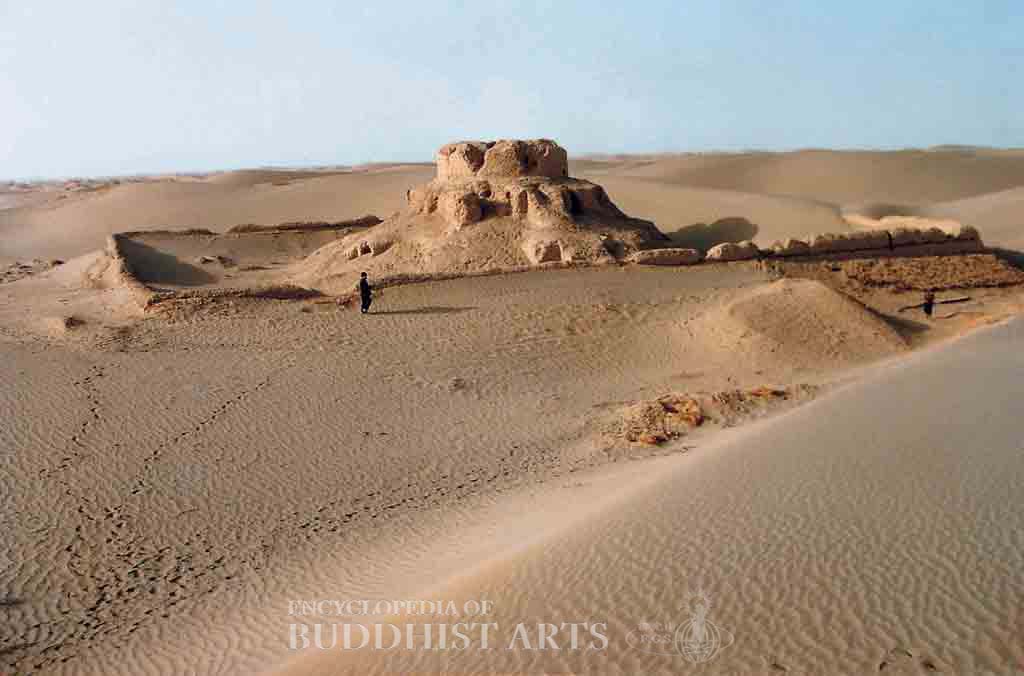
Rawak Stupa

Rawak Stupa: Outer Wall (detail)
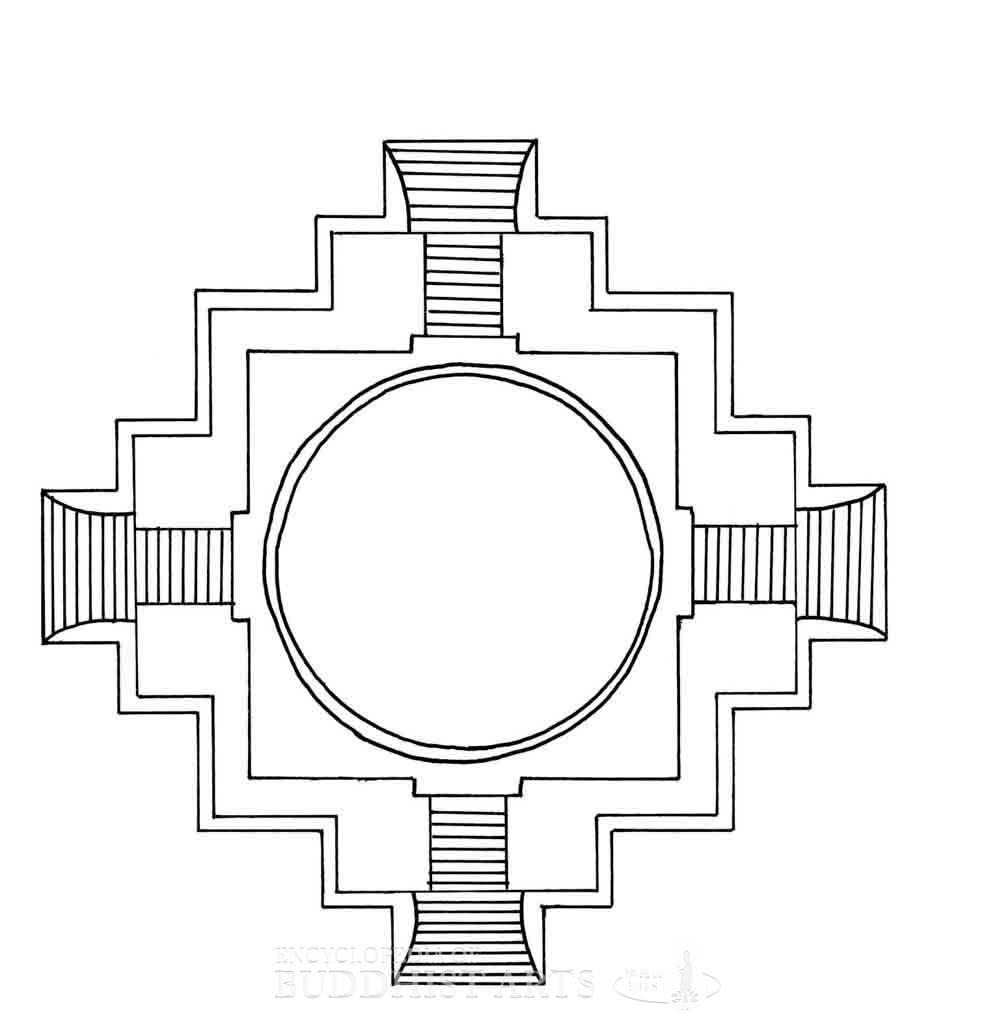
Rawak Stupa (plan)
Rawak Stupa
CHINA, Xinjiang, Hotan
This stupa is located in the Taklamakan Desert, 50 km northwest of Lop Nur. The date of construction is unknown, but it is thought to have been built around the 3rd to 4th century. It was an active Buddhist site until the arrival of Islam in the 11th century. At the start of the 20th century, British and German explorers and archaeologists carried out explorations of the site. In 1929 a study was undertaken by Chinese scholars. It was listed as a National Cultural Heritage Site in 2001.
A temple was built around the stupa, and the remains of the stupa are approximately 9 m high. It is the largest surviving stupa of the Kingdom of Khotan. It has a square base and a cylindrical body followed by a dome. It was constructed in adobe blocks of varying sizes. Each side of the base is 15 m long. It has two tiers: the first is almost 2.3 m high, while the second is 2.7 m high. The remains of the cylindrical body are 3.6 m high, with a diameter of 9.6 m. The dome has collapsed. In the middle of each side of the base, there is a ramp that leads to the top of the base. The overall layout is similar to the Kaniska Stupa in Pakistan.
The stupa is enclosed by walls forming an almost square compound measuring 50 m by 45 m. The remaining walls are approximately 3 m high and 3 m thick. There is a 2 m wide gateway in the center of the east wall. A pair of guardians, portrayed as laypeople, is painted on either side of the gateway. Both inner and outer sides of the compound walls are sculpted with clay statues of Buddhas, Bodhisattvas, and Heavenly Kings. Parts of the walls between the clay statues have murals painted on them.
For more details, go to the Encyclopedia of Buddhist Arts: Architecture M-S, page 895.
Cite this article:
author = Hsingyun and Youheng and Johnson, Peter and Mankuang and Lancaster, Lewis,
booktitle = {Encyclopedia of Buddhist Arts: Architecture M-S},
pages = 895,
title = {{Rawak Stupa}},
volume = 3,
year = {2016}}