
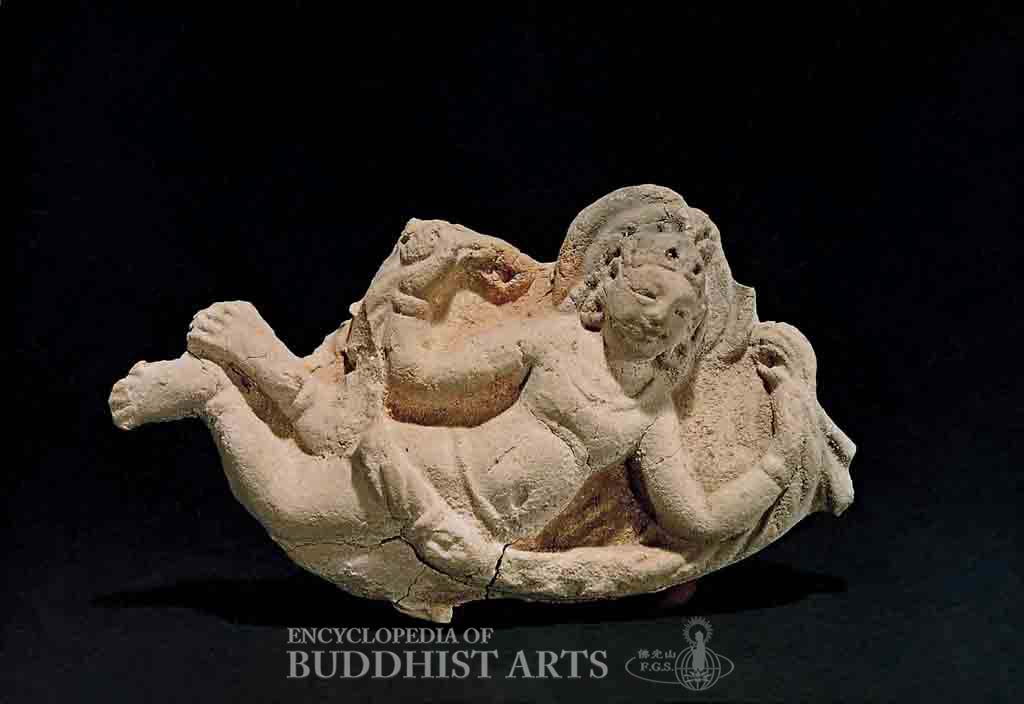
Bugaiwuyulaike Temple: Apsara
Gypsum
Bugaiwuyulaike Temple: Apsara
CHINA, Xinjiang, Hotan
This delicate statuette of an apsara was made of gypsum around the 5th to 6th century. It was excavated from the Buddhist ruins of Bugaiwuyulaike Temple. It was probably used as a wall decoration on one side of a Buddha image. The figure wears the hair in braids and is adorned with a few pieces of jewelry. There is a nimbus behind the head and both hands are holding garlands. The artist has produced a dynamic image of an apsara in flight.
For more details, go to the Encyclopedia of Buddhist Arts: Sculpture A-F, page 224.
Cite this article:
Hsingyun, et al. "Bugaiwuyulaike Temple: Apsara." Encyclopedia of Buddhist Arts: Sculpture A-F, vol. 10, 2016, pp. 224.
Hsingyun, Youheng, Yann Lovelock, Yuan Chou, Susan Huntington, Gary Edson, and Robert Neather. 2016. "Bugaiwuyulaike Temple: Apsara" In Encyclopedia of Buddhist Arts: Sculpture A-F, 10:224.
Hsingyun, Youheng, Lovelock, Y., Chou, Y., Huntington, S., Edson, G., & Neather, R.. (2016). Bugaiwuyulaike Temple: Apsara. In Encyclopedia of Buddhist Arts: Sculpture A-F (Vol. 10, pp. 224).
@misc{Hsingyun2016,
author = Hsingyun and Youheng and Lovelock, Yann and Chou, Yuan and Huntington, Susan and Edson, Gary and Neather, Robert,
booktitle = {Encyclopedia of Buddhist Arts: Sculpture A-F},
pages = 224,
title = {{Bugaiwuyulaike Temple: Apsara}},
volume = 10,
year = {2016}}
author = Hsingyun and Youheng and Lovelock, Yann and Chou, Yuan and Huntington, Susan and Edson, Gary and Neather, Robert,
booktitle = {Encyclopedia of Buddhist Arts: Sculpture A-F},
pages = 224,
title = {{Bugaiwuyulaike Temple: Apsara}},
volume = 10,
year = {2016}}