
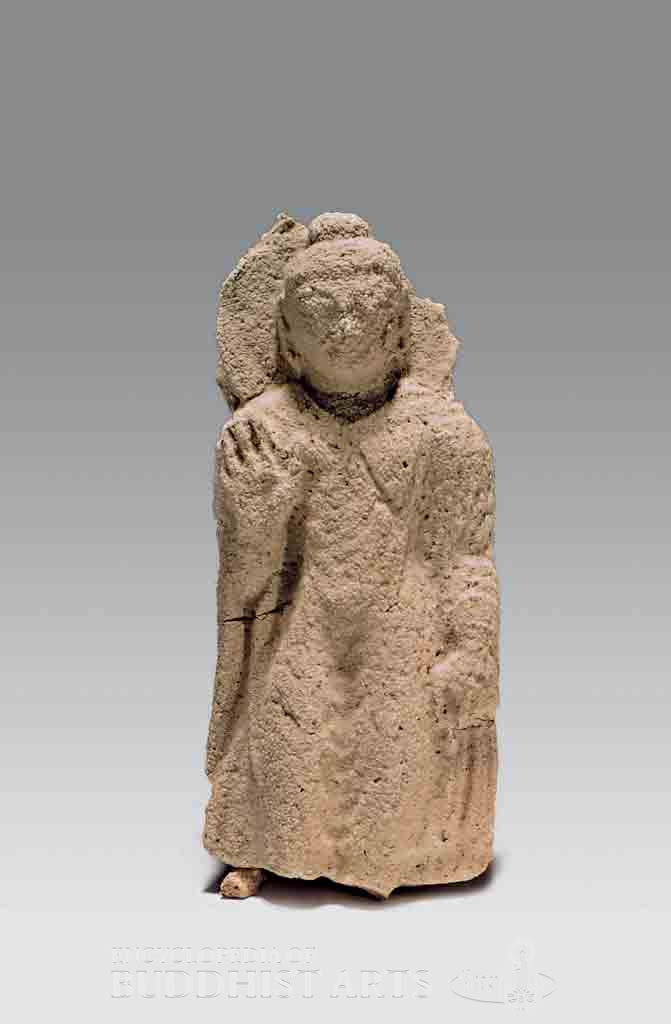
Melikawat: Standing Buddha
Clay
Melikawat: Standing Buddha
CHINA, Xinjiang, Hotan
This sculpture was discovered at the site of Melikawat in 1979. The place was once an important monastery in Khotan. The figurine is believed to have originally been part of a group on a larger statue’s nimbus or mandorla. Despite the heavy weathering, details such as the usnisa, the folds in the robe, the left hand holding the robe and the right hand making the abhaya (fearlessness) mudra, are still visible. The figure also had a nimbus of its own, of which a remnant remains.
For more details, go to the Encyclopedia of Buddhist Arts: Sculpture G-M, page 715.
Cite this article:
Hsingyun, et al. "Melikawat: Standing Buddha." Encyclopedia of Buddhist Arts: Sculpture G-M, vol. 11, 2016, pp. 715.
Hsingyun, Youheng, Yann Lovelock, Yuan Chou, Susan Huntington, Gary Edson, and Robert Neather. 2016. "Melikawat: Standing Buddha" In Encyclopedia of Buddhist Arts: Sculpture G-M, 11:715.
Hsingyun, Youheng, Lovelock, Y., Chou, Y., Huntington, S., Edson, G., & Neather, R.. (2016). Melikawat: Standing Buddha. In Encyclopedia of Buddhist Arts: Sculpture G-M (Vol. 11, pp. 715).
@misc{Hsingyun2016,
author = Hsingyun and Youheng and Lovelock, Yann and Chou, Yuan and Huntington, Susan and Edson, Gary and Neather, Robert,
booktitle = {Encyclopedia of Buddhist Arts: Sculpture G-M},
pages = 715,
title = {{Melikawat: Standing Buddha}},
volume = 11,
year = {2016}}
author = Hsingyun and Youheng and Lovelock, Yann and Chou, Yuan and Huntington, Susan and Edson, Gary and Neather, Robert,
booktitle = {Encyclopedia of Buddhist Arts: Sculpture G-M},
pages = 715,
title = {{Melikawat: Standing Buddha}},
volume = 11,
year = {2016}}