
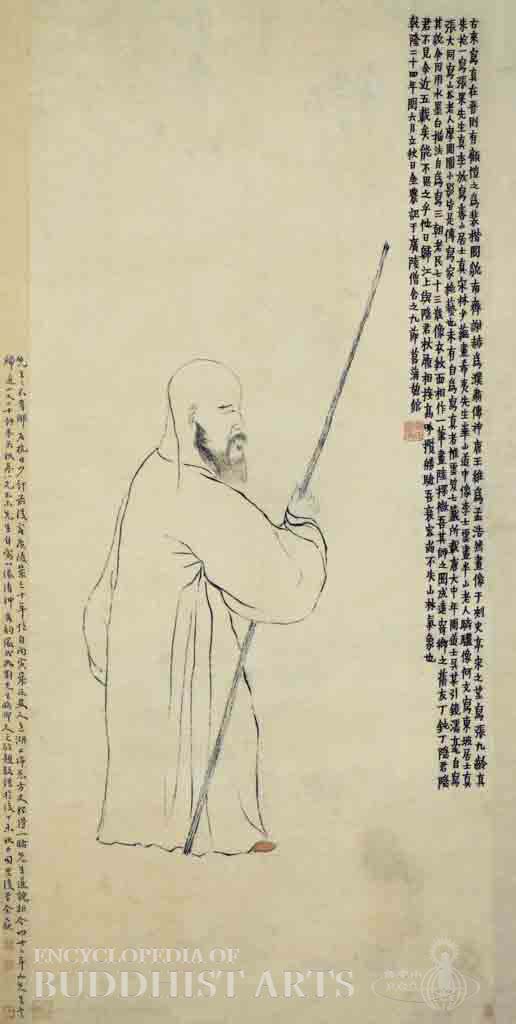
Self-Portrait by Jin Nong; Qing dynasty, dated 1759
Ink and color on paper
Jin Nong
CHINA, Zhejiang, Hangzhou; Qing dynasty
Jin Nong, also known as Shoumen or Sinong, was a calligrapher, painter, seal engraver, and poet from Renhe (present day Hangzhou, Zhejiang). He was known to be vastly intelligent, yet considerably aloof and pretentious. It was not until his middle age that he began studying Buddhism, becoming more and more devout as the years passed. On behalf of the Yuanchun Jushi, he produced a wood engraving of the Diamond Sutra, which was then circulated to well-known temples throughout the country. Jin later made a living by selling his artwork, residing in temples and living a frugal life.
Adept in poetry, prose, and calligraphy, Jin had a particular expertise in identifying originals from copies. He wrote poems in a immensely proud and extravagant style. In calligraphy, he was skilled in clerical and regular scripts, writing in a plain and profound manner. His calligraphic works include Painting the Buddha, which is collected at the Palace Museum in Beijing; Relics are Not Found in Stupas, at the Suzhou Museum in Jiangsu; as well as a scripting of the Diamond Sutra.
Jin began painting only at the age of 50; however, due to his extraordinary painting style, he was renowned as one of the Eight Eccentrics of Yangzhou, a group of eight painters of the Qing dynasty (1644–1911) known for rejecting orthodox ideas in painting in favor of an expressive and individualist style. His paintings include his Self-Portrait, Monk Knocking on the Door in the Mountains, Ascetic Sakyamuni, and Paying Respect to the Buddha, all of which are kept at the Palace Museum in Beijing; Standing Buddha, kept at the Yantai Municipal Museum in Shandong; and Longevity Buddha, kept at the Shanghai Museum.
For more details, go to the Encyclopedia of Buddhist Arts: People, page 119.
Cite this article:
author = Hsingyun and Youheng and Youlu and Pokorski, Stefanie and Yichao and Mankuang and Miaohsi,
booktitle = {Encyclopedia of Buddhist Arts: People },
pages = 119,
title = {{Jin Nong}},
volume = 19,
year = {2016}}