
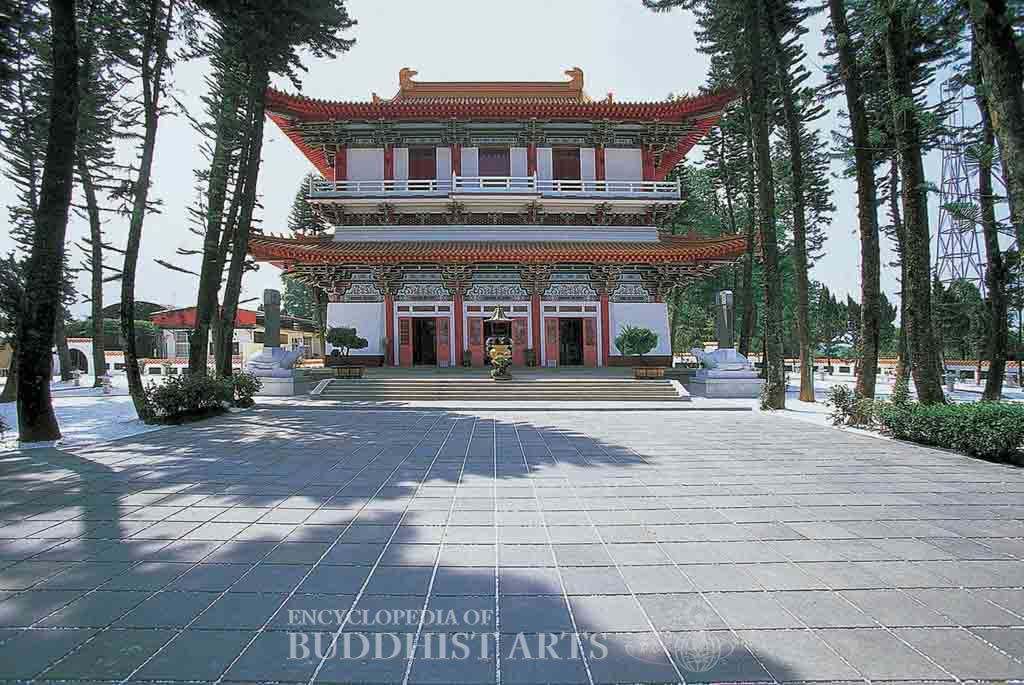
Xuanzang Temple: Main Hall
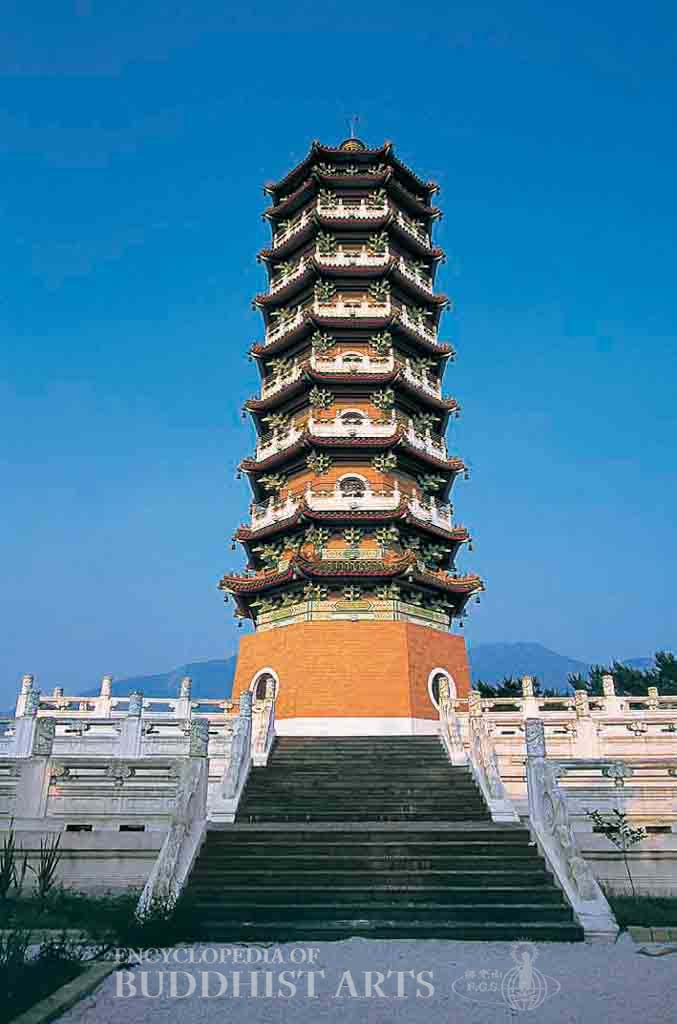
Xuanzang Temple: Ci'en Pagoda
Xuanzang Temple
TAIWAN, Nantou
The temple stands on a hill above Sun Moon Lake and was built in 1961 to enshrine the skull bone relic of Master Xuanzang, who made a famous journey to India during the Tang dynasty (618–907). The relic was originally hidden in Nanjing, where it was discovered and removed to Japan in 1942. During the World Buddhist Fellowship conference in 1952 it was agreed that the relic would be taken to Taiwan.
The principal buildings of the temple are the main temple gate, main hall, bell and drum towers, and the Ci’en Pagoda. The main hall has a hip-and-gable roof and from the outside it appears to be two stories high, while internally there are three stories. There are intermediate eaves between the two stories. The second story is surrounded by a balcony with low balustrades. Both the eaves and the balcony are supported by bracket sets. The hall is five bays wide and has doors in the three central bays on each story.
A statue of Master Xuanzang is enshrined on the first story, while the second story is dedicated to Avalokitesvara Bodhisattva. Master Xuanzang’s skull relic is housed on the third story. On the wall surrounding the compound there is a map showing Master Xuanzang’s journey to India.
For more details, go to the Encyclopedia of Buddhist Arts: Architecture T-Z, page 1332.
Cite this article:
author = Hsingyun and Youheng and Johnson, Peter and Mankuang and Lancaster, Lewis,
booktitle = {Encyclopedia of Buddhist Arts: Architecture T-Z},
pages = 1332,
title = {{Xuanzang Temple}},
volume = 4,
year = {2016}}