
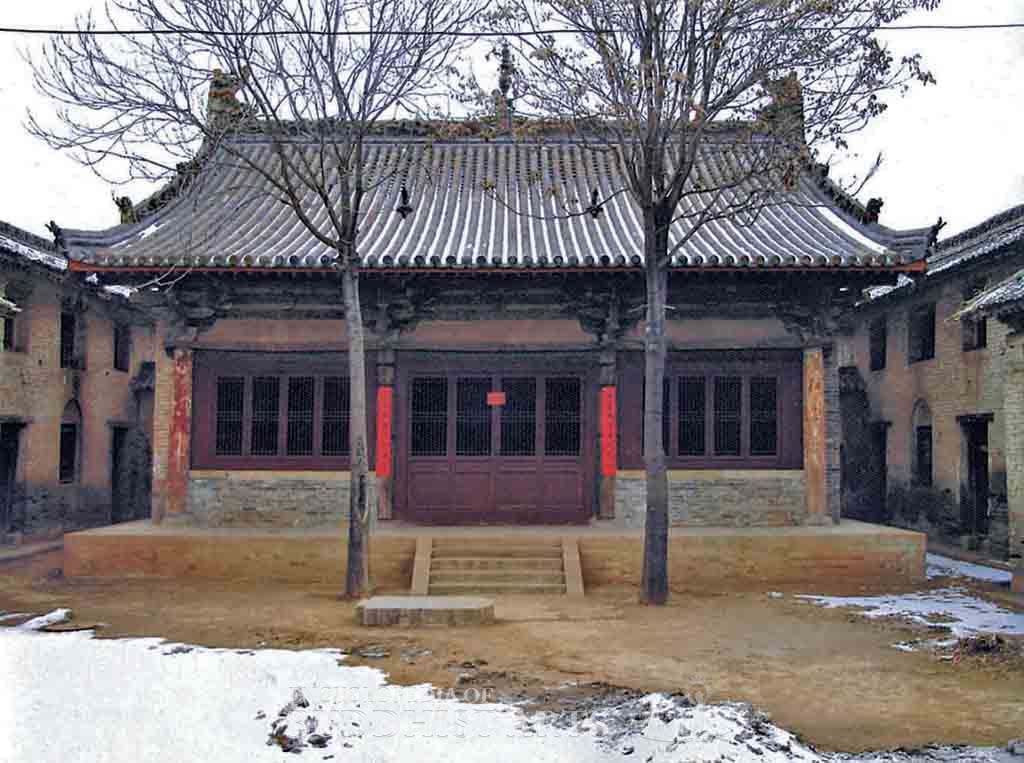
Beijixiang Temple: Middle Hall
Beijixiang Temple
CHINA, Shanxi, Jincheng
Beijixiang means North Auspicious. It was built in 770 during the Tang dynasty and repaired during subsequent dynasties. It was listed as a National Cultural Heritage Site in 1996.
Facing south, the temple is made up of three courtyards. The original main temple gate was destroyed, so the Heavenly King Hall became the main temple gate. Other buildings include the middle hall, rear hall, bell and drum towers, and the side halls. The Heavenly King Hall and middle hall were rebuilt during the Song dynasty (960–1279), while the rest of the buildings were built either during the Ming (1368–1644) or Qing (1644–1911) dynasties.
The three-by-three bay Heavenly King Hall has a single-eave hip-and-gable roof. The roof is relatively flat and has exaggerated eaves, which are features preserved from the original structure built in 978 during the Northern Song dynasty. The bracket sets on the capitals are two-tier with a single projecting bracket arm and downward-pointing cantilevers. There is an engraved bracket set between columns.
The middle hall is a three-bay wide, six-rafter deep structure with an overhanging gable roof. Supporting the eaves at the front of the hall there are two-tier bracket sets with two sets of downward-pointing cantilevers, whereas the eaves at the back of the hall are only supported by single-tier bracket sets. In between the columns there are engraved decorative bracket sets. The internal framework consists of four-rafter tie beams supported by three rows of tapered columns.
For more details, go to the Encyclopedia of Buddhist Arts: Architecture A-F, page 67.
Cite this article:
author = Hsingyun and Youheng and Johnson, Peter and Mankuang and Lancaster, Lewis,
booktitle = {Encyclopedia of Buddhist Arts: Architecture A-F},
pages = 67,
title = {{Beijixiang Temple}},
volume = 1,
year = {2016}}