
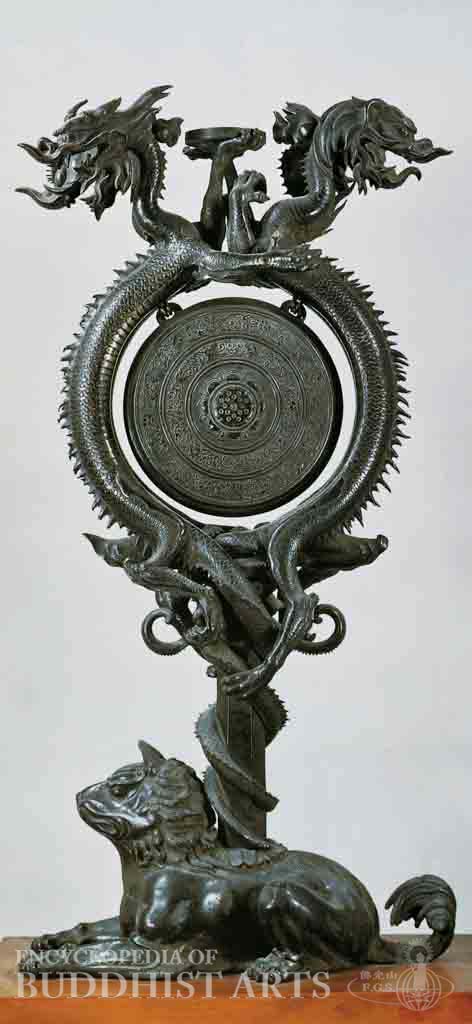
Gong Stand
Bronze
Gong Stand
CHINA; Tang dynasty
This ritual gong stand was created in Huayuan (present day Yaoxian, Shanxi), China during the Tang dynasty (618–907) and was taken to Kofukuji Temple in Nara, Japan. The gong was renamed as Huayuan Gong, after the place where it was made, during the Kamakura period (1185–1333). It was listed as a National Treasure in 1952.
The stand was created using the lost-wax method and then welded together. The base is in the form of a lion supporting a hexagonal pillar. Two dragons coil up and outward from the pillar to the top of the stand. The dragons’ heads face out, and their claws hold a round disc. The bodies form a circle with a gong suspended at the center.
According to records, there was once a revolving seated Bodhisattva on the disc and an image of Brahma holding the striker at the side; however, they are both missing.
For more details, go to the Encyclopedia of Buddhist Arts: Artifacts, page 112.
Cite this article:
author = Hsingyun and Youheng and Youji and Pokorski, Stefanie and Mankuang and Fan, Wen,
booktitle = {Encyclopedia of Buddhist Arts: Artifacts },
pages = 112,
title = {{Gong Stand}},
volume = 18,
year = {2016}}