

Kofukuji Temple: East Golden Hall and Five-Story Pagoda

Kofukuji Temple: North Octagonal Hall

Kofukuji Temple: Southern Octagonal Hall
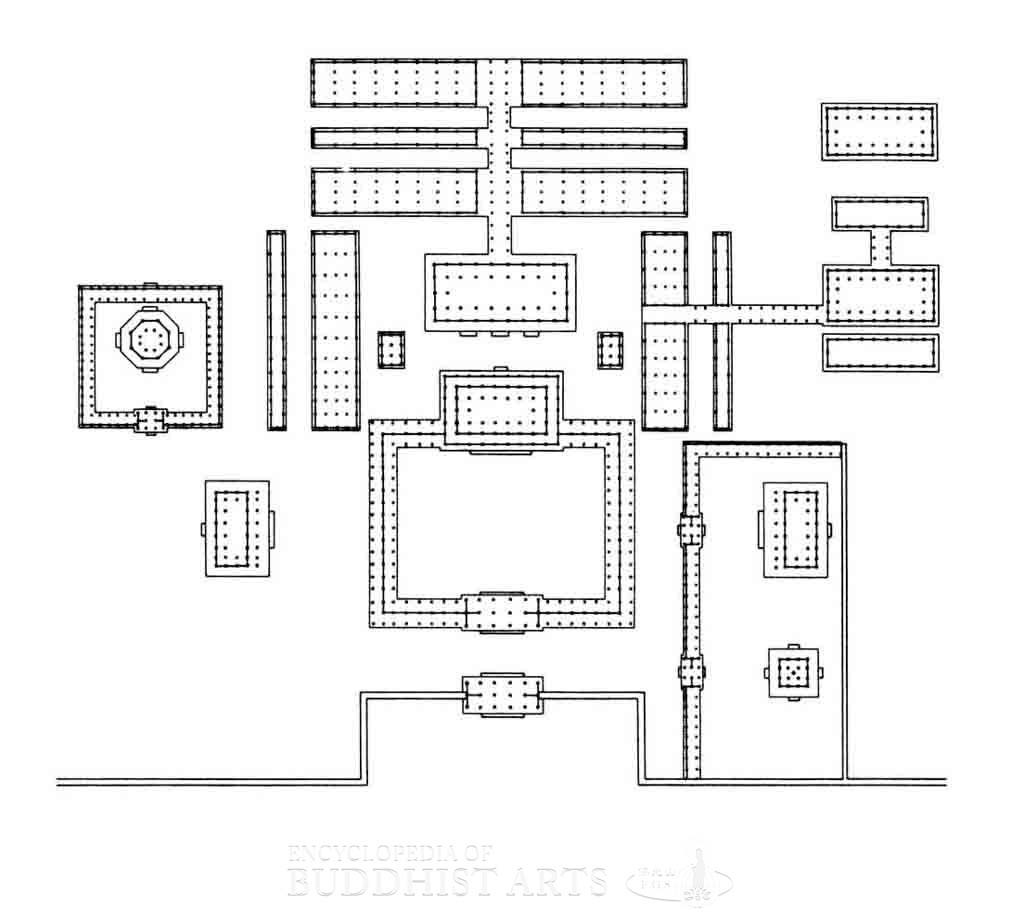
Kofukuji (site layout)
Kofukuji Temple
JAPAN, Nara
This temple is one of the Seven Major Temples in Nara. In 669 during the Hakuho period, the consort of Fujiwara no Kamatari built a temple named Yamashinadera in gratitude for his recovery from illness. During the reign of Emperor Tenmu (reigned 673–686), the temple was relocated to Fujiwarakyo (present day Kashihara) and renamed Umayasakadera. Its name was changed to Kofukuji Temple in 710 during the Nara period. The temple flourished under royal patronage and became a major political and cultural center in Japan. Kofukuji Temple has burned down and been rebuilt several times. In 1897 during the Meiji period, it was again restored. As part of the Historic Monuments of Ancient Nara, it was listed as a UNESCO World Heritage Site in 1998.
This temple has a slightly different layout from other traditional temples. The main buildings include the East Golden Hall, Central Golden Hall, West Golden Hall, North Octagonal Hall, South Octagonal Hall, three-story and five-story pagodas, and National Treasure Museum. The seven-by-four bay East Golden Hall has a single-eave hip roof covered in cylindrical tiles. The North Octagonal Hall was rebuilt in 1210 during the Kamakura period and is the oldest building in the temple. It is 15.2 m high and has a single-eave octagonal pyramidal roof covered with cylindrical tiles. In order to preserve the building, interlocking beams supported by circular columns have been used to reinforce the structure. An elaborate inverted lotus canopy is suspended from the ceiling, which is a feature unique to the Nara period. The South Octagonal Hall, rebuilt in 1741 during the Edo period, was the largest of its kind. It is one of the 33 Avalokitesvara temples of the Saigoku Kannon Pilgrimage. The three-story pagoda has a height of 19 m. It was built during the Kamakura period (1185–1333). The five-story pagoda is the second highest pagoda in Japan built before the Edo period (1615–1868) and it is the landmark of the temple. This pagoda as well as the North Octagonal Hall, three-story pagoda and East Golden Hall were listed as National Treasures in 1952.
The National Treasure Museum was inaugurated in 1959 and houses an extensive collection of Buddhist statues and artifacts, many of which are listed as National Treasures. The museum is noted for its collection of Kamakura Buddha statues.
For more details, go to the Encyclopedia of Buddhist Arts: Architecture G-L, page 611.
Cite this article:
author = Hsingyun and Youheng and Johnson, Peter and Mankuang and Lancaster, Lewis,
booktitle = {Encyclopedia of Buddhist Arts: Architecture G-L},
pages = 611,
title = {{Kofukuji Temple}},
volume = 2,
year = {2016}}