
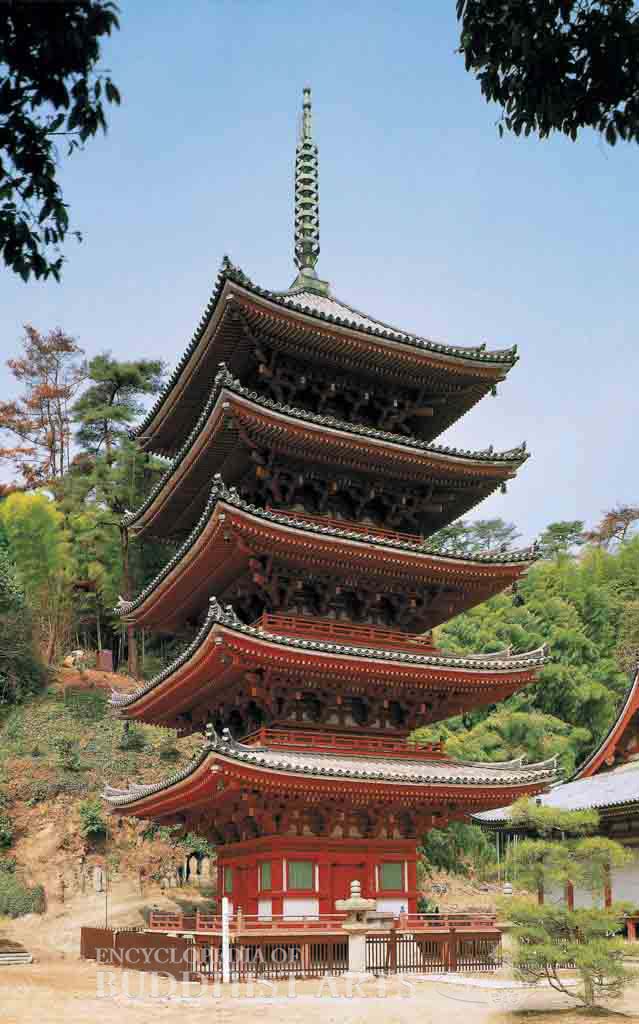
Myooin Temple Five-Tier Pagoda
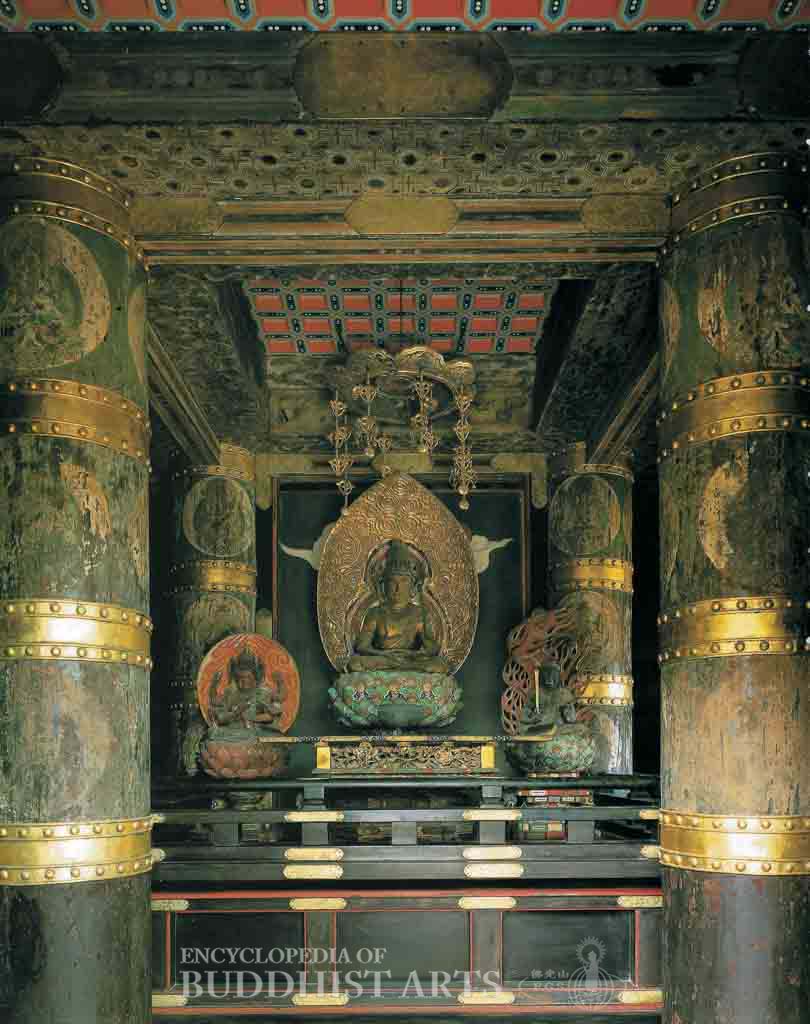
Myooin Temple Five-Tier Pagoda (interior)
Myooin Temple Five-Tier Pagoda
JAPAN, Hiroshima, Fukuyama
The pagoda was established in 1348, during the Nanbokucho period (1336–1392). The three-by-three bay wooden pagoda was listed as a National Treasure in 1953.
The pagoda has an overall height of 29.1 m. The first tier is surrounded by a veranda and there are low balustrades on all tiers. The roofs are covered with cylindrical tiles and the eaves are supported by rafters, corner beams, architraves, bracket sets, and cantilevers. The spire consists of a base, an inverted bowl, upright lotus, stacked rings, flame, and jewel. The central pillar rises up from the ceiling on the first tier to the roof. Within the hall there are Four Heavenly King pillars surrounding the central Sumeru platform, upon which there are statues of Vairocana Buddha, Acala, and Ragaraja. The Buddhist paintings and decorations in vivid colors on the pillars, walls, and ceilings are the most distinctive features of this pagoda.
For more details, go to the Encyclopedia of Buddhist Arts: Architecture M-S, page 762.
Cite this article:
author = Hsingyun and Youheng and Johnson, Peter and Mankuang and Lancaster, Lewis,
booktitle = {Encyclopedia of Buddhist Arts: Architecture M-S},
pages = 762,
title = {{Myooin Temple Five-Tier Pagoda}},
volume = 3,
year = {2016}}