
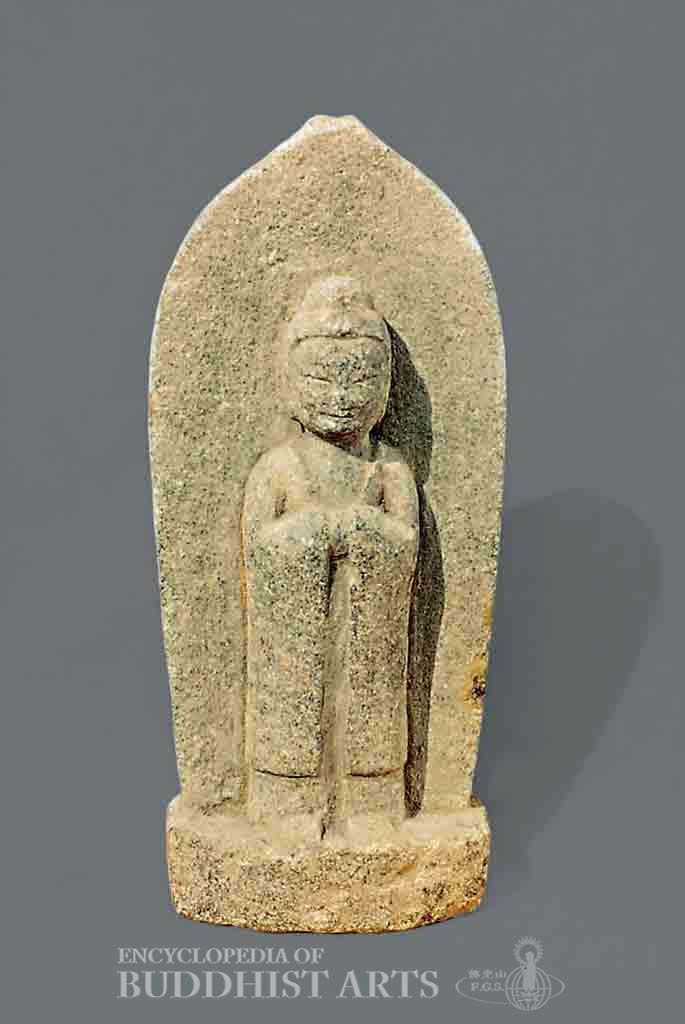
Kongwangshan: Standing Buddha
Gneiss
Kongwangshan: Standing Buddha
CHINA, Jiangsu, Lianyungang; Northern Qi dynasty
The sculpture was discovered on Kongwangshan in 1961. The statue combines the balance of the Southern Dynasties (420–589) artistic style with the spirit of the Northern Qi dynasty (550–577). The Buddha stands out in mid-relief from the surrounding petal shaped mandorla. He wears monastic robes and hides his raised hands in its folds. The carving technique is simplified, with the eyes beneath the wide forehead reduced to mere chiseled slits and the division of the robe cut in a squared hollow from the hands to the feet. On the back of the mandorla is an inscription stating that the work was presented by a monk in 572.
For more details, go to the Encyclopedia of Buddhist Arts: Sculpture G-M, page 557.
Cite this article:
Hsingyun, et al. "Kongwangshan: Standing Buddha." Encyclopedia of Buddhist Arts: Sculpture G-M, vol. 11, 2016, pp. 557.
Hsingyun, Youheng, Yann Lovelock, Yuan Chou, Susan Huntington, Gary Edson, and Robert Neather. 2016. "Kongwangshan: Standing Buddha" In Encyclopedia of Buddhist Arts: Sculpture G-M, 11:557.
Hsingyun, Youheng, Lovelock, Y., Chou, Y., Huntington, S., Edson, G., & Neather, R.. (2016). Kongwangshan: Standing Buddha. In Encyclopedia of Buddhist Arts: Sculpture G-M (Vol. 11, pp. 557).
@misc{Hsingyun2016,
author = Hsingyun and Youheng and Lovelock, Yann and Chou, Yuan and Huntington, Susan and Edson, Gary and Neather, Robert,
booktitle = {Encyclopedia of Buddhist Arts: Sculpture G-M},
pages = 557,
title = {{Kongwangshan: Standing Buddha}},
volume = 11,
year = {2016}}
author = Hsingyun and Youheng and Lovelock, Yann and Chou, Yuan and Huntington, Susan and Edson, Gary and Neather, Robert,
booktitle = {Encyclopedia of Buddhist Arts: Sculpture G-M},
pages = 557,
title = {{Kongwangshan: Standing Buddha}},
volume = 11,
year = {2016}}