
Yungang Grotto 8: Kumaraka
Stone
Yungang Grotto 8: Kumaraka
CHINA, Shanxi, Datong; Northern Wei dynasty
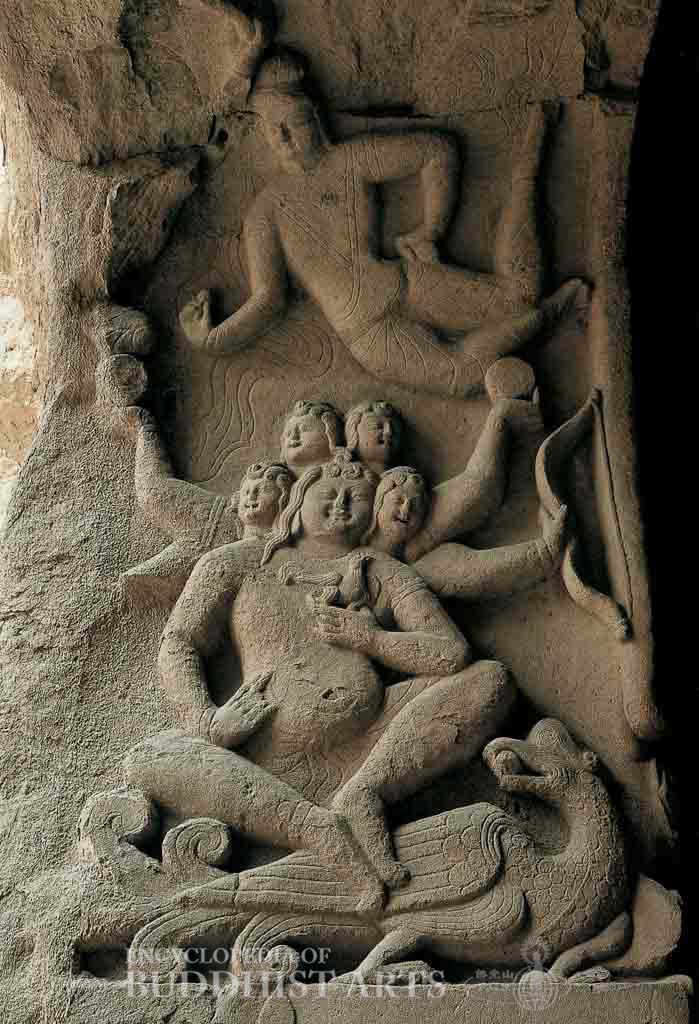
Situated on the west inner wall within the arched doorway to the rear chamber, the Kumaraka is a heavenly being who, according to the Mahaprajnaparamita Sastra, holds a chicken, a bell, and a banner while riding on a peacock. This figure and the Mahesvara opposite it represents a unique and creative combination of eastern and western art styles. These images are considered to be of particularly high artistic value among the carvings at Yungang.
Kumaraka is depicted with five smiling heads, six arms, and a protruding belly. One arm has been broken off and one rests on the figure’s waist, while each of the remaining hands holds a different object, including a chicken, a bow, and a sun. Kumaraka is seated upon a peacock which has long, curled tail feathers and carries a jewel in its mouth. An apsara flies above Kumaraka in an elegant posture, holding a jewel in one hand. The apsara’s garments consist of a dhoti and long stole detailed in sparse line incisions.
For more details, go to the Encyclopedia of Buddhist Arts: Caves T-Z, page 1682.
Cite this article:
author = Hsingyun and Youheng and Johnson, Peter and Mankuang and Huntington, Susan and Edson, Gary and Neather, Robert,
booktitle = {Encyclopedia of Buddhist Arts: Caves T-Z},
pages = 1682,
title = {{Yungang Grotto 8: Kumaraka}},
volume = 9,
year = {2016}}