
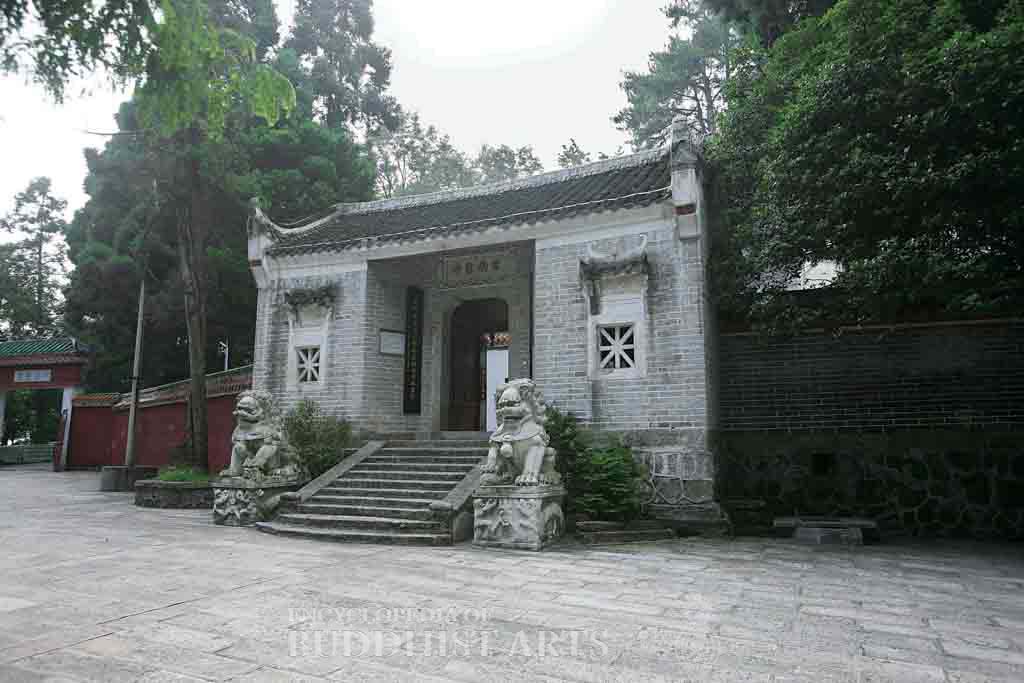
Nantai Temple: Main Temple Gate
Nantai Temple
CHINA, Hunan, Hengyang
Nantai means Southern Platform. It is one of the Five Major Temples in Nanyue. The temple was built during the rule of Emperor Wu (reigned 502–549) of the Liang dynasty by Monk Fayin. During the rule of Emperor Xuanzong (reigned 712–756) of the Tang dynasty, Chan Master Xiqian resided here and promoted Chan Buddhism, which resulted in a long-lasting influence. The temple later became the ancestral temple of three schools of the Chinese Chan Buddhism, namely the Caodong, Yunmen, and Fayan. During the Southern Song dynasty (1127–1279), the Caodong school was introduced into Japan, where it became the Soto school of Zen Buddhism. It later regarded this temple as its ancestral temple. The temple is therefore also known as Dharma Source of the World.
The temple was destroyed during the late Song dynasty (960–1279) and it was rebuilt during the rule of Emperor Hongzhi (reigned 1470–1505) of the Ming dynasty. During the rules of Qianlong and Jiaqing (reigned 1796–1820) of the Qing dynasty, some monks divided the temple’s assets and built new temples near the original one, calling them New Nantai Temple and Old Nantai Temple. The original temple was later abandoned. Reconstruction of the temple was started during the rule of Emperor Guangxu (1875–1908) of the Qing dynasty. The temple was listed as a key Buddhist temple in the Han region of China in 1983.
The temple faces south and its principal buildings include the main temple gate, Maitreya Hall, Great Hero Hall, and abbot’s quarters. Side buildings include the dining hall, meditation hall, and the reception hall. A memorial stupa for Master Xiqian is located next to the temple and is the only stupa from the Tang dynasty in Nanyue. A Vajra Pagoda is located on top of Ruiying (Auspicious Response) Peak. It was built in 1996 and is approximately 48 m high. The temple houses historical artifacts, such as stone jars from the Liang dynasty (502–557) and the stele of Nantai Temple.
For more details, go to the Encyclopedia of Buddhist Arts: Architecture M-S, page 786.
Cite this article:
author = Hsingyun and Youheng and Johnson, Peter and Mankuang and Lancaster, Lewis,
booktitle = {Encyclopedia of Buddhist Arts: Architecture M-S},
pages = 786,
title = {{Nantai Temple}},
volume = 3,
year = {2016}}