
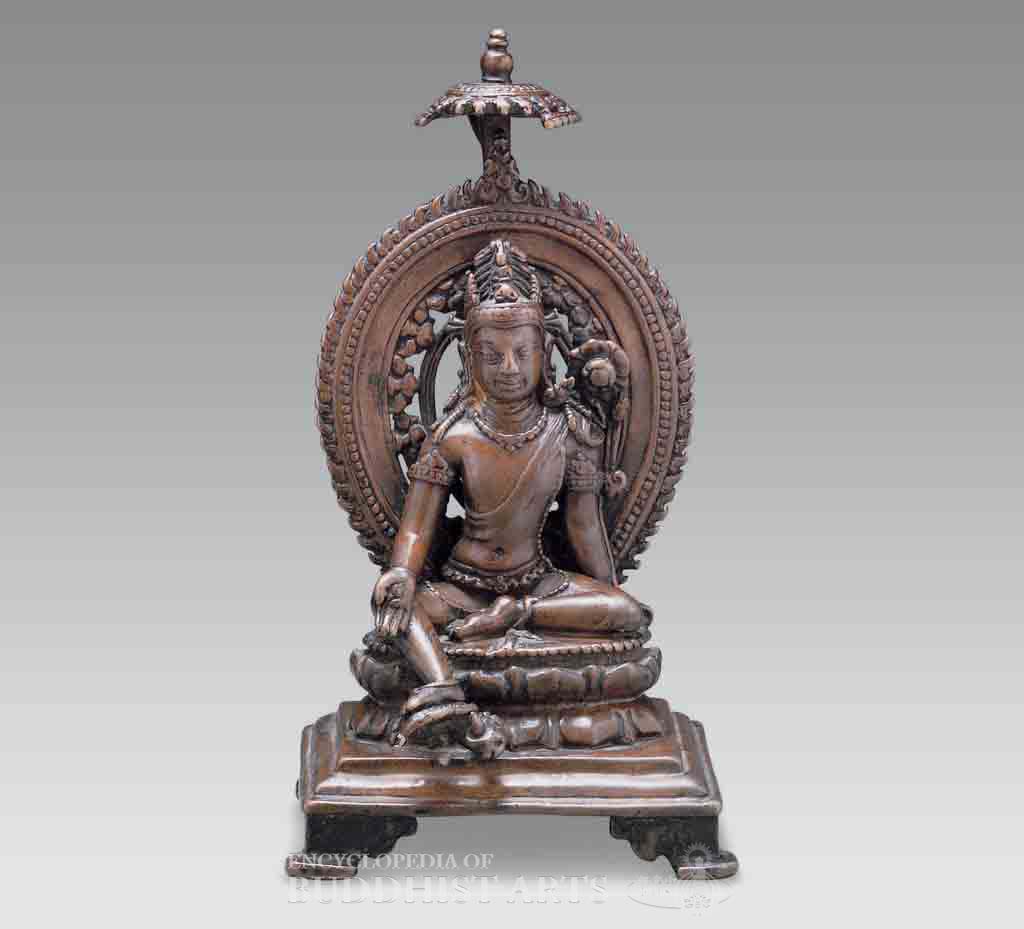
Bihar: Avalokitesvara Bodhisattva
Bronze
Bihar: Avalokitesvara Bodhisattva
INDIA, Bihar
This statue was excavated in Bihar, one of whose religious centers was Nalanda. Bronze sculpture reached its pinnacle at Nalanda in the 9th century during the Pala period (circa 8th–12th century). The finest achievement during this period was the attention to detail in the realistic body proportions and skin texture.
The Amitabha Buddha on the headdress indicates that the statue is Avalokitesvara Bodhisattva. The figure sits in relaxation posture on a lotus throne. Inclined in a slight tribhanga posture, the right hand rests on the knee forming the varada (wish-granting) mudra, with a pearl or similar object resting on the palm. The left hand supports the body and holds the long stalk of a lotus. The figure sits in relaxation posture on a lotus throne.
The Bodhisattva wears a heavy necklace, large armlets, a belt, and sacred thread, all shown in the detail characteristic of Nalanda bronze statues from that period. The center of the mandorla consists of openwork and is filled with floral designs. While the perimeter consists of a flame design, the outer circle is decorated with stringed beads. A small canopy decorated with lotus patterns followed by a jeweled finial is above the mandorla.
For more details, go to the Encyclopedia of Buddhist Arts: Sculpture A-F, page 144.
Cite this article:
author = Hsingyun and Youheng and Lovelock, Yann and Chou, Yuan and Huntington, Susan and Edson, Gary and Neather, Robert,
booktitle = {Encyclopedia of Buddhist Arts: Sculpture A-F},
pages = 144,
title = {{Bihar: Avalokitesvara Bodhisattva}},
volume = 10,
year = {2016}}