
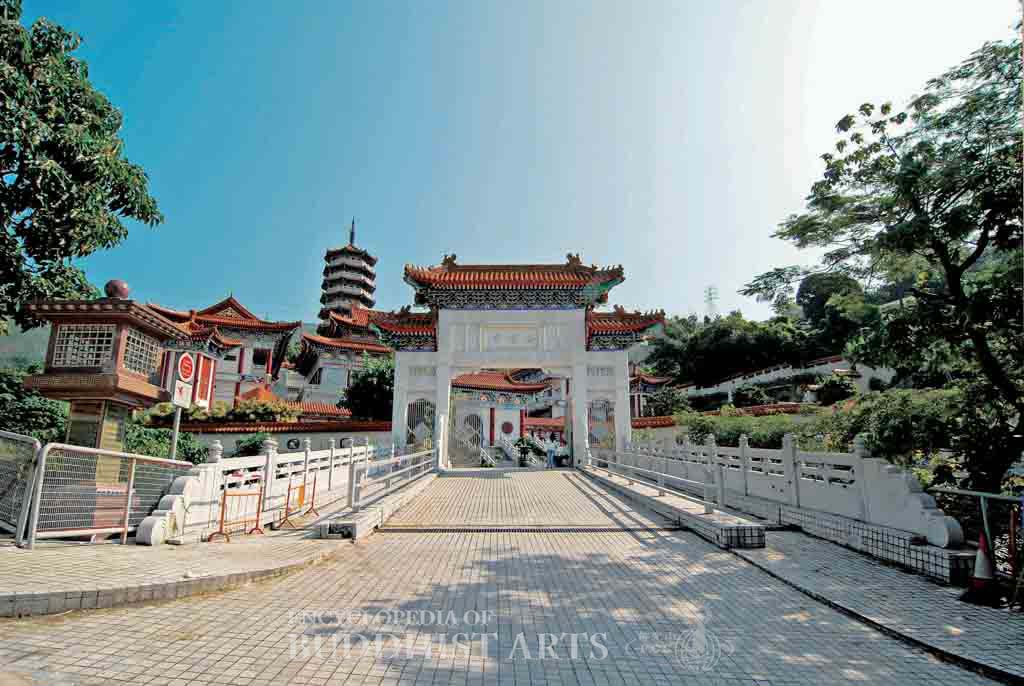
Sai Fong Monastery

Sai Fong Monastery: Main Hall

Sai Fong Monastery: Main Hall (interior)
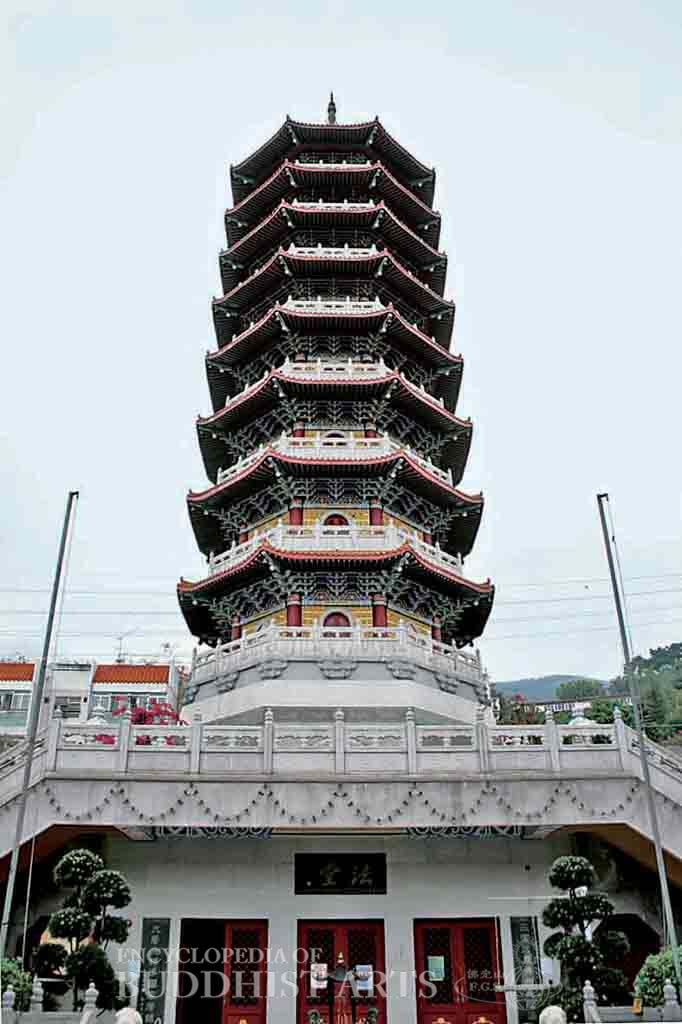
Sai Fong Monastery: Ten Thousand Buddha Pagoda
Sai Fong Monastery
CHINA, Hong Kong
The monastery was built in 1970 by monk Yongxing, with the library and pagoda added later. Reconstruction of the monastery started in 1998 and was completed in 2003. It is considered to be one of the most important temples of the Pure Land school in Hong Kong.
It is built according to the hilly terrain and occupies 20 ha. The principal buildings are the main temple gate, Heavenly King Hall, bell and drum towers, main hall, and the Ten Thousand Buddha Pagoda. Side buildings include the lecture hall, library, Buddhist college, and the Ksitigarbha Hall. The monastery is built in imitation of imperial Chinese architecture, so that most of the buildings have red doors and roofs covered with yellow glazed tiles. The seven-by-five bay main hall has a double-eave hip-and-gable roof. It is also known as the Amitabha Buddha Triad Hall, which houses statues of Amitabha Buddha, Avalokitesvara Bodhisattva, and Mahasthamaprapta Bodhisattva. The statues are contained in a delicately carved shrine-like niche with eaves. There is also a cloisonné Avalokitesvara statue dating back to the Ming dynasty (1368–1644). On both sides of the hall, there are stone rubbings of the Eighteen Arhats, while the walls are covered with inlaid illustrations from the Amitayurdhyana Sutra. The illustrations are 70 m long and 2 m high and consist of 68 smaller paintings pieced together. It is considered to be one of the largest murals inlaid with seven jewels of the world. The level underneath the Amitabha Buddha Triad Hall is the dining hall.
Behind the main hall there stands the nine-story, octagonal Ten Thousand Buddha Pagoda. The base of the pagoda is decorated with limestone carvings of the Four Heavenly Kings, illustrations of the Buddha teaching the Dharma, and a copy of the Diamond Sutra written by Master Hongyi. The roofs are covered in yellow glazed tiles and there are balconies on every story. On the first story is the Hall of the Five Dhyani Buddhas, which houses these five Buddhas and has illustrations of the Life of the Buddha inlaid into the walls. The second story contains the Hall of the Buddhas of the Past, Present, and Future. From the third story upwards there are the following halls: Hall of the Three Buddhas, Avalokitesvara Hall, Medicine Buddha Hall, Amitabha Hall, Avatamsaka Hall, Maitreya Hall, and Reclining Buddha Hall. The walls on every story are decorated with sutra illustrations and the ceilings is in Tang style.
For more details, go to the Encyclopedia of Buddhist Arts: Architecture M-S, page 910.
Cite this article:
author = Hsingyun and Youheng and Johnson, Peter and Mankuang and Lancaster, Lewis,
booktitle = {Encyclopedia of Buddhist Arts: Architecture M-S},
pages = 910,
title = {{Sai Fong Monastery}},
volume = 3,
year = {2016}}