
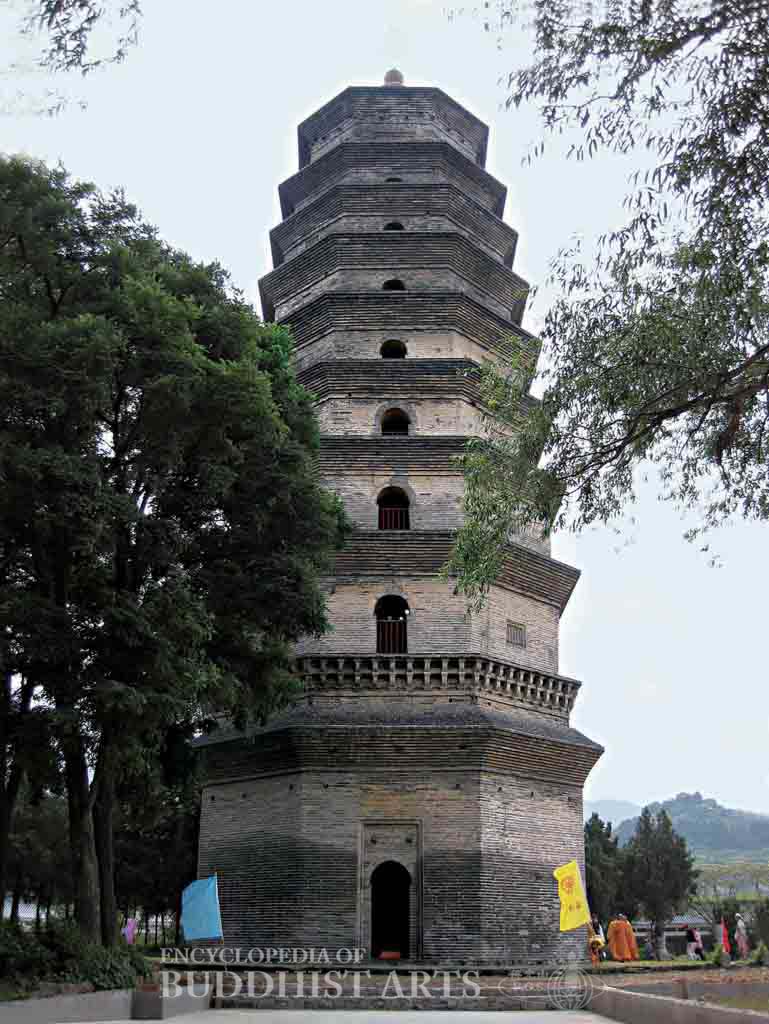
Haiqing Temple Ayuwang Pagoda
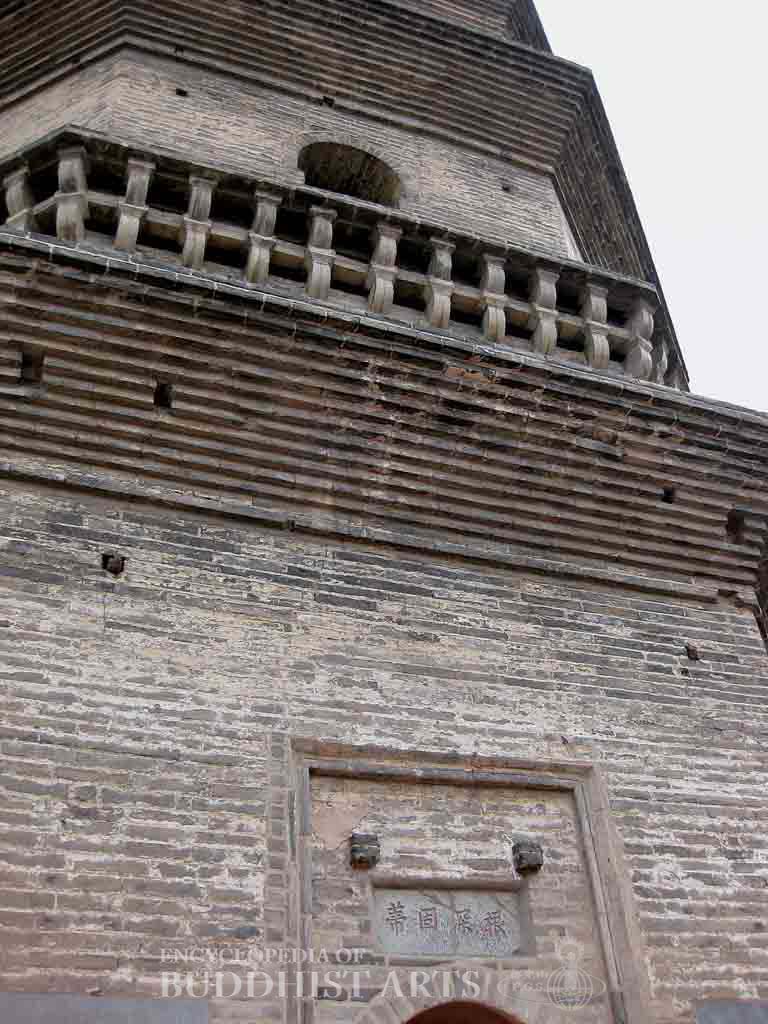
Haiqing Temple Ayuwang Pagoda (detail)
Haiqing Temple Ayuwang Pagoda
CHINA, Jiangsu, Lianyungang
According to stele inscriptions found within the pagoda, it was built between 1023 and 1031 during the Northern Song dynasty. In 1974, while repairs were being made, a long rectangular compartment was discovered in the middle of the central pillar at the bottom of the pagoda. Numerous artifacts were discovered hidden within the secret compartment. The pagoda was listed as a Provincial Cultural Heritage Site in 1982.
The nine-story, octagonal brick pagoda is 40.6 m high. There are arched doorways on each of the sides facing the four cardinal directions. From the second story upwards, vertical bar windows occupy the remaining four sides. The base of the second story is surrounded by balustrades but this feature is absent from the other stories. All the eaves are in the form of corbeling. A pillar runs from the second story to the eighth, through the center of each chamber. There are Buddha niches on the sides of the pillar. Stairs inside the pillar allow access to higher levels. The ninth level does not have the pillar, just an octagonal chamber. It has an octagonal caisson ceiling.
This Song dynasty brick pagoda is simple in style, with only a few features resembling a wooden structure.
For more details, go to the Encyclopedia of Buddhist Arts: Architecture G-L, page 426.
Cite this article:
author = Hsingyun and Youheng and Johnson, Peter and Mankuang and Lancaster, Lewis,
booktitle = {Encyclopedia of Buddhist Arts: Architecture G-L},
pages = 426,
title = {{Haiqing Temple Ayuwang Pagoda}},
volume = 2,
year = {2016}}