

Mahabodhi Temple

Mahabodhi Temple: Bodhi Tree
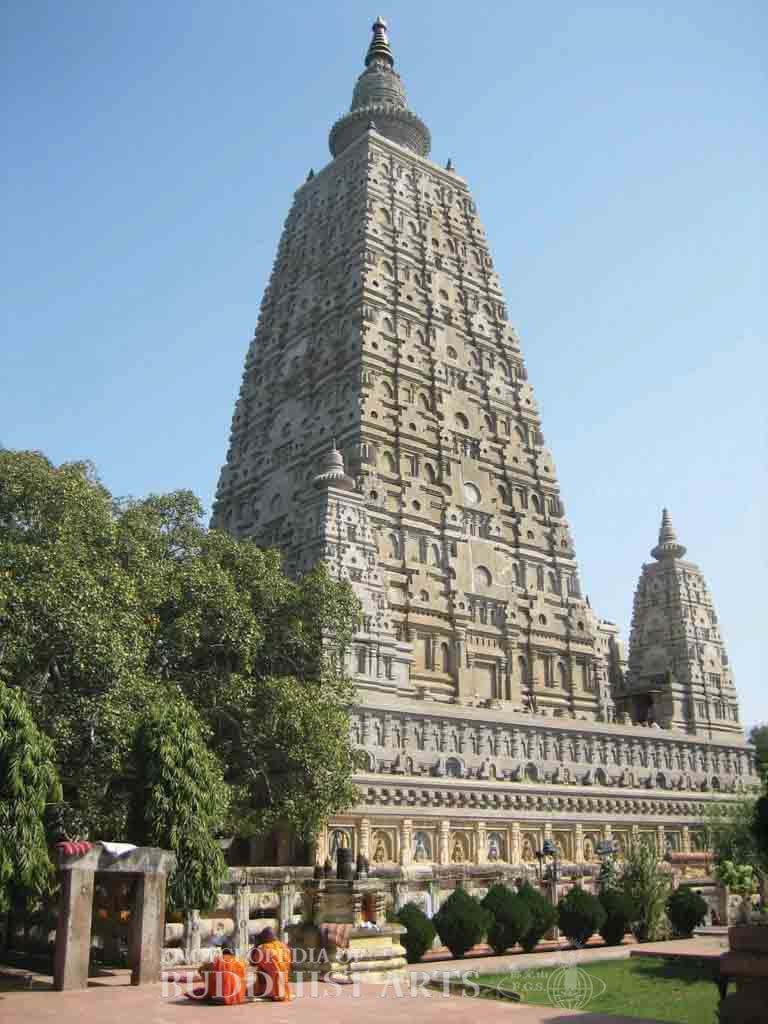
Mahabodhi Temple
Mahabodhi Temple
INDIA, Bihar, Bodhgaya
Mahabodhi means Great Enlightenment, and this temple is also known as Mahabodhi Mahavihara, Bodhgaya Temple, or the Great Stupa. It marks the location where the Buddha attained enlightenment, and is one of the Four Major Buddhist Sites. In the 3rd century BCE, King Asoka (reigned circa 269–232 BCE) of Maurya visited Bodhgaya and constructed a temple there. He also built the Diamond Throne in an attempt to mark the exact spot where Buddha attained enlightenment under the Bodhi tree. The temple was reconstructed during the Gupta period (circa 320–550). In the early 5th century, Chinese pilgrim Master Faxian traveled to this place and noted three monasteries nearby. In 645 Chinese Ambassador Wang Xuance from the Tang dynasty visited Bodhgaya and erected a stele to commemorate his visit. The temple was rebuilt in the 12th century during the Pala period (circa 8th–12th century). Since then the temple underwent several renovations and restorations with contributions from the Burmese. With the decline of Buddhism in India, the temple was neglected and buried under rubble. It was not until the 19th century that an excavation and reconstruction was led by British archaeologist Alexander Cunningham, resulting in the temple assuming its present appearance. The Mahabodhi Temple Complex was listed as a UNESCO World Heritage Site in 2002.
The site consists of the main Mahabodhi Temple and seven sacred places. The main temple is built of brick and is one of the earliest brick structures in India. It is in a Diamond Throne style, with a 55 m high central stupa surrounded by four smaller stupas at the corners. The base platform is square with each side measuring 15 m. The exterior walls are decorated with moldings. Above the base there is a central stupa with walls decorated with geometric patterns. The spire is in the shape of a small inverted-bowl stupa topped with gilded stacked rings and a finial. Stone railings about 2 m high surround all four sides of the temple.
Within the complex there are seven sacred places related to the Seven Weeks after the Buddha’s Enlightenment. In order, they are the Diamond Throne, Place of Unblinking Gazing, Cloister Walk, Jewel House, Banyan Tree, Naga King Pond, and Rajayatana Tree. In addition, the sacred Bodhi tree is situated to the west of the main temple. The present tree is probably the fifth generation of the original Bodhi tree, under which the Buddha sat while attaining enlightenment.
For more details, go to the Encyclopedia of Buddhist Arts: Architecture M-S, page 712.
Cite this article:
author = Hsingyun and Youheng and Johnson, Peter and Mankuang and Lancaster, Lewis,
booktitle = {Encyclopedia of Buddhist Arts: Architecture M-S},
pages = 712,
title = {{Mahabodhi Temple}},
volume = 3,
year = {2016}}