
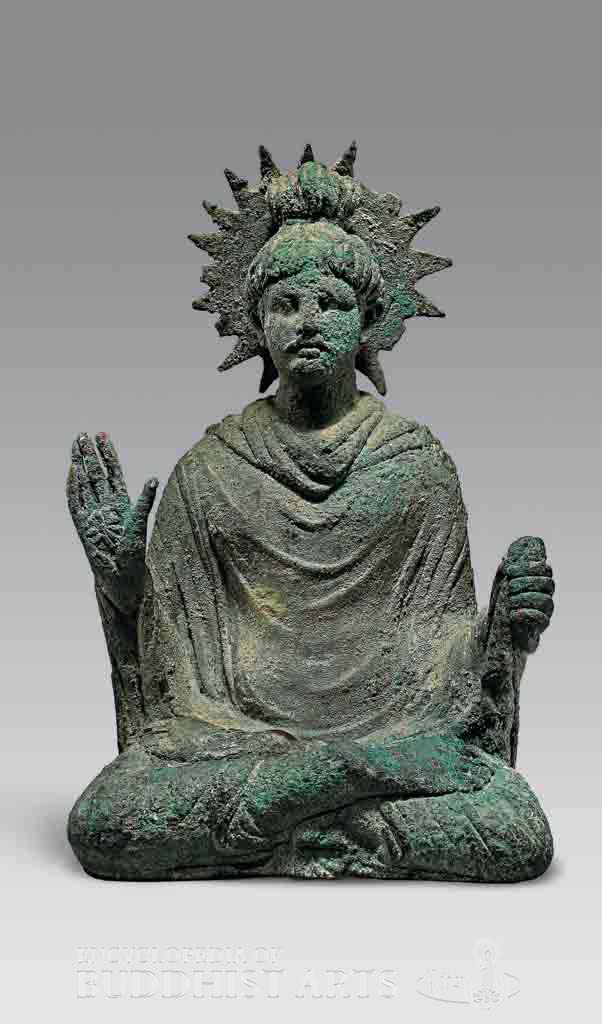
Seated Buddha
Bronze
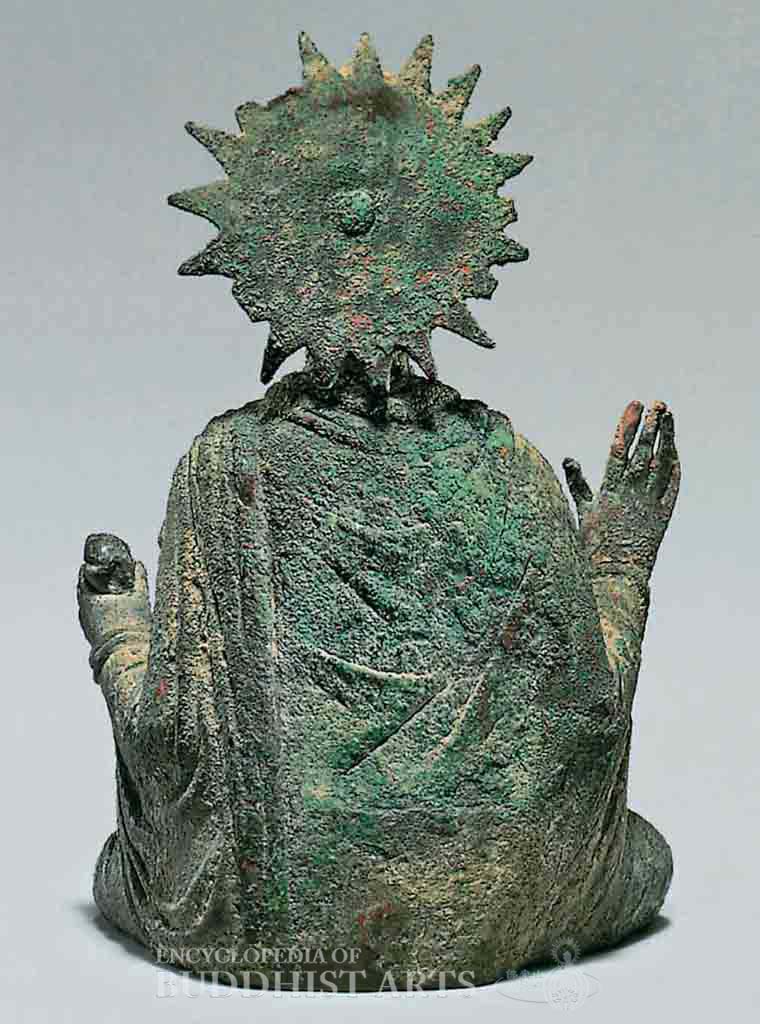
Seated Buddha (back)
Seated Buddha
PAKISTAN; Kushan period
The distinctly Western features of the statue and the fringed hair are commonly seen in busts of Roman emperors; however, the mustache, and rolled topknot are Gandharan characteristics. The rare solar nimbus attached to the back of the figure’s head is not commonly seen. These elements have led experts to believe that the statue was created no later than the mid-2nd century or some time during the Kushan period (circa 1st–3rd century). Sculptures created during the early Gandharan period are mostly made from schist so the bronze casting of this work adds to its rarity and unusualness. There is evidence of gilding on the nimbus and robe.
The figure wears a robe that covers both shoulders, with the fabric falling down the back on the left and supported by the hand on that side. The right hand is raised in abhaya (fearlessness) mudra and features a Dharma wheel on the palm. The Dharma wheels also appear on the soles of the feet crossed in full lotus position which is rarely found on early Gandharan sculptures. A curious feature is the anatomically incorrect positioning of the feet, with the big toe facing towards rather than away from the body.
For more details, go to the Encyclopedia of Buddhist Arts: Sculpture N-Sr, page 1028.
Cite this article:
author = Hsingyun and Youheng and Lovelock, Yann and Chou, Yuan and Huntington, Susan and Edson, Gary and Neather, Robert,
booktitle = {Encyclopedia of Buddhist Arts: Sculpture N-Sr},
pages = 1028,
title = {{Seated Buddha}},
volume = 12,
year = {2016}}