
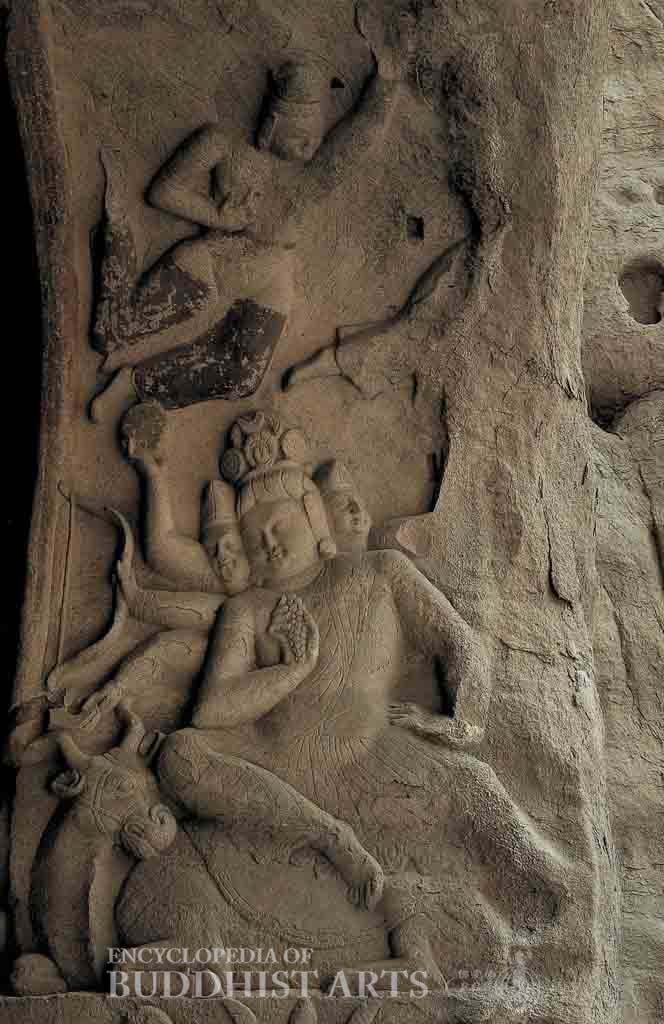
Yungang Grotto 8: Mahesvara
Stone
Yungang Grotto 8: Mahesvara
CHINA, Shanxi, Datong; Northern Wei dynasty
This carving is located on the east inner wall of the arched doorway to the rear chamber, opposite Kumaraka. According to Buddhist texts, Mahesvara is the highest level of heavenly being within the “form realm,” and has eight arms, three heads, and rides on a white bull. Among Indian folk religious faiths, Mahesvara is regarded as a deity of harvest, birth, and proliferation, and is often symbolized by grapes.
In this depiction, Mahesvara has eight arms, three heads, and sits on the back of a bull. The central head wears a tall headdress, while the other two wear peaked caps. The garments include a long skirt and stoles incised in faint lines. Some of the left hands and arms have broken off, but those that remain hold a bunch of grapes before the chest, a bow, and a round object. The bull beneath Mahesvara kneels on all fours with its head turned to look backwards. Carved above Mahesvara are apsaras, though these have suffered weathering and only one figure can still be discerned. The apsara has hair tied in a topknot, and wears a long garment and a flowing stole.
For more details, go to the Encyclopedia of Buddhist Arts: Caves T-Z, page 1683.
Cite this article:
author = Hsingyun and Youheng and Johnson, Peter and Mankuang and Huntington, Susan and Edson, Gary and Neather, Robert,
booktitle = {Encyclopedia of Buddhist Arts: Caves T-Z},
pages = 1683,
title = {{Yungang Grotto 8: Mahesvara}},
volume = 9,
year = {2016}}