
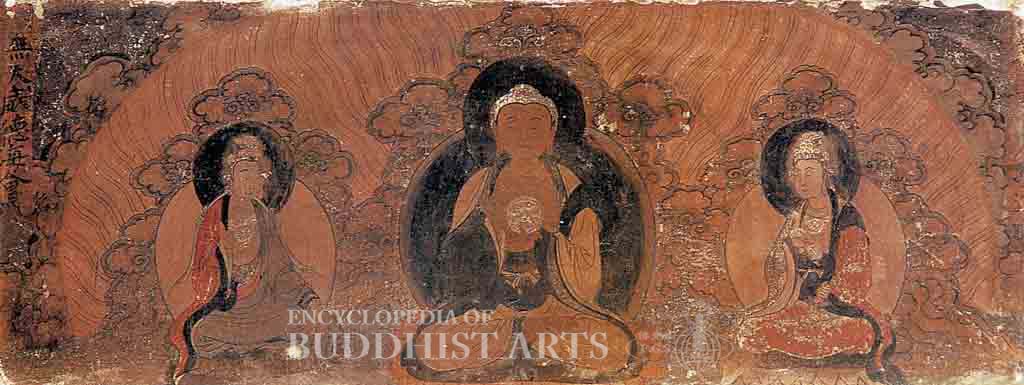
Liuli Hall Murals: Vairocana Buddha Assembly
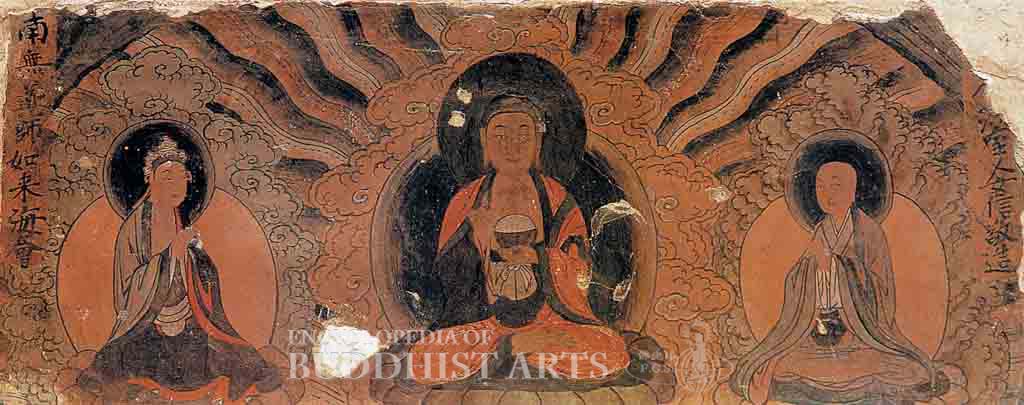
Liuli Hall Murals: Medicine Buddha Assembly
Liuli Hall Murals
CHINA, Yunnan, Lijiang; Qing dynasty
These murals are painted in the Liuli Hall in Lijiang. The hall, separated from Dabaoji Palace by a covered walkway, was constructed in 1417, and the murals were painted soon after. They were repainted during early Qing dynasty (1644–1911). Most of the murals have been destroyed, but eight murals are preserved in the Yunnan Provincial Museum, and there are 16 small images still visible on the beams of the hall. Inscriptions on the murals identify the donors who sponsored their creation.
The 16 murals remaining in the hall all depict assemblies of Buddhas and Bodhisattvas, including the Vairocana Buddha Assembly, the Medicine Buddha Assembly, and the Usnisa Sitatapatra Assembly. Vairocana Buddha, wearing a golden headdress and holding a Dharma wheel, is flanked by Manjusri and Samantabhadra Bodhisattvas. One of the Bodhisattvas holds a vajra and the other forms a mudra. All three figures, with swirling clouds behind their nimbuses and aureoles, are surrounded by a large mandorla decorated with curving lines.
In the Medicine Buddha Assembly, Medicine Buddha is in the center holding a medicine bowl. The Buddha is accompanied by Avalokitesvara and Ksitigarbha, rather than the customary Suryaprabha and Candraprabha Bodhisattvas.
Usnisa Sitatapatra, with a dark nimbus and aureole, wears a tall golden crown and holds a parasol. The two Bodhisattvas hold lotus flowers. As in the other two images, the three figures are surrounded by swirling clouds and a mandorla painted with colorful lines.
For more details, go to the Encyclopedia of Buddhist Arts: Painting I-O, page 487.
Cite this article:
author = Hsingyun and Youheng and Youlu and Wilson, Graham and Manho and Mankuang and Huntington, Susan,
booktitle = {Encyclopedia of Buddhist Arts: Painting I-O},
pages = 487,
title = {{Liuli Hall Murals}},
volume = 15,
year = {2016}}