
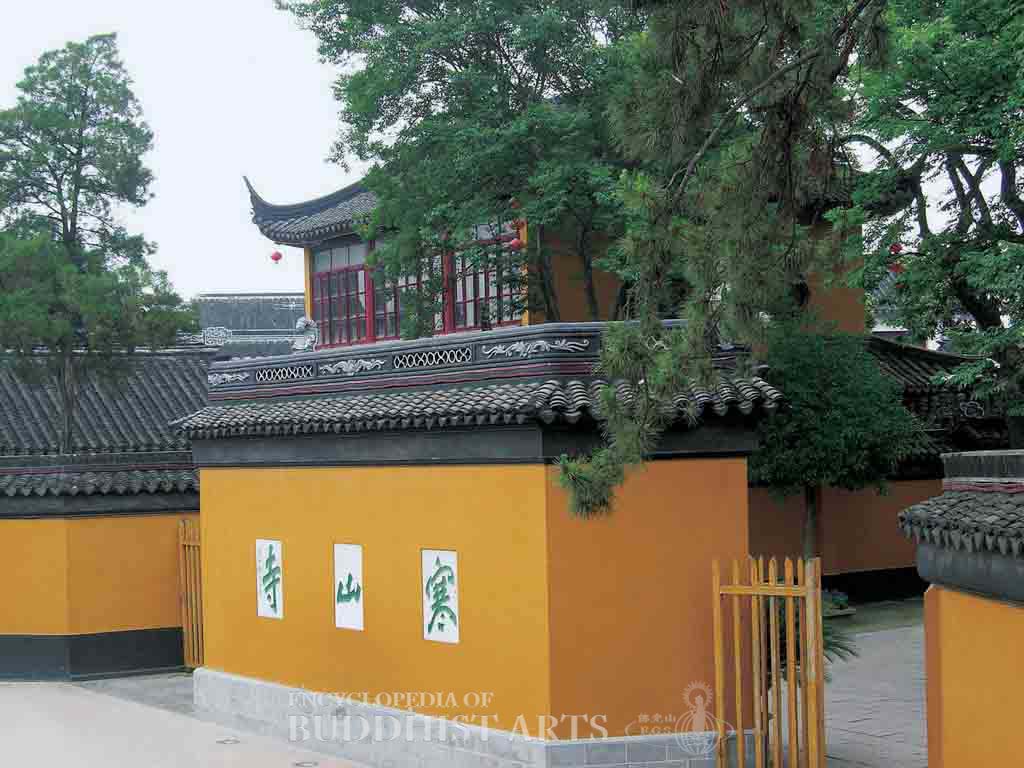
Hanshan Temple: Screen Wall
Hanshan Temple
CHINA, Jiangsu, Suzhou
Hanshan stands for Cold Mountain. This temple was built between 502 and 519 during the rule of Emperor Wu (reigned 502–549) of the Liang Dynasty. It has undergone a number of name changes and it may have acquired this name because the monks Hanshan and Shide built a hut here between 627 and 649 during the Tang dynasty. The temple and pagoda were destroyed during warfare in the late Yuan dynasty (1271–1368) and were rebuilt during the early Ming dynasty (1368–1644). Most of the structures were rebuilt between 1896 and 1911, during the Qing dynasty. After 1949 the temple has undergone a number of renovations. It was listed as a key Buddhist temple in the Han region of China in 1983.
Facing west towards a river, the temple occupies approximately 1.6 ha. Along the central axis there are the screen wall, main temple gate, Great Hero Hall, sutra repository, and the Puming Pagoda, which was built in 1996. Along the sides lie the bell tower, Arhat Hall, Dharma Teaching Hall, Maple River Building, and a stele passageway. Along the top of the roof of the yellow screen wall there is a ridge decorated with dragons. Embedded within the actual wall are three rectangular blocks of blue limestone. The limestone is carved with the three characters for Hanshan Temple. The five-by-four bay Great Hero Hall has a single-eave hip-and-gable roof. A statue of Sakyamuni Buddha is enshrined within the hall with gilt iron statues of the Eighteen Arhats along either side. They were cast between 1465 and 1487 during the Ming dynasty. There is a stone carving of Hanshan and Shide by Luo Pin embedded in the wall, as well as a finger painting of Hanshan by Zheng Wenzhuo. The three-bay wide, two-story sutra repository has a flush gable roof. The lower story is the Hanshi Hall, which houses statues of Hanshan and Shide. The partition wall contains an inlaid stele of the Thousand-Armed Avalokitesvara, while the other side has a stone inscription of the Diamond Sutra written in running script by Zhang Jizhi.
The temple became famous because Tang dynasty (618–907) poet Zhang Ji, referred to the sound of the bell of Hanshan Temple. The bell mentioned in the poem no longer exists and the current bronze bell in the Great Hero Hall is a Japanese copy cast in 1905. The bell room houses numerous bells dating back to either the Ming or Qing (1644–1911) dynasty.
For more details, go to the Encyclopedia of Buddhist Arts: Architecture G-L, page 430.
Cite this article:
author = Hsingyun and Youheng and Johnson, Peter and Mankuang and Lancaster, Lewis,
booktitle = {Encyclopedia of Buddhist Arts: Architecture G-L},
pages = 430,
title = {{Hanshan Temple}},
volume = 2,
year = {2016}}